

On this day, October 19, in 1953—the year I was born—Ray Bradbury’s Fahrenheit 451 was published.
I wonder if Bradbury had any idea how profoundly his writing would influence generations of readers. He was an insightful, imaginative, often humorous, and remarkably prolific writer. My shelves hold much-worn copies of The Illustrated Man, The Martian Chronicles, Dandelion Wine, Something Wicked This Way Comes, and Green Shadows, White Whale. And I have several copies of Fahrenheit 451.
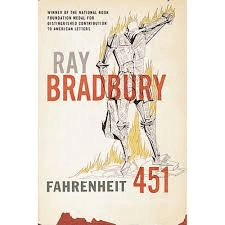
Original cover, October 1953
I probably first read Fahrenheit 451 around its tenth anniversary, when I was about ten years old, and again a few years later. The book made an impression on me that has lasted a lifetime.
On the occasion of its fortieth anniversary in 1993, I wrote Bradbury a letter telling him how much his book had inspired me and how I was beginning to see some of his predictions coming true.
More than thirty years later, I wish I could say those concerns were unfounded.
We are not yet living in a society where firemen burn books rather than extinguish fires, but there is a growing movement in our country to remove certain books from libraries and schools. Some people have even called for books to be burned. Perhaps even more troubling is a culture increasingly uncomfortable with reading anything longer than what fits on a smartphone screen.
Consider a few statistics.
In 2004, on an average day, 28% of Americans read for pleasure. Twenty years later, that number had fallen to 16%. That includes reading books, magazines, newspapers, online articles, and even listening to audiobooks.
The decline among children is particularly disturbing. In 2012, 53% of nine-year-olds reported reading for pleasure every day. By 2022, that number had dropped to 39%. The numbers become even more discouraging as children grow older. In 2012, only 27% of thirteen-year-olds read daily for pleasure. By 2023, the figure had fallen to just 14%.
A Pew survey in 2025 found that a quarter of Americans had not read a single book in the previous year. Another 38% had read between one and five books, including audiobooks.
There is an old saying, frequently attributed to Mark Twain, although no one seems able to prove he said it: “The person who does not read has no advantage over the one who cannot read.”
Whoever said it had a point.
Oddly enough, while recreational reading has declined, book sales have remained relatively strong. Apparently, people are still buying books. Reading them is another matter.
I have a friend with bookshelves filled with beautifully bound editions of classic literature. They are impressive volumes, the sort of books that make a room look distinguished and intellectual.
He hasn’t read a single one.
They’re decorations.
I suppose there are worse things to decorate a room with, but I can’t help thinking that books deserve better than that.
But back to Fahrenheit 451.
Somehow, my letter reached Ray Bradbury. To my surprise and delight, he autographed a fortieth-anniversary edition of the novel and sent it to me. It remains one of my treasured possessions. It is now in the possession of my nephew.
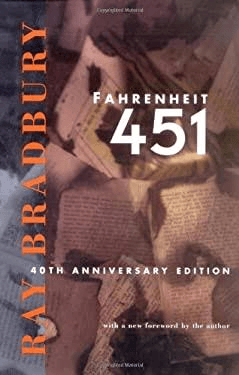
40th Anniversary Edition
Recently, I bought another edition, a boxed version released by Simon & Schuster in November 2025. It features one of the cleverest bits of book packaging I’ve ever seen.
Instead of displaying the title on the spine of the box, the publisher made it a striking surface. You can actually strike a match on it.
The front of the box doesn’t even have the book’s title. It simply carries the novel’s chilling opening words:
“It was a pleasure to burn.”
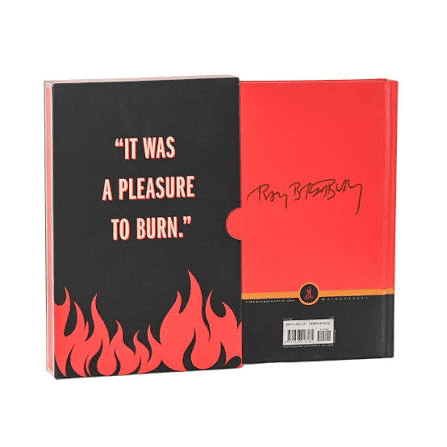
November 2025 edition
The back displays only the number 451—the temperature at which book paper supposedly catches fire.
I love the irony of a publisher selling a book about burning books in a box designed to strike matches.
All of this prompted me to pull out my oldest copy of Fahrenheit 451, a battered paperback that has been highlighted, underlined, dog-eared, tagged, and thoroughly worn.
Most of my books, including my Bibles, look as though I’ve been wrestling with them. In a sense, I have. I don’t believe books are meant simply to be admired on shelves. They are meant to be opened, questioned, argued with, and occasionally wrestled to the ground.
As I leafed through that old paperback, I came across passages that captured my imagination as a young teenager and still haunt me more than sixty years later.
Bradbury urged his readers to fill their eyes with wonder, to see the world, and to recognize that reality can be more astonishing than anything manufactured for our entertainment.
He wrote about the importance of leaving something behind when we die—a child, a book, a painting, a garden, something touched by our hands and changed by our presence. I especially love his distinction between someone who merely cuts grass and a gardener whose work leaves something of himself behind. The gardener, Bradbury suggests, will be remembered long after the work is done.
Then there is the haunting question of what could possibly be so valuable in a book that a woman would choose to remain with her books in a burning house rather than abandon them.
And I still smile at the seventeen-year-old who announces that he is crazy because, according to his uncle, being seventeen and being insane naturally go together.
These days, I would amend that to seventy-three and insane.
But perhaps the passage that most closely connects Bradbury’s fictional world to our own is his description of a book as a loaded gun in the house next door. What makes a well-read person so dangerous?
Perhaps it is the possibility that such a person might begin to think independently, ask uncomfortable questions, challenge accepted opinions, or imagine a world different from the one being handed to us.
That, after all, is what books do.
They take us places we have never been. They introduce us to people we would otherwise never meet. They challenge our assumptions, expand our sympathies, sharpen our minds, and sometimes change our lives.
A good book doesn’t simply give us something to think about. It teaches us how to think.
And that may be precisely why some people find books so threatening.
Bradbury understood something important: You don’t have to burn books to destroy a culture of reading. You simply have to persuade people that reading is no longer worth their time.
If you’ve made it this far, congratulations. And thank you for reading.
Now, please, put down your phone, close your computer, and pick up a book.
Preferably one that someone doesn’t want you to read.

