

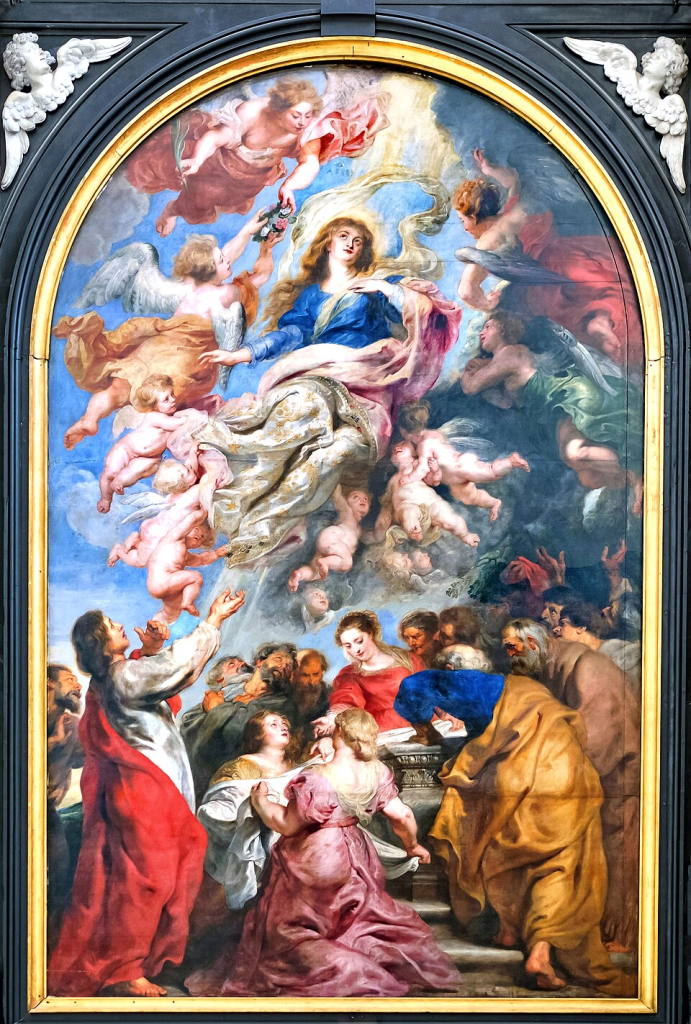
The Assumption of the Virgin Mary by Peter Paul Rubens, 1626. An altarpiece for the high altar of the Cathedral of Our Lady, Antwerp.
Today, August 15, is the date on the Catholic and Orthodox calendars to celebrate the Assumption of Mary, the mother of Jesus. Most Protestants do not know about this date, and the ones that do do not celebrate it in any way. For me, though, the Assumption has become a way to think about God’s grace, the limits of the boundaries Christians draw, and the hope that this life is not all there is.
Growing up in mostly small and medium-sized Southern towns, I had little contact with Catholics. I was taught—not by my parents, family, or church, but by the culture—to be suspicious of them. I was handed many falsehoods about “those people”: “They get their orders from the Pope.” “They do not believe in the Bible.” “They worship Mary instead of Jesus.” “They are not Christians.” I remember a fellow student in one of my first-year religion classes saying that Catholics worshipped Mary. A Catholic student in the class replied, “No, we do not worship her, but we do respect and honor her. How would you treat the mother of Jesus if she walked in the room?”
Most of my Southern Baptist friends do not believe Catholics are Christians. That’s okay; they do not believe that I, a United Methodist, am either. So many people who go by the name Christian are drawing lines to define who is in and who is out. They seem to ignore Psalm 24:1: “The earth is the Lord’s, and everything in it, the world, and all who live in it.” (Emphasis mine.)
Over time, that kind of boundary-drawing began to seem smaller than the gospel itself. If the earth and everyone in it belong to the Lord, then perhaps Mary can help me see not who is excluded, but how God keeps inviting ordinary people to bear grace into the world.
I eventually learned to see Mary as a model for all of us. God sends a messenger and asks whether she will bear Christ into the world. She says yes. She learns that doing so will involve pain and suffering, as well as joy. Still, she is faithful.
To be sure, there are all kinds of doctrines about Mary that I am not sure about—her perpetual virginity, whether she physically died, and exactly how to describe what happened at the end of her earthly life. John Wesley believed in Mary’s perpetual virginity, though Mary’s other children after Jesus present a problem or two for me. Some believe her physical body was taken to heaven without death; others believe she died and was then raised into new life. I do not need to settle those questions to find meaning in the feast.
What matters most to me is the word used to describe the transition from this life to the next: assumption. When Jesus left the earth, according to Christian scripture, he ascended; that is, he went up by his own power. Mary was taken—assumed—into heaven.
This tells me that God is never through with us. By God’s power, we continue to move and grow and live in the realm of God. This life matters: the earth is the Lord’s, and so are the people in it. God created it, loves it, cares for it, renews it, and calls us to care for it—including all creatures—too. But this life is not all there is. There is more yet to come.
And that is what I celebrate today: the joy, wonder, and beauty of this life, along with its pain, anguish, and hardship—and the promise that it does not end here.

