
I’m With The Banned

October 4–10 marks Banned Books Week, an event sponsored by the American Library Association and 15 other organizations, including Amnesty International, Little Free Library, and the National Council of Teachers of English. Established in 1982 in response to a sudden surge in challenged and banned books nationwide, the initiative highlights the essential freedom to access diverse literature and read without censorship. Unfortunately, the history of book banning is neither new nor brief.

In 1959, Alabama challenged Garth Williams’s children’s book The Rabbits’ Wedding. The story simply depicts two bunnies getting married—one black and one white. State officials and the White Citizens Council argued the book went too far, prompting State Senator E. O. Eddins to demand that libraries remove it and burn it. Emily Wheelcock Reed, Director of the Alabama Public Service, refused to destroy or pull the book, though she ultimately moved it to a reserved section to protect it. It was not until June 1967 that the U.S. Supreme Court struck down all state laws prohibiting interracial marriage, and Alabama’s state constitution was not updated until November 2000. Eventually, The Rabbits’ Wedding returned to the children’s section where it belonged.

While most states restrict books on a district-by-district or county-by-county basis, my home state of South Carolina is among the few that have enacted statewide bans. In May 2025, South Carolina led the nation in statewide book bans—a disheartening distinction. This censorship coincides with broader educational challenges: South Carolina ranks roughly 13th highest in functional illiteracy nationwide, with nearly 57.6% of adults reading below an 8th-grade level and only 54% to 56% of 3rd-grade students reading at grade level.

Despite these challenges, many books eventually find their way back. Acclaimed works like Toni Morrison’s The Bluest Eye, Margaret Atwood’s The Handmaid’s Tale, and Khaled Hosseini’s The Kite Runner have all overcome local challenges in South Carolina. In Beaufort County alone, people challenged 97 books in 2022, though libraries ultimately returned all but five to the shelves.

Resistance to censorship has historical roots here, too. In 1987, a student at Baptist College of Charleston (now Charleston Southern University) asked to remove F. Scott Fitzgerald’s The Great Gatsby from the undergraduate reading list. The college president, Jairy Hunter, refused. Years later, when a member of a local church tried to remove the first Harry Potter book from a school district because of its themes of magic, a parishioner asked what I thought. My response was simple: “The only real magic in Harry Potter was that it was able to get kids to read.”

When this week rolls around each year, I look up the list of challenged and banned books in South Carolina. This year, there are 21. They remain available in bookstores and select public libraries by request, but they’ve been removed from school shelves—though I’m told a few manage to sneak back in.

I usually pick one up out of curiosity. Of the 21 titles, six are by Sarah J. Maas, a fantasy author who has sold over 75 million copies worldwide; I read one recently and found it genuinely intriguing. Ellen Hopkins has three books on the list, tackling heavy, real-world themes like addiction, abuse, mental health, and trauma—topics that deeply resonate with young readers.

Which brings me to my point: if you want your pre-teen or teen to read, tell them they can’t. But if you do, be prepared. It might just spark a change—or convince them that bunnies who love each other deserve to get married.
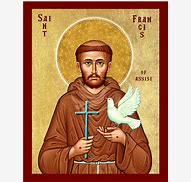
Feast Day of St. Francis of Assisi

Today, October 4, is the Feast Day of St. Francis of Assisi (born around 1181, died October 3, 1226, at 44 or 45 years old). One of the most beloved and recognizable saints, Francis is remembered for his deep love of nature, his famous prayer (“Lord, make me an instrument of thy peace…”), and for founding a new order in the Catholic Church. His followers became known as the Friars Minor (“Lesser Brothers”), a name he chose to reflect humility and service. Francis wanted his community to live simply, caring for the poor and embracing poverty as a way to imitate Christ. Over time, they came to be called Franciscans, honoring their founder’s vision of joy, compassion, and reverence for all creation. He may rightly be considered a reformer, calling the Church back to its roots.

Francis, whose birth name was Giovanni di Pietro di Bernardone, was born into a wealthy family whose business was cloth. He spent much of his youth enjoying a lavish lifestyle, then joined the army and was sent into war. Captured and held prisoner for a year, he became seriously ill and began to reevaluate his life. Upon returning home, he resumed his old ways for a time but soon experienced a vision that changed him forever. He lost interest in worldly pleasures and wealth. When asked if he was considering marriage, he replied, “Yes, a fairer bride than any you have ever seen.” That “bride” came to symbolize Lady Poverty, his lifelong companion.

While praying in the ruins of a dilapidated church, Francis had a vision of Christ speaking to him from an icon. The crucified Christ said, “Francis, Francis, go and repair my church, which, as you can see, is falling into ruins.” At first, Francis thought this meant rebuilding the physical structure, but he later understood it as a call to renew the spiritual and moral life of the Church itself.

From that moment, Francis devoted himself to serving the poor and living the Gospel in its purest form. His humility, joy, and love for all creation continue to inspire people across centuries and faiths. His legacy reminds us that peace, simplicity, and compassion are not just ideals — they are ways of life.

He took up a life of poverty, chastity, and obedience, which forms the Rule of the Franciscans today. To celebrate his day, I read the Rule and reflected on it. (Here’s a site with the Rule and some interpretation of it.) There are 12 sections. They are worth reading and reflecting upon today. Those of us who are or have been preachers should pay special attention to Rule IX.

Franco Zeffirelli made a beautiful movie about Francis and Clare in 1972 titled Brother Sun, Sister Moon. A song from the movie, Little Church, by Donovan, has these lyrics-

If you want your dream to be Take your time, go slowly

Do few things but do them well Heartfelt work grows purely

If you want to live life free Take your time, go slowly

Do few things but do them well Heartfelt work grows purely

Day by day, stone by stone Build your secret slowly

Day by day, you’ll grow too You’ll know heaven’s glory

Here’s a link to the song in the movie. It has one of the best altars I have seen anywhere.

Francis had 11 brothers join him in Assisi, and they worked there, focusing on calling the church to its mission. The movement began to grow organically. It was not planned to be a worldwide movement, but it became one. Francis simply wanted to start where he was.

And I think that’s his message to me today. Start where you are. Do good work. Go slowly. But go.

And remember, in the words of Francis himself, “All the darkness in the world cannot extinguish the light of a single candle.”