Fahrenheit 451

On this day, October 19, in 1953—the year I was born—Ray Bradbury’s Fahrenheit 451 was published.

I wonder if Bradbury had any idea how profoundly his writing would influence generations of readers. He was an insightful, imaginative, often humorous, and remarkably prolific writer. My shelves hold much-worn copies of The Illustrated Man, The Martian Chronicles, Dandelion Wine, Something Wicked This Way Comes, and Green Shadows, White Whale. And I have several copies of Fahrenheit 451.
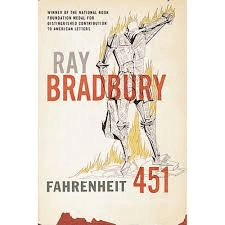
Original cover, October 1953

I probably first read Fahrenheit 451 around its tenth anniversary, when I was about ten years old, and again a few years later. The book made an impression on me that has lasted a lifetime.

On the occasion of its fortieth anniversary in 1993, I wrote Bradbury a letter telling him how much his book had inspired me and how I was beginning to see some of his predictions coming true.

More than thirty years later, I wish I could say those concerns were unfounded.

We are not yet living in a society where firemen burn books rather than extinguish fires, but there is a growing movement in our country to remove certain books from libraries and schools. Some people have even called for books to be burned. Perhaps even more troubling is a culture increasingly uncomfortable with reading anything longer than what fits on a smartphone screen.

Consider a few statistics.

In 2004, on an average day, 28% of Americans read for pleasure. Twenty years later, that number had fallen to 16%. That includes reading books, magazines, newspapers, online articles, and even listening to audiobooks.

The decline among children is particularly disturbing. In 2012, 53% of nine-year-olds reported reading for pleasure every day. By 2022, that number had dropped to 39%. The numbers become even more discouraging as children grow older. In 2012, only 27% of thirteen-year-olds read daily for pleasure. By 2023, the figure had fallen to just 14%.

A Pew survey in 2025 found that a quarter of Americans had not read a single book in the previous year. Another 38% had read between one and five books, including audiobooks.

There is an old saying, frequently attributed to Mark Twain, although no one seems able to prove he said it: “The person who does not read has no advantage over the one who cannot read.”

Whoever said it had a point.

Oddly enough, while recreational reading has declined, book sales have remained relatively strong. Apparently, people are still buying books. Reading them is another matter.

I have a friend with bookshelves filled with beautifully bound editions of classic literature. They are impressive volumes, the sort of books that make a room look distinguished and intellectual.

He hasn’t read a single one.

They’re decorations.

I suppose there are worse things to decorate a room with, but I can’t help thinking that books deserve better than that.

But back to Fahrenheit 451.

Somehow, my letter reached Ray Bradbury. To my surprise and delight, he autographed a fortieth-anniversary edition of the novel and sent it to me. It remains one of my treasured possessions. It is now in the possession of my nephew.
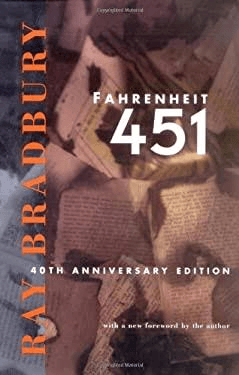
40th Anniversary Edition

Recently, I bought another edition, a boxed version released by Simon & Schuster in November 2025. It features one of the cleverest bits of book packaging I’ve ever seen.

Instead of displaying the title on the spine of the box, the publisher made it a striking surface. You can actually strike a match on it.

The front of the box doesn’t even have the book’s title. It simply carries the novel’s chilling opening words:

“It was a pleasure to burn.”

November 2025 edition

The back displays only the number 451—the temperature at which book paper supposedly catches fire.

I love the irony of a publisher selling a book about burning books in a box designed to strike matches.

All of this prompted me to pull out my oldest copy of Fahrenheit 451, a battered paperback that has been highlighted, underlined, dog-eared, tagged, and thoroughly worn.

Most of my books, including my Bibles, look as though I’ve been wrestling with them. In a sense, I have. I don’t believe books are meant simply to be admired on shelves. They are meant to be opened, questioned, argued with, and occasionally wrestled to the ground.

As I leafed through that old paperback, I came across passages that captured my imagination as a young teenager and still haunt me more than sixty years later.

Bradbury urged his readers to fill their eyes with wonder, to see the world, and to recognize that reality can be more astonishing than anything manufactured for our entertainment.

He wrote about the importance of leaving something behind when we die—a child, a book, a painting, a garden, something touched by our hands and changed by our presence. I especially love his distinction between someone who merely cuts grass and a gardener whose work leaves something of himself behind. The gardener, Bradbury suggests, will be remembered long after the work is done.

Then there is the haunting question of what could possibly be so valuable in a book that a woman would choose to remain with her books in a burning house rather than abandon them.

And I still smile at the seventeen-year-old who announces that he is crazy because, according to his uncle, being seventeen and being insane naturally go together.

These days, I would amend that to seventy-three and insane.

But perhaps the passage that most closely connects Bradbury’s fictional world to our own is his description of a book as a loaded gun in the house next door. What makes a well-read person so dangerous?

Perhaps it is the possibility that such a person might begin to think independently, ask uncomfortable questions, challenge accepted opinions, or imagine a world different from the one being handed to us.

That, after all, is what books do.

They take us places we have never been. They introduce us to people we would otherwise never meet. They challenge our assumptions, expand our sympathies, sharpen our minds, and sometimes change our lives.

A good book doesn’t simply give us something to think about. It teaches us how to think.

And that may be precisely why some people find books so threatening.

Bradbury understood something important: You don’t have to burn books to destroy a culture of reading. You simply have to persuade people that reading is no longer worth their time.

If you’ve made it this far, congratulations. And thank you for reading.

Now, please, put down your phone, close your computer, and pick up a book.

Preferably one that someone doesn’t want you to read.
The Spaces Between the Pictures

I have gone back to school.

Our local university, Francis Marion University, is offering non-credit evening classes for the community, taught by its faculty, for the incredibly inexpensive price of $10 per course. I signed up for two: Photography: Make Not Take Better Photos, taught by Professor Julie Mixon, and Revolutionary War Battles in South Carolina, taught by Dr. Will Bolt.

I have a nice mirrorless digital camera that I know embarrassingly little about, and lately I have been traveling around South Carolina looking for lesser-known Revolutionary War battle sites. So both classes were right up my alley.

Professor Mixon’s first class introduced photography and what she believes makes a good photograph. A good photograph tells us something. It invites us into a part of the world we may not have noticed before. It often raises more questions than it answers. And, at its best, it gives us a new way of seeing the world around us.

She showed us photographs from her travels—landscapes, flowers, and some incredible close-ups of insects. She loves bugs. For our homework, she asked us to think about what makes a good photograph.

I’ve been doing just that.

Ansel Adams famously distinguished between taking a photograph and making one. Even when the shutter is open for only a thousandth of a second, the photographer has decisions to make. What am I photographing? Why? What belongs inside the frame? What should be left outside it? What should be sharp, and what should disappear into the blur?

A photograph may capture only a fraction of a second, but a good one can hold an entire story.

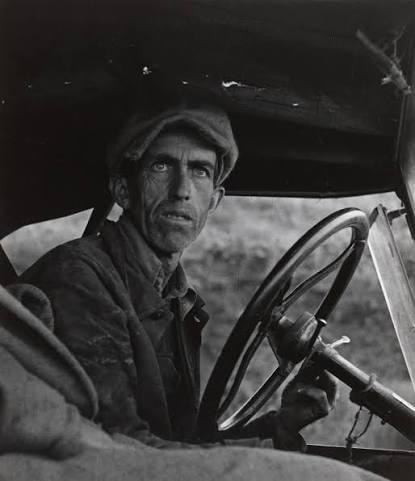
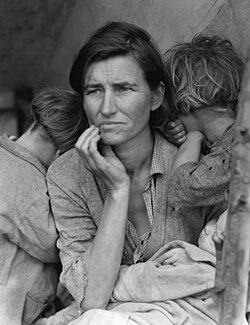
Professor Mixon showed us photographs by Dorothea Lange, whose work documented the human cost of the Great Depression. Nearly a century later, her photographs still allow us to look into the faces of people who endured the Dust Bowl and Depression and wonder about their lives. Her famous Migrant Mother, along with photographs such as Ditched, Stalled and Stranded, does more than record what someone looked like at a particular moment.

Migrant Mother

Ditched, Stalled, and Stranded

The pictures make you wonder what happened five minutes before the shutter clicked—and what happened five minutes afterward.

They make you compose a story in your mind.

Years ago, in a previous chapter of my life, I visited a young friend in the pediatric cancer ward of a hospital in Columbia. Most of the patients on that floor were under twelve, and many stayed for long periods.

As I stepped into the elevator, a young woman stepped in with me. She looked to be in her early thirties. She had long, straight hair and wore loose-fitting pants and an oversized, long-sleeved T-shirt. She carried a large bag. Stuffed animals peeked out of the top, along with a few clothes and snacks.

She never looked at me.

She looked at the elevator buttons.

When she saw the floor I had already selected, she didn’t press another button. She simply turned and stared at the wall.

I tried not to stare at her.

I knew nothing about this woman. I didn’t know who she was going to see or what news she had received. But something about her told me she had ridden that elevator a hundred times. She looked tired—deeply tired—but determined. There was a strength in the way she stood there that seemed greater than the circumstances surrounding her.

I wish I could have made a photograph of her.

Not because I wanted a picture of a tired woman carrying a bag of stuffed animals, but because I wish I could have captured that strength. I wish I could have taken a photograph that made someone who had never met her stop and wonder about her story.

Over the years, I have visited many people in their homes, and I have developed a habit of noticing the photographs they display.

Photographs tell so much about us.

And they keep so many secrets.

Most are the expected pictures—weddings, birthdays, anniversaries, vacations, graduations. In that way, the photographs on our walls are a little like the pictures we post on social media. They tend to show the good moments. Everybody is smiling. Everybody is dressed nicely. Everybody appears happy.

But occasionally a collection of photographs tells a deeper story.

Years ago, I visited a family who lived in a small mobile home. On one wall were eight photographs. As best I could tell, they were the only family photographs displayed in the house.

Each one had been made for a church pictorial directory.

You can usually recognize those photographs from across the room. Everybody is wearing their Sunday clothes. The smiles are slightly forced. And somewhere behind them is that inevitable blue background.

Eight of these pictures hung in a row.

The first showed a young couple. They were smiling and looked recently married.

In the second, they were holding a baby. Their smiles were even bigger.

The third showed the couple with a small child and another baby.

Then came the fourth photograph.

The children were teenagers now.

Nobody was smiling.

The mother looked tired. The father looked angry.

In the fifth photograph, the father was gone. Only the mother and her two older teenagers remained. She looked worried.

The sixth showed the mother alone.

She had a slight smile.

The seventh showed her with her two now-grown children.

All three were smiling.

And then there was the eighth.

The mother was gray-haired now. Beside her stood her two adult children, their spouses, and a small baby.

Everyone was beaming.

Eight photographs.

No captions. No explanations.

I never knew the whole story behind that wall, and perhaps that is what made those photographs so powerful. Somewhere between those blue backgrounds there had been love and disappointment, babies and teenagers, anger and absence, loneliness and reconciliation. Some chapters of a family’s life no camera recorded.

But you could still see traces of them.

The pictures told a story.

And so did the spaces between the pictures.

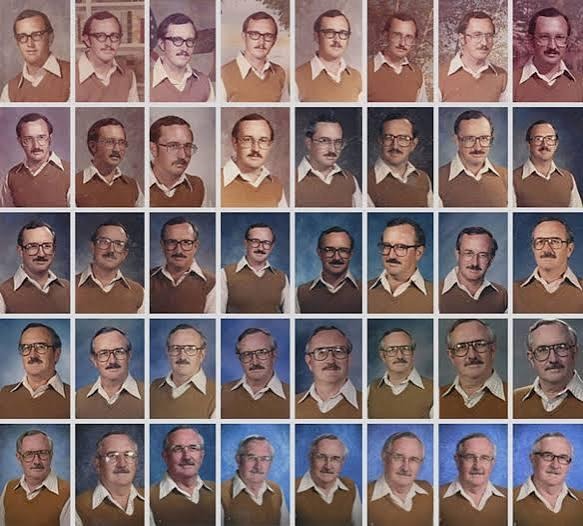
Several years ago, I read about Dale Irby, a physical education teacher in Dallas who accidentally wore the same outfit for his school yearbook photograph two years in a row. His wife dared him to do it again. Eventually it became a tradition, and for decades he appeared in his yearbook photograph wearing essentially the same polyester shirt and sweater vest.

What began as an ordinary school photograph became something else entirely.

It became a record of time passing.

The clothes stayed the same. The man did not.

Dale Irby, Prestwood Elementary School, Dallas, TX

Maybe that is part of what photographs do for us. They remind us that the world is always changing, even when we aren’t paying attention.

Today we probably take more photographs than any generation in human history. Our phones contain thousands of them. We photograph our meals, our pets, our grandchildren, sunsets, vacations, birthday cakes, and ourselves standing in front of places we may never visit again.

But strangely, the more photographs we take, the fewer we seem to keep.

We don’t print many of them anymore. We upload them online, look at them for a day or two, and then they disappear into the enormous digital attic of our phones and computers.

Perhaps that is why Professor Mixon’s distinction between taking and making photographs has stayed with me.

I don’t really need to learn how to take more pictures.

I already know how to do that.

I want to learn how to see.

I want to notice the woman in the elevator. The changing faces on the wall. The things most people walk past without seeing. I want to learn to make photographs worth printing and putting somewhere that people might stop and look at them years from now.

Maybe they will wonder what happened just before the shutter clicked.

Maybe they will wonder what happened afterward.

Maybe they will see something in the picture that I didn’t even know was there.

Because it is a big old world, filled with people and places we pass every day without really seeing.

Sometimes all it takes is a camera—and someone willing to pay attention.

Every picture tells a story.

Hampton, my cat, whom I miss