

On November 11, 1926, exactly one hundred years ago today, a highway was officially established that would become one of the most famous roads in America. It was called U.S. Highway 66, but over the years it took on other names, including the Main Street of America, the Mother Road, the Will Rogers Highway, and, perhaps most fittingly, the Highway of Dreams.
Route 66 stretched about 2,448 miles from Chicago, Illinois, to Santa Monica, California, passing through Missouri, Kansas, Oklahoma, Texas, New Mexico, and Arizona. Eight states, three time zones, and enough small towns, roadside diners, gas stations, motels, and tourist traps to keep a traveler entertained for weeks. It was more than a road. It was a ribbon of asphalt connecting people, places, and possibilities. It may have inspired Woody Guthrie’s This Land Is Your Land. “As I went walking that ribbon of highway…”
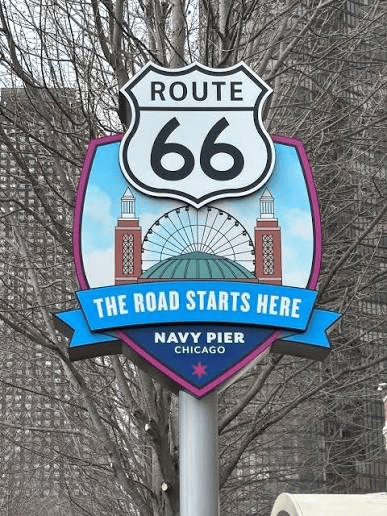
Before our modern highway system, traveling across America was not particularly easy. Roads were often little more than dirt paths, and rain could turn a pleasant drive into an adventure that nobody wanted. Route 66 was not the first transcontinental highway, nor was it entirely paved when it opened. In fact, it would take another twelve years for the entire route to be paved. But it became one of the country’s most important roads, linking the industrial Midwest with the rapidly growing Southwest and California.
During the Great Depression, Route 66 became a road of desperation and hope. Thousands of families, particularly from Oklahoma, Arkansas, and Texas, loaded everything they owned into battered automobiles and headed west, hoping to find work and a better life. Drought, dust storms, and economic collapse had driven them from their homes. John Steinbeck immortalized their journey in his 1939 novel The Grapes of Wrath. Steinbeck gave Route 66 its most enduring nickname: the Mother Road.
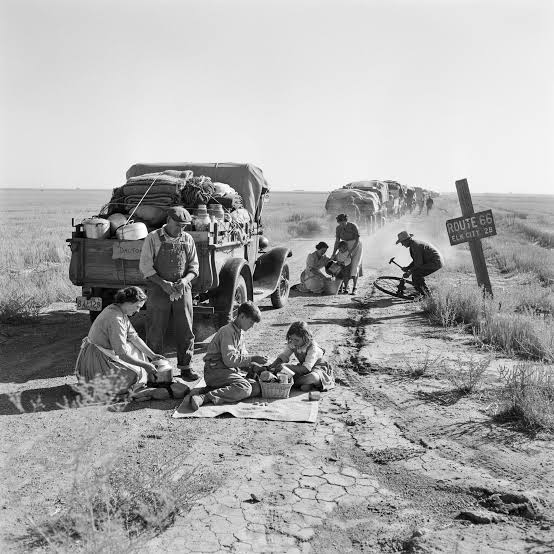
For those families, the Mother Road was not a vacation. It was a road of hardship, hunger, uncertainty, and sometimes disappointment. California did not always turn out to be the promised land they had imagined. Yet the road represented something deeply American: the belief that somewhere beyond the horizon there might be a better life.
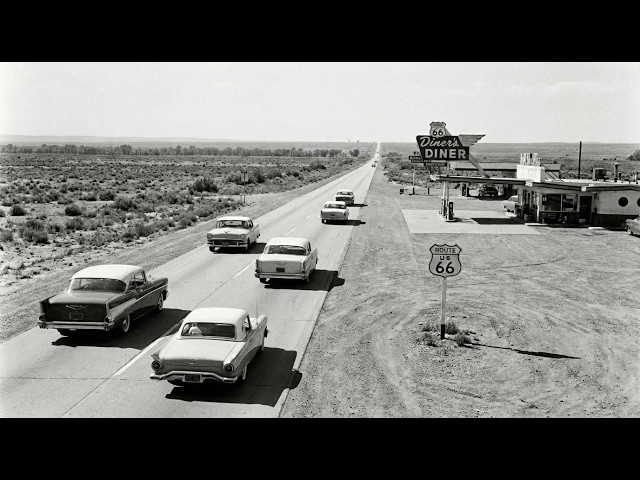
Following World War II, Route 66 took on a different character. Americans had money in their pockets, automobiles in their driveways, and a growing desire to see the country. The highway became a vacation destination in itself. Families piled into their Chevrolets, Fords, and Plymouths, packed suitcases, picnic baskets, and restless children, and headed west.
Along the way, a whole new American culture developed. Motor courts, which eventually became motels, restaurants with enormous neon signs, souvenir shops selling everything imaginable, and roadside attractions designed to separate tourists from their money appeared. Giant dinosaurs, concrete teepees, trading posts, and enough signs advertising the next attraction made sure nobody missed it.
In Missouri, travelers could explore Meramec Caverns, advertised for miles as Jesse James’s hideout. In Texas, they could stop at the Big Texan Steak Ranch, where anyone who could eat a seventy-two-ounce steak and all the accompanying food within an hour got the meal free. In Arizona, travelers could sleep at the Wigwam Motel, where they stayed in concrete structures shaped like teepees. In New Mexico, trading posts offered genuine Indian souvenirs, though some were undoubtedly more genuine than others.
Route 66 was also an important part of American music. In 1946, songwriter Bobby Troup wrote “(Get Your Kicks on) Route 66,” which became a hit for Nat King Cole and was later recorded by Chuck Berry, the Rolling Stones, and numerous other performers. The song named many of the towns along the highway and made them familiar to people who had never traveled farther west than their own county line.
Then, in 1960, CBS introduced a television series called Route 66, starring Martin Milner and George Maharis as two young men traveling around America in a Chevrolet Corvette. The show ran for four seasons. Interestingly, although the program was named for the highway, much of it was filmed in places nowhere near Route 66. But that really did not matter. The road had become a symbol of freedom, adventure, and the possibility of finding something new around the next bend. Rather than pay Bobby Troup a royalty for using his song, the producers hired Nelson Riddle to write a unique song for the show. I like both songs, but the Nelson Riddle one seems to have that call of the open road that Troup’s does not.
I was seven years old when that television show premiered. For those of us growing up in the 1950s and 1960s, the automobile represented a kind of freedom that earlier generations had never known. We could go places our grandparents might never have imagined visiting. My grandfather, who helped to raise me, was born in 1892. He used to complain that people only saw America through a car window. The interstate highway system was beginning to connect the country in ways that would have seemed miraculous only a few decades earlier.
Ironically, that very interstate system eventually brought about the demise of Route 66.
In 1956, President Dwight Eisenhower signed legislation creating the Interstate Highway System. The new roads were wider, straighter, faster, and safer. They bypassed towns rather than passing through them. Travelers could cover hundreds of miles without stopping at a traffic light, slowing down for a courthouse square, or being tempted by a roadside sign promising the world’s largest whatever.
Progress is wonderful, but it often comes at a price. That same grandfather said, of the interstate system, “Now you can travel from the Atlantic to the Pacific and not see anything.”
As the interstates replaced Route 66, the little businesses that depended on passing motorists began to disappear. Gas stations closed. Motels stood empty. Diners that had served generations of travelers shut their doors. Some towns that had once thrived along the highway became little more than forgotten places on an old map.
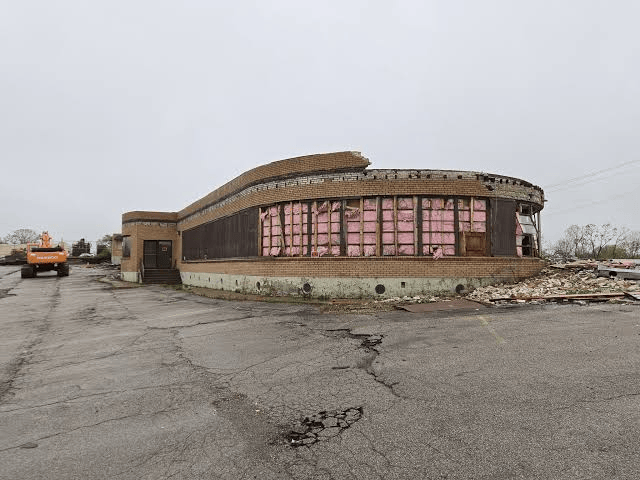
On June 27, 1985, the U.S. Highway System officially removed Route 66. The road that had carried millions of Americans westward was no longer an official U.S. highway.
But something interesting happened. People refused to forget it.
Preservation groups began restoring old buildings, saving neon signs, and marking surviving sections of the highway as Historic Route 66. Travelers who could get from Chicago to California much faster on the interstate began deliberately taking the slower road. They wanted to see the old diners, drive across the narrow bridges, visit the abandoned gas stations, and experience a little of the America that had existed before everything became standardized.
Today, portions of Route 66 remain open, and travelers can still follow much of the original journey, although it requires some careful planning. On our honeymoon, Cathy and I drove part of 66 through Winslow, Arizona. If it weren’t for that song the Eagles sang, that town would not be there today. Some sections of the Mother Road have disappeared entirely. Others are little more than frontage roads running beside the interstates. But hundreds of miles still let you travel through small towns, stop at independent restaurants, and see remnants of an America that has largely vanished.
This year marks the centennial of Route 66, and communities along the old highway are celebrating its history. There is something fitting about celebrating a road that officially ceased to exist more than forty years ago.
I think part of our fascination with Route 66 comes down to nostalgia. We remember, or imagine, a time when traveling was not simply about getting somewhere as quickly as possible. The journey itself was part of the adventure. We stopped to look at unusual things. We ate in restaurants where the owner might also be the cook and the waitress. We stayed in motels where the room key was attached to a large plastic tag, and the sign outside proudly advertised COLOR TV and AIR CONDITIONING.
Of course, we tend to romanticize the past. Those old roads were often dangerous, the cars were not nearly as reliable as we remember, and not everyone was equally welcome at the roadside establishments. For Black Americans traveling during segregation, a cross-country automobile trip required careful planning to find safe places to eat, sleep, and purchase gasoline. The Negro Motorist Green Book was not a collection of interesting tourist attractions. It was often a necessity.
The history of Route 66 is, in many ways, the history of twentieth-century America, complete with its hopes, achievements, contradictions, and failures.
I have always enjoyed traveling the back roads, stopping in small towns, visiting historic places, and discovering things that never make it into the tourist brochures. I would rather spend an hour exploring an old courthouse square than drive past it at seventy-five miles an hour. There is something to be said for taking the road that goes through a town instead of the one that goes around it.
Perhaps that is why Route 66 continues to capture our imagination.
A hundred years ago, America built a highway to connect Chicago with California. Along the way, it connected generations of people through their dreams, disappointments, adventures, and one another.
The road may have disappeared from official maps, but it has never left the American imagination.
And perhaps there is a lesson in that. We spend so much of our lives trying to get somewhere that we sometimes forget to enjoy the trip. We are always looking for a faster road, a shorter route, or a way to avoid the inconvenience of stopping.
But sometimes the most interesting things in life are found along the old roads, in the little towns, and at the unexpected stops we would have missed if we had been in too much of a hurry.
After a hundred years, Route 66 still has something to teach us.
Sometimes the journey is just as important as the destination.
And sometimes, to get your kicks, you have to get off the interstate.

