The Assumption of Mary

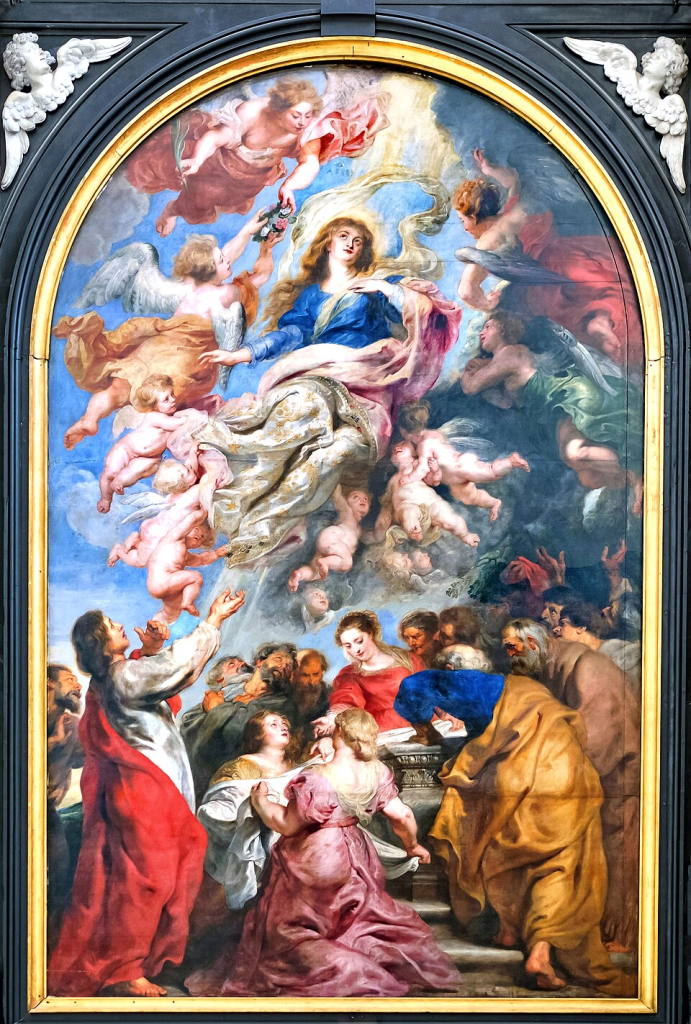
The Assumption of the Virgin Mary by Peter Paul Rubens, 1626. An altarpiece for the high altar of the Cathedral of Our Lady, Antwerp.

Today, August 15, is the date on the Catholic and Orthodox calendars to celebrate the Assumption of Mary, the mother of Jesus. Most Protestants do not know about this date, and the ones that do do not celebrate it in any way. For me, though, the Assumption has become a way to think about God’s grace, the limits of the boundaries Christians draw, and the hope that this life is not all there is.

Growing up in mostly small and medium-sized Southern towns, I had little contact with Catholics. I was taught—not by my parents, family, or church, but by the culture—to be suspicious of them. I was handed many falsehoods about “those people”: “They get their orders from the Pope.” “They do not believe in the Bible.” “They worship Mary instead of Jesus.” “They are not Christians.” I remember a fellow student in one of my first-year religion classes saying that Catholics worshipped Mary. A Catholic student in the class replied, “No, we do not worship her, but we do respect and honor her. How would you treat the mother of Jesus if she walked in the room?”

Most of my Southern Baptist friends do not believe Catholics are Christians. That’s okay; they do not believe that I, a United Methodist, am either. So many people who go by the name Christian are drawing lines to define who is in and who is out. They seem to ignore Psalm 24:1: “The earth is the Lord’s, and everything in it, the world, and all who live in it.” (Emphasis mine.)

Over time, that kind of boundary-drawing began to seem smaller than the gospel itself. If the earth and everyone in it belong to the Lord, then perhaps Mary can help me see not who is excluded, but how God keeps inviting ordinary people to bear grace into the world.

I eventually learned to see Mary as a model for all of us. God sends a messenger and asks whether she will bear Christ into the world. She says yes. She learns that doing so will involve pain and suffering, as well as joy. Still, she is faithful.

To be sure, there are all kinds of doctrines about Mary that I am not sure about—her perpetual virginity, whether she physically died, and exactly how to describe what happened at the end of her earthly life. John Wesley believed in Mary’s perpetual virginity, though Mary’s other children after Jesus present a problem or two for me. Some believe her physical body was taken to heaven without death; others believe she died and was then raised into new life. I do not need to settle those questions to find meaning in the feast.

What matters most to me is the word used to describe the transition from this life to the next: assumption. When Jesus left the earth, according to Christian scripture, he ascended; that is, he went up by his own power. Mary was taken—assumed—into heaven.

This tells me that God is never through with us. By God’s power, we continue to move and grow and live in the realm of God. This life matters: the earth is the Lord’s, and so are the people in it. God created it, loves it, cares for it, renews it, and calls us to care for it—including all creatures—too. But this life is not all there is. There is more yet to come.

And that is what I celebrate today: the joy, wonder, and beauty of this life, along with its pain, anguish, and hardship—and the promise that it does not end here.

St. John the Baptizer Eve

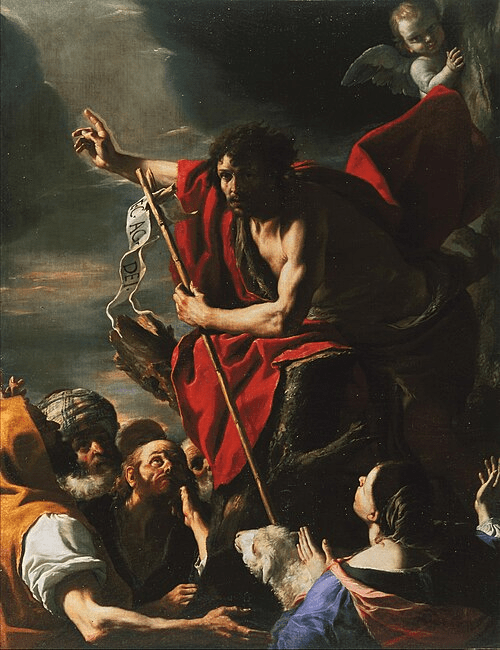
Today, June 23, is the feast day of St. John the Baptizer—or rather, the eve of the feast. Technically, the celebration does not begin until sunset, which is 8:34 p.m. where I am. It is one of only two major saint days in the Christian calendar that commemorate a saint’s birth rather than death. The other celebrates the birth of Mary, the mother of Jesus, on September 8. According to the Gospel of Luke, John was born six months before Jesus, which explains the date.

People observe this day in different ways. In many places, bonfires are lit. Some communities hold parades. Others celebrate baptisms or services for the renewal of baptismal vows. I prefer a quieter observance: reflecting on the saint, considering what I can learn from his life, and finding one practical way to put that lesson into action. Since it is far too hot to build a bonfire here, I took a short walk along nearby Jefferies Creek instead.

John, as you may know, was a fiery prophetic preacher who spoke boldly against the corruption of both the Roman Empire and the religious establishment of his day. He called people away from lives centered on themselves and toward lives centered on God and neighbor. His message can be summarized in five themes.

1. Repent — because the kingdom of heaven is near.

“Repent, for the kingdom of heaven has come near.” (Matthew 3:2)

Repentance does not simply mean feeling sorry for something. It literally means to turn around and head in a different direction. For John, genuine repentance required a changed life. Which leads naturally to his second theme.

2. Bear fruit — live a changed life.

“Bear fruits worthy of repentance.” (Luke 3:8)

A changed heart should produce a changed life. Jesus later echoed this teaching when he said that people are known by their fruits (Matthew 7:15–20). John insisted that faithfulness could not be inherited. He challenged those who trusted in their ancestry:

“Do not begin to say to yourselves, ‘We have Abraham as our father.'” (Luke 3:8)

Faith requires a personal response. No one can believe for us. Which brings us to theme three.

3. Practice justice and generosity — treat people rightly.

John’s preaching was remarkably practical.

“Whoever has two coats must share with anyone who has none.” (Luke 3:11)

Compassion and generosity are marks of genuine repentance.

To tax collectors he said:

“Collect no more than the amount prescribed for you.” (Luke 3:13)

Repentance affects how we conduct our work and handle our finances.

To soldiers he said:

“Do not extort money from anyone by threats or false accusation, and be satisfied with your wages.” (Luke 3:14)

Reject abuse of power. Reject greed. Treat people fairly.

4. Prepare for God’s judgment — take God seriously.

John preached both grace and judgment.

“His winnowing fork is in his hand.” (Luke 3:17)

God cares about how we live. John warned that a day of accountability would come when righteousness and wickedness would be separated. His message was urgent because he believed that what we do matters.

5. Look to Jesus — the Messiah, the Lamb of God, the Son of God.

Above all else, John pointed beyond himself.

“One who is more powerful than I is coming.” (Luke 3:16)

True ministry points people to Christ rather than to oneself.

“He will baptize you with the Holy Spirit and fire.”

“Behold, the Lamb of God, who takes away the sin of the world!” (John 1:29)

“I have seen and have testified that this is the Son of God.” (John 1:34)

“Look, here is the Lamb of God!” (John 1:36)

John taught that Jesus is God’s answer to our separation from God, from one another, and from creation itself. He willingly directed his own disciples away from himself and toward Christ.

Perhaps John’s greatest statement was simply this:

“He must increase, but I must decrease.” (John 3:30)

The faithful servant seeks Christ’s glory rather than personal recognition.

John’s final recorded testimony centers on faith:

“Whoever believes in the Son has eternal life.” (John 3:36)

In many ways, John stands as the bridge between the Hebrew prophets and the ministry of Jesus, fulfilling Isaiah’s vision of “a voice crying out in the wilderness: Prepare the way of the Lord” (Isaiah 40:3; Matthew 3:3).

There is no evidence that John continued baptizing after he baptized Jesus. But he never stopped preaching. He continued to speak the truth, refusing to back down, until it ultimately cost him his life.

Mussorgsky’s Night on Bald Mountain was originally titled St. John’s Eve on Bald Mountain. Inspired by a story by Nikolai Gogol, the music captures something of John’s spirit: the fire, intensity, urgency, and thunder of prophetic judgment. Yet the piece concludes with church bells and a sense of peace. The storm passes. A new day dawns.

Perhaps that is fitting. John’s ministry was never the destination. He was preparing the way for One who would bring a new way of living, a new kingdom, and a new hope.

As for me, I think I will spend this St. John’s Eve looking for something worth standing for. Maybe even something worth losing my head over.

Companions

I was welcomed as a Companion into the Northumbria Community last Saturday (October 4, 2025). For those unfamiliar with Northumbria, it is a semi-monastic, dispersed Celtic Christian community. It is small, and members are scattered worldwide. Its home is the Northumbria area of Great Britain. The “mother house,” Nether Springs, is situated halfway between Newcastle and Lindisfarne (the Holy Island). You can check out the community online here.

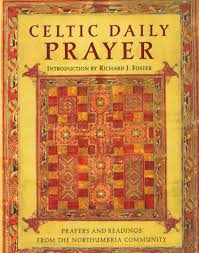
In 2002, I came across the book Celtic Daily Prayer on a bookshelf and decided to purchase it. It had a glowing review by Richard Foster, and you cannot go wrong with him. I took it home, put it on my bookshelf, and it remained unopened for a little over ten years.

For about 40 years, I had been starting each day using readings from one of Reuben Job’s Guide to Prayer books. They served me well for those years, but it was time for something new. I had been interested in Celtic Christianity for a long time, so I pulled CDP down and began to explore it. Soon, I looked up Northumbria, contacted them, and Catherine, one of the resident staff, responded. It turns out that this fine Celtic woman was from East Tennessee and attended college in upstate South Carolina. She invited me to investigate Northumbria and encouraged me in my spiritual walk. I became a “friend” of the community, which meant I was on their email list.

I started practicing their daily devotions (morning, midday, and evening prayer) and was drawn to the community. After attending an online introductory retreat, I became a novitiate, undergoing a series of studies and times of prayer with a mentor to determine if the Spirit was leading me to become a deeper part of this community. Catherine told me not to hurry, to take my time, to listen, pray, and think about it. Most novitiates took between nine months and a year. I took about 4 years.

My mentor, Craig, was incredibly patient with me. He walked beside me at my pace. He did not push or guide me as much as he explored with me. At the very beginning of our time together, since he was my mentor and I was his mentee, I sent him a bag of Mentos as a gift for the journey. Along the way, I made friends with other members of the Community, all of whom were online and living in Europe, Asia, Africa, and America. I now have a group (Ann, Alan, Sarah, Chris, and Ali) who are spiritual traveling companions with me. We are spread out from Madagascar to England, New York, Washington, and down to Florence.

After finishing my novitiate, I was accepted as a Companion in the Community. Companions make a vow to live according to the Rule of the Community.  Rule here does not mean regulations, like the rules of a game, but rather, in the orthodox sense, a way of living. The Rule of Northumbria is Availability and Vulnerability. “We are called to be AVAILABLE to God and to others… We are called to intentional, deliberate VULNERABILITY…”You can check out more about it here.

Although Northumbria is a religious organization, it is not a church. Most of us in the community are members of other churches, various denominations. I am still a member of the United Methodist Church and an ordained elder within it.

The Welcoming Ceremony was a simple online service attended by my mentor Craig, Catherine from the Mother House, my group friends, and a few individuals Craig had invited. Prayers were said, blessings bestowed, testimonies shared, and gifts exchanged. It was a genuinely nice ceremony. I knew I would like it, but I was surprised at the effect it had on me afterwards.

When it was over, I signed off the meeting and stepped outside to do my regular Saturday errands —wash the car, fill it with gas, and buy groceries. As I walked off my front porch, I had a sense I was not alone. These people I had grown to know and love, though all living hundreds and thousands of miles from me, were somehow with me. And not just them, but others who had committed to this Rule of life, to availability and vulnerability. The saints I had been studying —Aiden, Cuthbert, Finan, Boisil, Brigid, Patrick, Brendan, Ita, Samthann, and so many more — surrounded me. They were with me as I washed the car, spoke to the people at the gas station, and chatted with the woman at the grocery checkout. They were reminding me that every step was walking on holy ground and that I was never alone. They were my Companions.

Companion comes from the Latin and Old French words that mean “one who breaks bread with another.” Better translated, one who shares your life, because breaking bread is what we do to live. Companions walk with us, share their experiences, and explore our path. When I was ordained an elder in the UMC, I had a vision of all of us working together, sharing our lives, and being fellow travelers on the Way of Jesus. However, we quickly discover that it is less of a path we walk and more of a job we do. Numbers measure us. All meaningful, but still numbers. The number of new members, people attending worship, people involved in ministries to the community and the world, and dollars given to support ministries around the world—essential numbers, but still numbers. And we are judged and measured by them, by some of the people who were ordained with us. It quickly becomes a formal and informal hierarchy. We are no longer sharing bread; we are earning it.

But in my new community, none of us work for it (or very few do). No One exercises authority over others. We travel together, being available to God and others. We are open to questions and do not have to answer or defend anything. A song from my late teen years says.

“…he walks in quiet solitude, the forests and the streams.
Seeking grace in every step he takes
His sight has turned inside himself to try and understand
The serenity of a clear blue mountain lake.”

Though I am far from the Rocky Mountains, as mentioned in this song, with my Companions, I am seeking grace in every step I take, and my sight has turned inside where Jesus said the realm of God is.

Into My Heart

“You should think about getting a calcium score test.” Don, my general practitioner, was not only my primary physician but also my friend. And his advice had always been good before, although I had not always heeded it, so I said yes. He set up the scheduled test.

A calcium score test utilizes a CT scanner and is a quick and easy procedure. You do not have to undress, remove all metal, or go into a long tube, unlike with other tests. It measures the amount of calcium buildup in your coronary arteries. The information can help you determine what you can do to ward off further heart problems. Mine took about 5 minutes.

Scores from 0-50 are considered good; scores from 51-400 are considered moderately risky; scores over 500 are highly risky. As soon as he got the results, Don called me. “Yours is right at 2600,” he said. “You should see a cardiologist.” He set up the appointment.

A calcium score tells you that calcium buildup is there, but it does not tell you where. For that, they have to go in and look. My cardiologist, the newest addition to my medical team (I now have enough to form a football team), said I needed a heart cath. He would go in through my wrist, but if something kept him from doing that, he would go in through my groin. The procedure date was set.

I arrived at McLeod Medical Center at 6 a.m. and was quickly taken back to what my sister-in-law (who was there with my wife) called “the getting ready room.” Nurses and techs began coming in. An EKG was done, probably the most painful part of the whole day, but only because they had to push the wand hard against my ribs. While it was uncomfortable, it was not very painful. My arm was shaved, along with the area on my groin (in case they needed it). One nurse, Paige, was with me the whole time I was there. She was great in caring for me and very comforting to Cathy, who was worried but trying her best not to show it. About 9:30, they wheeled me back to the procedure room. As I was being wheeled into the room, one of the nurses, Misty, recognized me. “Pastor Mike!” she said. “I saw that name and hoped it was you.” I had been her pastor for 9 years, had baptized her child (now a middle schooler), and gotten to know her and her husband. It was good to have someone you know in the room.

I slid onto the OR table. They strapped my body down, then pulled out arm extensions, and strapped my arms and hands down to keep me from moving. I lay there in cruciform, looking up at the devices over me. They explained that they would put an IV in my left arm and then a catheter in my right. They would give me something to dilate the artery so the cath tube could go easily up to my heart (this was the shortest route), and I might feel some burning for a few seconds as they did that. (I did not.)

I was not worried. I don’t worry about much these days. Somewhere along my spiritual journey, I have become something of a Celtic Buddhist Stoic Christian, accepting each day as it comes. If they found blockages and needed to use stents or a balloon, I would be okay with that. If things were terrible and I needed heart surgery, I would be OK. And if I were one of the sporadic cases where I died, I would still be okay.

As I lay there, strapped down, waiting, praying, another image came to mind. I was in the same position- cruciform and strapped down- that people being executed by lethal injection are put. You are laid out, the needles used for injecting the deadly chemicals are hooked to your IV, and you wait.

This, of course, was the form Jesus was in when he was executed, only he was upright. More people could see him, and it was more torturous.

I remembered years ago when a person was being killed in Texas. There was a group of anti-death penalty folks protesting outside the building. There was also a group of females dressed as cheerleaders holding up a giant syringe and cheering for the procedure.

An old song from my teenage years came to mind. “Lift Jesus higher. Lift Jesus higher. Lift him up for the world to see. He said, ‘If I be lifted up from the earth, I will draw all men unto me.’” We used to sing it as loud as we could, pouring our hearts and souls into it. We thought it meant singing praise songs, telling others about him, wearing crosses, bracelets, and t-shirts with Jesus on them. Eventually, I read the Bible. Jesus did say that. But it wasn’t a praise thing. He was talking about his death, specifically his death on a cross.

Then it dawned on me. Maybe the easiest way for Jesus to “get into our hearts” was when we were like this—strapped down, immobile, unable to do anything. So many of us are raised thinking that we have to get our lives straight, give up our sinful ways, and become something new before Christ can come to us. But maybe it’s when we aren’t able to do anything that the Christ of the cross can get to our hearts. Perhaps that’s when it is easiest.

A couple of weeks after the procedure, I was having coffee with a friend. I told her my thoughts, and she said, “You know, that’s the same position they put you in when you have a child by C-section.” I did not know that. But now I do.

Perhaps it is all connected. When we cannot do anything, when we are without control of even our own life, then death and a new birth can come. Another song from years ago came to mind. “Into my heart. Into my heart. Come into my heart, Lord Jesus. Come in today. Come in to stay. Come into my heart, Lord Jesus.”

So you’ll know, my procedure showed one artery blocked at 50%. They do not need to take any action until it reaches 70%. All the rest were negligible. After the preparation, the procedure took only ten minutes. And all of the people at McLeod were great! My cardiologist said everything was okay and that he would see me in six months. He did tell me I needed to lose some weight. He agreed with my other nine physicians. “Ten out of ten doctors agree, Mike needs to lose weight.” I’m working on it. Since the procedure, I find myself singing more during my daily times of meditation and devotion. The songs vary, but always a verse of Into My Heart sneaks in.

A Reminder…and a Testimony

This morning I read John 12:44-50. Jesus says this wonderful thing in this passage. “I do not judge anyone who hears my words and does not keep them, for I came not to judge the world but to save the world.” (verse 47) But then he goes on to say, “The one who rejects me and does not receive my words has a judge; on the last day the word that I have spoken will serve as judge,…” (verse 48).

I sat in silence, trying to hear something profound in my heart, when a memory came flooding back from many years ago.

I went one night to hear a friend preach. I was always looking for a sermon idea to “borrow,” a good phrase or turn of words—maybe a story or image. But I also went because I had screwed up some things badly in my life. Nothing new, it seems. I had a habit of doing that. Ask any of my friends, and more of those who used to be friends. They will tell you. I was feeling pretty bad about it. Well, about myself.

It just so happened that my friend was preaching about screwing up. From the way he preached, I could tell that he had, too. Maybe we all have.

Near the end of the sermon, when I was beating myself up inside, he said, “You have been weighed in the balance and found wanting,” quoting Daniel. I thought that’s true right here. Then he said, “You have sinned and fallen short…,” quoting Paul in Romans. I felt another punch to my gut. A third hit came when he said, “For we must all appear before the judgment seat of Christ, so that each one may receive what is due for what he has done in the body, whether good or evil,” from 2 Corinthians.

He wound it up with this- “You have been judged by God and found guilty, and your judgment is this. You are judged to be loved by God forever, and there is nothing you can do to stop it.” Then, as he often did, he sat down.

This morning, I felt the tears of relief and joy again that I felt that night long ago. I remembered. God loves me and there’s nothing I can do to stop it.

A Summer Solstice Meditation

Today, June 20, 2025, is the longest day of the year for those of us in the northern hemisphere. (I now have lots of friends in South Africa, Zimbabwe, Zambia, and other countries on the other side of the equator, so I am constantly reminded that my “northern” view is not the only one. Thanks to them for helping me with that.) The sun rose at 6:07 this morning, and will set at 8:33 this evening- making 14 hours and 26 minutes of direct sunlight, and an extra half hour on each side of indirect. It’s a long day.

In my festering childhood days, I loved the summer! You could spend almost all of the time outdoors. As a matter of fact, parents would push us out the door if we stayed in. Shoes were optional. Even in the stores. If you didn’t get hot and sweaty and then cool yourself off with a spray from the garden hose, the day was not quite right. When the sun would go down and finally get dark, we would watch the fireflies- lightning bugs called them- blinking through the night. Kids in Inman would search through the night for the mythical lightning bug hive, a place that would glow all night because of the number of fireflies there.

We slept with windows open and maybe a fan in the window to cool things off, or we took blankets out in the backyard and “camped out” behind the house. Ancient communities used to dance around the fire at this time of the year, believing this special day to be one when the wall between heaven and earth became very thin. In the late-night cool air, we could somehow feel the breath of God blowing on us.

This year, we need God’s breath to blow on us again—to cool our fevered brows, reawaken our joy in everyday life, remove the heat, and let us enjoy the light. I see the light of God in the people working for justice for all God’s children. I feel the breath of God in the prayers offered by so many. I see the fire of God in those who call out for us to stand against the symbols of hate and division in our land.

But I see heat without light in so many, too. Those who blame the victims. Those who want to further divide people. Those who wish to use violence as a way to end violence. Even Jesus did not do that, though he could (see Matthew 26:47-53).

As the day is brighter, I pray for more light in my soul, for more fire in my heart, and for the breath of God to blow through me.

Today I found myself singing several songs. John Mellencamp wrote a moving song about the brevity of life. He had recently experienced a heart attack. He wrote a great song, Longest Days, with this haunting lyric, “Life is short, even in its longest days.” Take a listen.

I recalled that we kids used to sing while lying on blankets at night. We would sing the only three songs we knew—starting with Elvis Presley’s “You Ain’t Nothing But A Hound Dog ” and ending with Sheb Wooley’s “One-Eyed, One-Horned Flying Purple People Eater.” Between the two, we would sing “Beneath the Cross of Jesus.” 

O God, today we need a place to rest from the burning of the noon-tide heat, and the burden of the day.

A New Season/A New Chapter

“Those who lean on Jesus’ breast feel the heartbeat of God.”- Monk of Patmos

It was on Epiphany, January 6, 2020, that my doctor cut open my chest to see what was wrong. (Epiphany, by the way, means “unveiling” or “revealing.”) For the previous two months I had been in and out of the hospital and had several different specialists trying to figure out what was making me sick. Each path we took came to a dead end, a bad term to use when it seems that may be the actual ending. Finally, a couple of doctors thought they had a pretty good idea of what was going on. I had septic arthritis, And sepsis seemed to have filled my chest cavity. My surgeon, Dr. Holley, an expert in the area and a man I will be forever grateful for, was going to have to remove part of my sternum, clavicle, and first rib. Then he would clean out my chest. Cathy had been sitting by my bedside constantly for the weeks and helping me as I got weaker and weaker. They rolled me off to prep me for surgery while she wondered if I would live. I did not know how serious it was and would not find out until later when I was well on the way to recovery.

In the OR the anesthesiologist explained everything to me and began to do the things that would knock me out for the next few hours. His assistant talked to me and offered words of encouragement. I do not know if he knew I was a minister and a follower of Jesus, but he may have. My writings had appeared in the local newspaper for the previous seven years. It may have been because he was a follower of Jesus, too. Just before I closed my eyes and the anesthetic took over, he leaned down beside my head and whispered in my ear, “Just be like John and lean your head on Jesus’ breast.”

And that was the image I went to sleep with, just leaning my head on the breast of someone who loved me and whom I loved.

When I woke up, Cathy was there. They told me that everything had gone well, and that I would eventually be fine. The scar on my chest looked familiar to me. I realized one day it was the Hebrew letter daleth Icon

Description automatically generated with medium confidence, which is often used to mean “door.” I told the few people who saw it that it was the door to my heart. What I have come to understand over the last few years is that it was a way of my heart being open to God’s heart. There are many doors to God’s heart, I believe. But for some of us, we must listen for the heartbeat to find it.


I am getting ready to enter a new season in my life. My friend Johnathon calls it a new chapter, which I like, especially since I plan to spend more time writing. I do not know what the next season, the next chapter, will hold for me. Whatever it holds, I’ll try to remember my friend’s words, and just lay my head on the breast of Jesus.

St. Patrick- A Meditation

Today is St. Patrick’s Day. There are all kinds of celebrations happening around the United States, and around the world. Many have to do with Irish culture more than St. Patrick. A few do honor him. Most are just a great way for us to party, drink Guinness, eat corned beef and cabbage, wear green, and be thankful that somehow all of us are Irish. Oddly enough, most of the things we do to celebrate did not start in Ireland, but in America.

The Chicago River dyed green for St. Patrick’s Day.

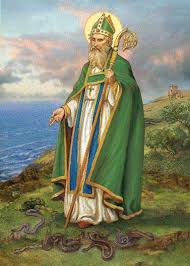
Patrick had a lot of myths grow up about him- he was Irish (he was born in Britain); he brought Christianity to Ireland (he, in fact, was converted while in Ireland); he chased the snakes out of Ireland (Ireland has been snake free since it became an island).

There are a few things that most historians agree on regarding Patrick. He was born somewhere in Britain, sometime around 390 CE. Sixteen years later he was taken captive by Irish raiders, taken to Ireland, and sold as a slave, where he became a shepherd for his owners. He was held a slave for six years, during which time he became an ardent follower of Jesus. (Note: his parents were most likely Christians, and Patrick may have been baptized early in life, but there is no indication that he took it seriously.) After six years of slavery, he escaped and went back to Britain, where he became a priest. He stayed in Britain for 16 years (until he was 38), rising in the ranks of the Catholic church. He then returned to Ireland, to the people who held him captive as a slave, and brought the gospel of Jesus to them in new ways. Many became followers of Jesus, and the country itself changed.

In my meditation time this morning I was reading about having “a great heart.” There is a Buddhist term, bodhichitta, which means “a heart that is noble and awakened, filled with compassion for others so that you feel the pain they feel.” I think it is what Jesus telling us in the Beatitudes in Matthew 5. Otherwise, they do not make sense. I’ve been thinking about people with great hearts. People who see beyond the pain that others have caused, and long for them to find the peace they know, even if it is costly. Stories I read of Corrie Ten Boom, David Wilkerson, Elisabeth Elliot shaped my early life in following Jesus. Watching Martin Luther King, Jr., and Nelson Mandela spurred me on. Patrick, too, leaves me awestruck. Honestly, I do not think I have a heart that wants the best for those who have hurt people. But I want to have that heart.

I find myself singing Johnny Clegg’s Great Heart almost every day. Though it’s not Irish, but African, I think Patrick would like it. He had a great heart.

And I know it is the only way things change.

“I swear on a stack of Bibles…”

Having watched the inauguration and seeing Mrs. Trump hold two Bibles for her husband (one given to him by his mother, the other belonging to Abraham Lincoln), but Mr. Trump not putting his hand on either of them while he was being sworn in as President, I’ve been thinking about Bibles and how we use them in public settings.

There is no requirement to use Bibles for anything in public life. George Washington used one, but Thomas Jefferson did not. Neither did Teddy Roosevelt or Calvin Coolidge. John Quincy Adams used a book of law. Truman, Eisenhower, Nixon, George H. W. Bush, and Obama each swore the oath on two Bibles. Biden’s Bible had been in his family since 1893.

Members of Congress do not use a Bible for their official swearing in, which they do en masse. However, many of them have a second, unofficial swearing in while holding a Bible, mostly as a photo op. Same goes for members of the Supreme Court. If you are called to give testimony in a court you are not required to place your hand on a Bible, though some do give you that option.

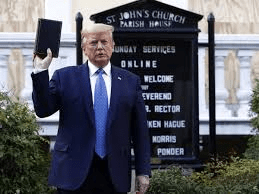
We all remember June 1, 2020, when Trump gave a speech from the Rose Garden encouraging governors to use National Guards to rule the streets and quiet protest, or else he would send in military power to do it, then walked to St. John Episcopal Church and held up a Bible for people to take photos. He did not make a speech there. He just stood and held the Bible.

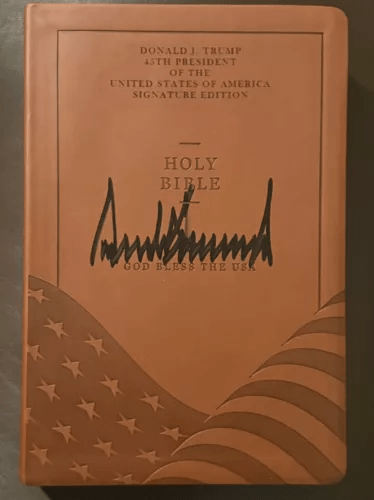
And, we also remember how during the last campaign, he sold a special edition of the Bible as a fundraising tool. By the way, he had those Bibles printed in China at about $3 each and sold them for $59.99. Reported production and shipping costs for the Bibles was $342,000. He hoped to make $7 million but ended up with just around $300,000 for a loss of about $42,000. (You can buy one on eBay autographed by Mr. Trump for $4,700. Or you can get a Bible for free at just about any church you visit.)

It has always seemed odd to me that people would think placing your hand on a Bible would make you more likely to keep your oath or tell the truth. As far as I know, there has never been anyone struck down (“smote” in the King James vernacular) for lying or breaking an oath after swearing on a Bible. And almost all of us can list in great detail the number of people who actually preach from it, declare it to be God’s Word, and swear by it who have not done the simplest things it proclaims.

I have never had the opportunity to ask any of the leaders of our country who have used Bibles in their publicity shots which part of it they believe. The part about stoning adulterers (Leviticus 20:10-12)? Or the part about all debts being forgiven every seven years (Deuteronomy 15:1-2)? How about the part about welcoming foreigners to your land (Matthew 25:31-40)? Or selling all you have and giving the money to the poor (Matthew 19:21-24)?

I have an idea. Let’s do the one thing Jesus said about it. “Let what you say be simply ‘Yes’ or ‘No’; anything more than this comes from evil.” (Jesus, Matthew 5:37)

I swear on a stack of Bibles that this would be best.

January 20, 2025

Well, it’s time for me to tick off a few people, disappoint a few, and most likely lose a few “friendships.” I put that in quotes very intentionally. After listening to today’s inauguration speech, I am more convinced than ever that Trump is president of the United States, but he is not my leader.

I do not say this because of his speech, which, by the way, was the most frightening I have ever heard. I say it because I am a follower of Jesus, one who accepts him as Lord of my life. And for the last 44 years I have become increasingly convinced that you cannot be a person who calls Jesus Lord and serve anyone or anything else.

Let me take you back to my early teen years, when I first decided to follow Jesus.

A side note: you will notice that I rarely, if ever, refer to myself as Christian. That term, which was originally used as a mocking term to describe followers of “The Way” who were being persecuted, has been co-opted by the right-wing political groups in America. “Christian” and “Follower of Jesus” seem to have two different meanings these days. I go with the second.

In my early teens I was pretty much lost in this world and a young ministerial student told me about Jesus. I fell in love with Jesus and decided I would follow him. I remember Jesus saying that you could not serve two gods, that there could only be one. So I took him literally at that and for years I would not say the Pledge of Allegiance. After all, after all, if I pledge allegiance to one thing, it takes precedence over all else. My allegiance was to Jesus.

Then there came a time when people began to convince me that you could have more than one god. That it would be like flags on a flagpole- which one was on top. (Oddly enough, most of those people would say that the national flag should always be on top, with the Christian flag underneath.) I tried that for a while, thinking that I could love Jesus and country, just as long as I loved Jesus just a little bit more.

But a few decades ago, I began to see disturbing things happening in the name of Christianity. It built up to  today when those things showed themselves in the awful prayers that were said at the inauguration. There was hardly anything said in them about what Jesus said was important. And the inaugural speech actually spoke against the very things Jesus said was crucial. “…I was hungry and you gave me food, I was thirsty and you gave me something to drink, I was a stranger and you welcomed me, I was naked and you gave me clothing, I was sick and you took care of me, I was in prison and you visited me…” (Jesus, Matthew 25). It became clear again to me that you cannot partly follow Jesus. He said that in many ways.

I do think that today we saw what will be the end of democracy in America. The good news is that followers of Jesus have lived (and suffered) through times like this many times over the centuries. But the faith continues on. Many great nations, and a few empires, have come and gone in the last two millennia. And as much as I hate to see it, it appears that ours is on the way out. But the people of God, the followers of Jesus, will continue on.

So, while the speech was frightening and the prayers appalling, it has made me more committed to my leader than ever before.