

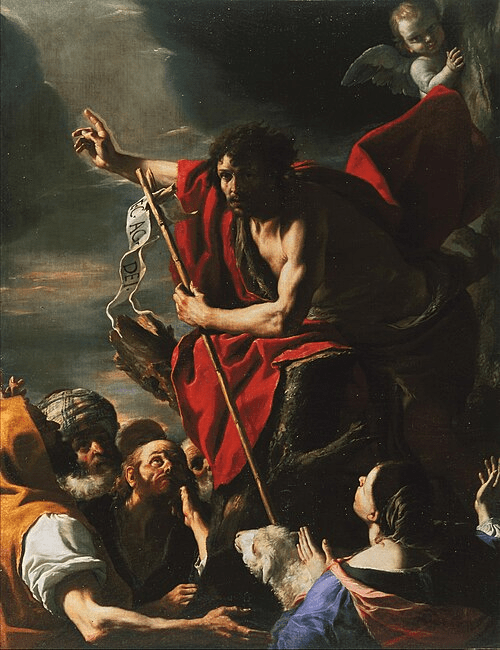
Today, June 23, is the feast day of St. John the Baptizer—or rather, the eve of the feast. Technically, the celebration does not begin until sunset, which is 8:34 p.m. where I am. It is one of only two major saint days in the Christian calendar that commemorate a saint’s birth rather than death. The other celebrates the birth of Mary, the mother of Jesus, on September 8. According to the Gospel of Luke, John was born six months before Jesus, which explains the date.
People observe this day in different ways. In many places, bonfires are lit. Some communities hold parades. Others celebrate baptisms or services for the renewal of baptismal vows. I prefer a quieter observance: reflecting on the saint, considering what I can learn from his life, and finding one practical way to put that lesson into action. Since it is far too hot to build a bonfire here, I took a short walk along nearby Jefferies Creek instead.
John, as you may know, was a fiery prophetic preacher who spoke boldly against the corruption of both the Roman Empire and the religious establishment of his day. He called people away from lives centered on themselves and toward lives centered on God and neighbor. His message can be summarized in five themes.
1. Repent — because the kingdom of heaven is near.
“Repent, for the kingdom of heaven has come near.” (Matthew 3:2)
Repentance does not simply mean feeling sorry for something. It literally means to turn around and head in a different direction. For John, genuine repentance required a changed life. Which leads naturally to his second theme.
2. Bear fruit — live a changed life.
“Bear fruits worthy of repentance.” (Luke 3:8)
A changed heart should produce a changed life. Jesus later echoed this teaching when he said that people are known by their fruits (Matthew 7:15–20). John insisted that faithfulness could not be inherited. He challenged those who trusted in their ancestry:
“Do not begin to say to yourselves, ‘We have Abraham as our father.'” (Luke 3:8)
Faith requires a personal response. No one can believe for us. Which brings us to theme three.
3. Practice justice and generosity — treat people rightly.
John’s preaching was remarkably practical.
“Whoever has two coats must share with anyone who has none.” (Luke 3:11)
Compassion and generosity are marks of genuine repentance.
To tax collectors he said:
“Collect no more than the amount prescribed for you.” (Luke 3:13)
Repentance affects how we conduct our work and handle our finances.
To soldiers he said:
“Do not extort money from anyone by threats or false accusation, and be satisfied with your wages.” (Luke 3:14)
Reject abuse of power. Reject greed. Treat people fairly.
4. Prepare for God’s judgment — take God seriously.
John preached both grace and judgment.
“His winnowing fork is in his hand.” (Luke 3:17)
God cares about how we live. John warned that a day of accountability would come when righteousness and wickedness would be separated. His message was urgent because he believed that what we do matters.
5. Look to Jesus — the Messiah, the Lamb of God, the Son of God.
Above all else, John pointed beyond himself.
“One who is more powerful than I is coming.” (Luke 3:16)
True ministry points people to Christ rather than to oneself.
“He will baptize you with the Holy Spirit and fire.”
“Behold, the Lamb of God, who takes away the sin of the world!” (John 1:29)
“I have seen and have testified that this is the Son of God.” (John 1:34)
“Look, here is the Lamb of God!” (John 1:36)
John taught that Jesus is God’s answer to our separation from God, from one another, and from creation itself. He willingly directed his own disciples away from himself and toward Christ.
Perhaps John’s greatest statement was simply this:
“He must increase, but I must decrease.” (John 3:30)
The faithful servant seeks Christ’s glory rather than personal recognition.
John’s final recorded testimony centers on faith:
“Whoever believes in the Son has eternal life.” (John 3:36)
In many ways, John stands as the bridge between the Hebrew prophets and the ministry of Jesus, fulfilling Isaiah’s vision of “a voice crying out in the wilderness: Prepare the way of the Lord” (Isaiah 40:3; Matthew 3:3).
There is no evidence that John continued baptizing after he baptized Jesus. But he never stopped preaching. He continued to speak the truth, refusing to back down, until it ultimately cost him his life.
Mussorgsky’s Night on Bald Mountain was originally titled St. John’s Eve on Bald Mountain. Inspired by a story by Nikolai Gogol, the music captures something of John’s spirit: the fire, intensity, urgency, and thunder of prophetic judgment. Yet the piece concludes with church bells and a sense of peace. The storm passes. A new day dawns.
Perhaps that is fitting. John’s ministry was never the destination. He was preparing the way for One who would bring a new way of living, a new kingdom, and a new hope.
As for me, I think I will spend this St. John’s Eve looking for something worth standing for. Maybe even something worth losing my head over.


❤️
LikeLike