The Spaces Between the Pictures

I have gone back to school.

Our local university, Francis Marion University, is offering non-credit evening classes for the community, taught by its faculty, for the incredibly inexpensive price of $10 per course. I signed up for two: Photography: Make Not Take Better Photos, taught by Professor Julie Mixon, and Revolutionary War Battles in South Carolina, taught by Dr. Will Bolt.

I have a nice mirrorless digital camera that I know embarrassingly little about, and lately I have been traveling around South Carolina looking for lesser-known Revolutionary War battle sites. So both classes were right up my alley.

Professor Mixon’s first class introduced photography and what she believes makes a good photograph. A good photograph tells us something. It invites us into a part of the world we may not have noticed before. It often raises more questions than it answers. And, at its best, it gives us a new way of seeing the world around us.

She showed us photographs from her travels—landscapes, flowers, and some incredible close-ups of insects. She loves bugs. For our homework, she asked us to think about what makes a good photograph.

I’ve been doing just that.

Ansel Adams famously distinguished between taking a photograph and making one. Even when the shutter is open for only a thousandth of a second, the photographer has decisions to make. What am I photographing? Why? What belongs inside the frame? What should be left outside it? What should be sharp, and what should disappear into the blur?

A photograph may capture only a fraction of a second, but a good one can hold an entire story.

Professor Mixon showed us photographs by Dorothea Lange, whose work documented the human cost of the Great Depression. Nearly a century later, her photographs still allow us to look into the faces of people who endured the Dust Bowl and Depression and wonder about their lives. Her famous Migrant Mother, along with photographs such as Ditched, Stalled and Stranded, does more than record what someone looked like at a particular moment.
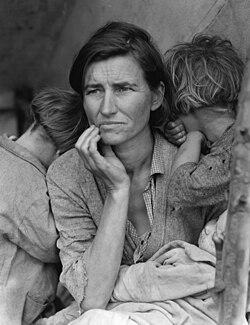
Migrant Mother
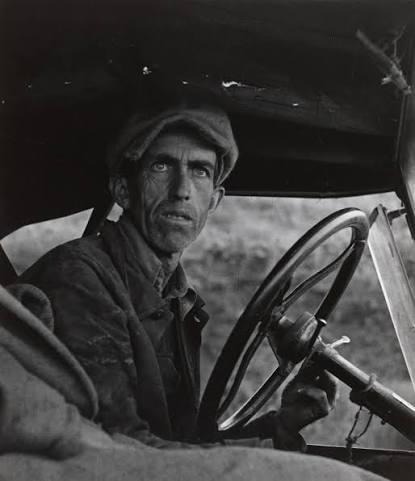
Ditched, Stalled, and Stranded

The pictures make you wonder what happened five minutes before the shutter clicked—and what happened five minutes afterward.

They make you compose a story in your mind.

Years ago, in a previous chapter of my life, I visited a young friend in the pediatric cancer ward of a hospital in Columbia. Most of the patients on that floor were under twelve, and many stayed for long periods.

As I stepped into the elevator, a young woman stepped in with me. She looked to be in her early thirties. She had long, straight hair and wore loose-fitting pants and an oversized, long-sleeved T-shirt. She carried a large bag. Stuffed animals peeked out of the top, along with a few clothes and snacks.

She never looked at me.

She looked at the elevator buttons.

When she saw the floor I had already selected, she didn’t press another button. She simply turned and stared at the wall.

I tried not to stare at her.

I knew nothing about this woman. I didn’t know who she was going to see or what news she had received. But something about her told me she had ridden that elevator a hundred times. She looked tired—deeply tired—but determined. There was a strength in the way she stood there that seemed greater than the circumstances surrounding her.

I wish I could have made a photograph of her.

Not because I wanted a picture of a tired woman carrying a bag of stuffed animals, but because I wish I could have captured that strength. I wish I could have taken a photograph that made someone who had never met her stop and wonder about her story.

Over the years, I have visited many people in their homes, and I have developed a habit of noticing the photographs they display.

Photographs tell so much about us.

And they keep so many secrets.

Most are the expected pictures—weddings, birthdays, anniversaries, vacations, graduations. In that way, the photographs on our walls are a little like the pictures we post on social media. They tend to show the good moments. Everybody is smiling. Everybody is dressed nicely. Everybody appears happy.

But occasionally a collection of photographs tells a deeper story.

Years ago, I visited a family who lived in a small mobile home. On one wall were eight photographs. As best I could tell, they were the only family photographs displayed in the house.

Each one had been made for a church pictorial directory.

You can usually recognize those photographs from across the room. Everybody is wearing their Sunday clothes. The smiles are slightly forced. And somewhere behind them is that inevitable blue background.

Eight of these pictures hung in a row.

The first showed a young couple. They were smiling and looked recently married.

In the second, they were holding a baby. Their smiles were even bigger.

The third showed the couple with a small child and another baby.

Then came the fourth photograph.

The children were teenagers now.

Nobody was smiling.

The mother looked tired. The father looked angry.

In the fifth photograph, the father was gone. Only the mother and her two older teenagers remained. She looked worried.

The sixth showed the mother alone.

She had a slight smile.

The seventh showed her with her two now-grown children.

All three were smiling.

And then there was the eighth.

The mother was gray-haired now. Beside her stood her two adult children, their spouses, and a small baby.

Everyone was beaming.

Eight photographs.

No captions. No explanations.

I never knew the whole story behind that wall, and perhaps that is what made those photographs so powerful. Somewhere between those blue backgrounds there had been love and disappointment, babies and teenagers, anger and absence, loneliness and reconciliation. Some chapters of a family’s life no camera recorded.

But you could still see traces of them.

The pictures told a story.

And so did the spaces between the pictures.

Several years ago, I read about Dale Irby, a physical education teacher in Dallas who accidentally wore the same outfit for his school yearbook photograph two years in a row. His wife dared him to do it again. Eventually it became a tradition, and for decades he appeared in his yearbook photograph wearing essentially the same polyester shirt and sweater vest.

What began as an ordinary school photograph became something else entirely.

It became a record of time passing.

The clothes stayed the same. The man did not.
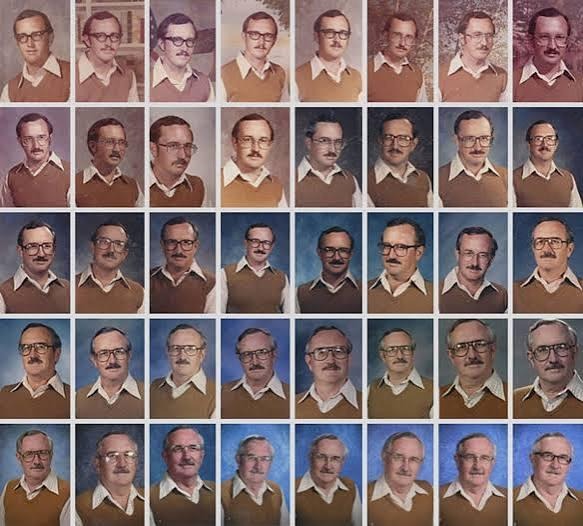
Dale Irby, Prestwood Elementary School, Dallas, TX

Maybe that is part of what photographs do for us. They remind us that the world is always changing, even when we aren’t paying attention.

Today we probably take more photographs than any generation in human history. Our phones contain thousands of them. We photograph our meals, our pets, our grandchildren, sunsets, vacations, birthday cakes, and ourselves standing in front of places we may never visit again.

But strangely, the more photographs we take, the fewer we seem to keep.

We don’t print many of them anymore. We upload them online, look at them for a day or two, and then they disappear into the enormous digital attic of our phones and computers.

Perhaps that is why Professor Mixon’s distinction between taking and making photographs has stayed with me.

I don’t really need to learn how to take more pictures.

I already know how to do that.

I want to learn how to see.

I want to notice the woman in the elevator. The changing faces on the wall. The things most people walk past without seeing. I want to learn to make photographs worth printing and putting somewhere that people might stop and look at them years from now.

Maybe they will wonder what happened just before the shutter clicked.

Maybe they will wonder what happened afterward.

Maybe they will see something in the picture that I didn’t even know was there.

Because it is a big old world, filled with people and places we pass every day without really seeing.

Sometimes all it takes is a camera—and someone willing to pay attention.

Every picture tells a story.
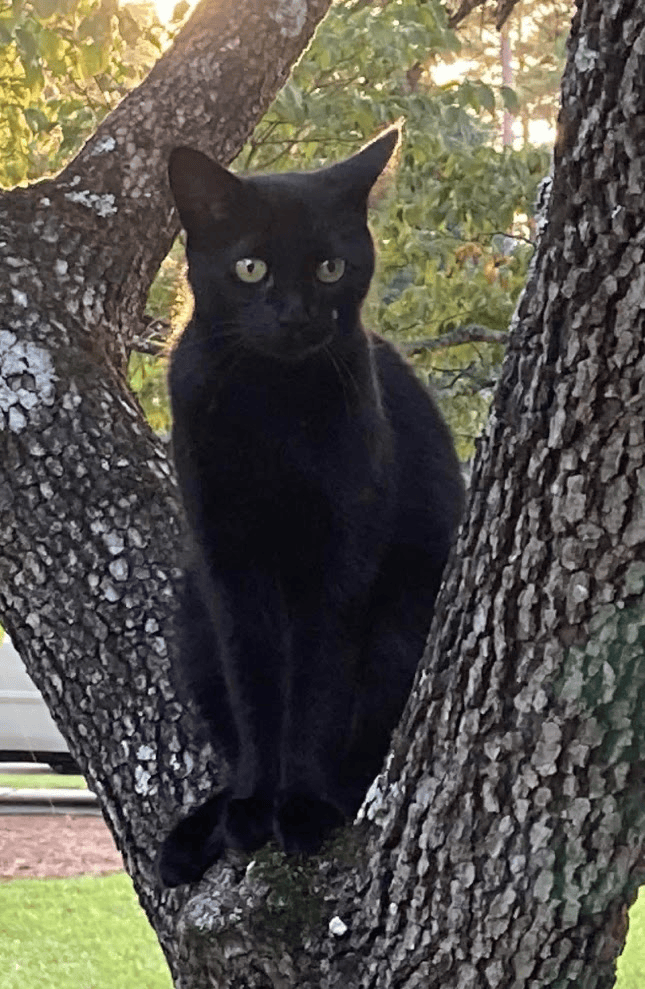
Hampton, my cat, whom I miss
SPANGHEW

Spanghew. This word has made me fall in love again with the English language.

As many of you know, I have a complicated relationship with my native tongue. Compared to other languages, it seems so feeble. For instance, consider the word “love.” The ancient Greeks had a whole collection of words that we now interpret simply as love: agape, philia, storge, eros, philautia, and pragma. We have “love.” “I love my wife. I love my children. I also love Pepsi Zero.”

And so many words we have can mean one thing and the opposite. They are called contronyms. For example, “bolt” can mean to secure something so it can’t be moved, or to run away from something very fast. Weather can mean to wear away, or to endure. Refrain can mean not to do something, while a refrain is something you’re expected to do again and again.

Steve Martin said, “Some people have a way with words, while other people…..not have way.” Even though most of my life has been dealing with words, I find I often not have way. 

Eventually I stopped opening the 20-pound Random House Webster’s Unabridged Dictionary my wife gave me a few years ago. Partly because I had given up on English and partly because the thing is a lumbar injury waiting to happen. 

And then spanghew somehow found its way to me. Spanghew, according to that same dictionary, means “to throw violently into the air; especially: to throw (a frog) into the air from the end of a stick.” 

We have a word for that? 

We have a word specifically for using sticks to throw frogs into the air? 

If I were still preaching, I would have to preach on Exodus 8:1-15 just so I could use the sentence “Egyptians and Jews, everyone from Pharaoh to Moses, spent days spanghewing.” 

There are so many words that I have completely overlooked or misused.

Defenestration- the act of throwing someone or something out the window. “You give me the urge to defenestrate.”

Syzygy- an alignment of at least three celestial bodies in a straight line. “Did you see the syzygy last night?”

Kenspeckle- conspicuous. “Mike’s attire of Dockers and a polo shirt made him kenspeckle at the Boy Harsher concert.”

Maybe I have been too hard on English. Any language that has survived long enough to have a word for throwing frogs into the air can’t be entirely feeble. There are probably thousands of wonderful words hiding in that 20-pound dictionary that I have never bothered to meet. 

And then there is the ever-popular floccinaucinihilipilification: the long, absurd act of judging something to be entirely worthless. Which, dear reader, you may be thinking of using now.

That’s okay. I have some spanghewing to do.

“I fought the law and…”

I was on my way to a meeting. An important meeting. In Columbia. I was thinking about the meeting and all the important people in it. And all the important things we would talk about. That’s when it happened.

I saw the blue lights flash behind me—no need to turn on the siren. I pulled over, turned the car off, rolled down the window, and waited. The officer came up to the window and asked for my license, registration, and insurance info. I have learned to wait until they ask before doing anything. Seeing me reach for the glove compartment (do they still call it that?) while walking up makes the officer wonder, “Is he reaching for something or hiding something?” I unbuckled my seat belt to get my wallet out of my back pocket. (Another thing- always wait until they get there to unbuckle. That way, they don’t ask why your seat belt was unbuckled.) After examining my documents, he said, “Mr. Henderson, you were going 46 in a 30 miles per hour zone.” No argument from me. He was right. He told me to wait a minute while he went to his cruiser. He came back with the ticket. “I’ve reduced your ticket down to 39 and 2 points. You can pay ahead of time or go to traffic court.” He told me the date, time, and address. I thanked him for reducing it. The fine was $76. It would not affect my insurance. At least, not yet.

I decided to go to court. Not because I was contesting the ticket. I was guilty as charged. But if, for some reason, the officer didn’t show up in court, they might dismiss the ticket. And besides, what else do I have to do?

The day for the court came. I was scheduled to be there at 8:15 am. Since Columbia is 60 miles away, I got up at 5:30, left the house by 6:30, drove an hour and fifteen minutes (Columbia traffic at the end slowed me down), found a parking spot, and walked to the building.

There must have been 125 people already there! We were all standing outside, waiting for the doors to open. Most were looking at their phones, busy doing important things. I talked with a couple of people, assuming they were there for the same reason I was. (They weren’t.) Then I started singing Folsom Prison Blues, doing my best Johnny Cash. No one joined in. Then I started Workin’ on the Chain Gang. You could hear Sam Cooke turning over in his grave. People turned and looked at their phones from another direction. I may have been the only person there who was born in the 1900s.

An officer came out and said, “Everyone here for jury duty, form a line to the right.” About a hundred people moved to the right. Including the two I had been talking to about speeding and going to jail—the twenty-five of us not-yet-convicted felons lined up on the left. I looked at the people in the jury duty queue. A few were wearing suits, and most were in casual clothes. One woman was in pajamas. Not cute ones. These you would not wear to Walmart. And she was wearing bedroom slippers.  I thought, “Now there’s someone who will hear a lawyer say ‘Your honor, please dismiss this juror.’”

The jury folks went in first. Then the rest of us did our perp walk in and through the security area. We spread out around the courtroom, more sparsely seated than most churches on Sunday morning. A man went around collecting our tickets. An officer asked us to watch a film in which a judge advised us of our rights. Then the officer said anyone who wanted to take the Traffic Education Program (TEP) could do so. It would cost $285, take 7 hours online, and require 4 hours of community service, which we could do at our local church. Then the ticket would go away. It was a good deal if you had a four-point ticket. He said he would answer any questions, but could not give legal advice. But he mouthed, “But take the course.” About half of the people raised their hands asking for the application.

The judge walked in. Then came three police officers. Mine was not there! I unfurrowed my brow. The judge was very good at going through the cases. She was patient with the offenders, always explaining their options, never losing her temper even when they asked the same thing four times in a row. Finally, my name was called. I approached the bench. “Mr. Henderson, your officer (she said his name) is not able to be here this morning.” I knew she was going to say, “So we are dismissing your case.” Instead, she said, “You can plead guilty or no contest, and I will reduce your fine by twenty percent. Or you can plead not guilty and come back in September. What do you wish to do?”

I threw myself upon the mercy of the court. “I’m guilty, your honor.” “Okay. Your fine is $61. Have a good day.”

I left the room, did the perp walk to the place where you pay the fine, and gave the City of Columbia $61. I did some quick math as I was walking out. I saved $15 on the fine, but paid $16 for gas driving to Columbia and back.  And I got up at the butt crack of dawn to do it.

Walking through the folks standing around as I headed back to my car, I started singing with the Bobby Fuller Four. Or The Crickets. Or The Clash. “Breaking rocks in the hot sun…”

Again, no one sang along.

Ode To Joy

The date was June 3, 1997. Nineteen months earlier, my life had fallen apart (that’s a story for another time). I was now living in the rural community of Oswego, SC, serving a church and healing up. As I rode from the parsonage on Red Apple Lane to the church on the corner of Lodebar and Leonard Brown Roads, I saw a couple of my church members out in their farm fields, taking care of the land. On my left was Billy McCoy, on a tractor, doing something to keep the crops growing. Across the street was his brother, Sam, baling hay. Billy and his wife Stella were leaders in the church and were very supportive and helpful to me. If you rode by their home and saw the front door open, you were invited to stop by. A glass of water or tea awaited you, maybe a snack, but most of all a listening ear, an open heart, and a wise mind if you needed any of them.

When I saw Billy and Sam working, an idea hit me. I called Billy. He answered. “Billy, do you know what day it is?” “Not really,” he replied. “It’s not your birthday, is it?” “Nope. What’s the date?” He thought and said, “It’s the third of June…” and I broke into my best Bobbie Gentry, singing “another sleepy, dusty, delta day…” I slid into those notes like I was sneaking into my house when I was a teenager. “It’s Billy McCoy Day!” I shouted, then resumed singing, “I was out chopping cotton and my brother was baling hay.” Although it was not cotton season yet in Oswego, or down in Mississippi, Billy got it immediately.

Since then, I have called Billy every June 3 and sung part of that song to him. Usually, I get him early in the morning while he is out on the porch with his break-of-day coffee. We catch up with each other, share news of our families, always laugh about things, and promise to keep each other in our prayers.

Today, June 3, 2025, is the 28th time I have called and sung to him. Twenty-eight years of love and support, friendship, and laughter. After I hung up the phone, I realized I was smiling.

Music often expresses the joy we feel. The words may say something meaningful, but the tune frequently speaks in more profound ways. One of Ludwig van Beethoven’s final works was Symphony Number 9, which concludes with his powerful “Ode to Joy.” We often sing that tune in church, saying, “Joyful, joyful, we adore Thee…”

People have different songs to express joy in their lives. Some sing hymns, like “Amazing Grace” or “This is My Father’s World.” For some, it may be an old pop song, like James Taylor’s “Country Roads” or “It’s a Beautiful Morning” by The Rascals. Chris Stapleton’s “Joy of My Life,” Beach Boys’ “Good Vibrations,” and Bobby McFerrin’s “Don’t Worry, Be Happy” all come to mind. For me, today, it’s “Ode to Billie Joe.”

The song itself is not that joyful. It’s rather tragic. Billy Joe MacAllister commits suicide. Something…or someone…was thrown into the Yazoo River. Brother gets married and moves away, Papa dies, Momma doesn’t want to do much of anything, and the singer spends her days dropping flowers off the Tallahatchie Bridge. Have a nice day.

But the song brings back memories of people who loved me, helped me heal, laughed, and cried with me, and a community where I found my wife. Oddly enough, “Ode to Billie Joe” has become my Ode to Joy.

Baby It’s Cold Outside….

Okay, I’m about to lose more friends, because today I’m going to say something that will really tick people off. And that is- I like the cold weather!

There. I said it and I’m sticking to it. A lot of you…okay…well…all of you…are complaining about the cold. Except for my friend Jeff. He’s from Erie, PA. He says, “You call this cold? You don’t know cold!” Many of them are longing for the blistering heat of summer. And that’s okay. It will come around soon enough.

But I like the cold. And here’s why.

  • It gives me an excuse, if I need one, to put on sweats, make a pot of coffee or mug of hot chocolate, sit around the house, and read books, do some writing, maybe watch a movie. Note- I do that anyway, but I don’t feel near as bad about it when it’s cold outside.
  • If I do decide to go outside, I breath in and am reminded that I am alive. I feel the cold air enter my lungs, and sometimes I see it come back out. I like bundling up in layers of clothing until I resemble the Michelin Man. And I like making eye contact with those other brave souls who are out walking dogs, checking the mail, getting some exercise. We all know who are the hardy ones in the neighborhood.
  • And you can always put on more clothes in the cold, while you can only take off a certain amount in the heat.
  • And it gives me the chance to check in with my friends via text to make sure they are okay. I know I could do that anyway anytime, but it seems less weird for me to check in on them when it’s cold. This in itself is good and warming to me because it reminds me of how many friends I have.

I pray for those who have problems with cold weather- the homeless, people without adequate warmth, the sick. And for those with no one to cuddle up to. I try to do things to help them- donating coats, gloves, hats, small heaters, electric blankets. Except for the cuddling. They are on their own.

So, pardon me while I bundle up and go out for a short walk. I love it! Baby, it’s cold outside!

Banished to the outer darkness of….

Most mornings I have a routine. After taking my meds, and getting my coffee, I spend time praying, studying, and meditating. Following that I open up Facebook, and try to lighten some people’s day by posting a bit of Useless Information and a historical event for the day. Sometimes I add commentary, sometimes I just let them stand. Often I will post something else that’s on my mind.

But this morning was different. When I tried to open Facebook, I received a message that my account had been suspended because I had broken Instagram’s rules of conduct. Which really surprised me, since, while I have an Insta account, I never use it. I could not send Facebook a message since I could not get into Facebook. So I wrote one to the folks at Insta.

This is not the first time something like this has happened to me. About a year and a half ago one of my Facebook pages, the one for Vox Memorial UMC, was blocked because we had broken Facebook’s rules of conduct. Which, again, was a surprise because the only thing we ever published was a daily photo with a Bible verse from a subscription service. And it went to both Brown’s Chapel and Vox’s pages. I contacted Facebook. Several times. Never heard anything from them.

It’s odd that they said my Insta account broke the rules, so they were suspending my Facebook account, but not the Insta account.

I fully do not expect to hear from them. Meta, the parent company of Facebook, Instagram, Threads, WhatsApp, and others, does not have very good customer service. But what did I expect? I don’t pay for them (other than what little I buy from those who run adds). But still, you think you’d hear something.

I had the memory of Ernestine, the telephone operator played by Lily Tomlin. In her comedy (but very real life) sketches, whenever she would be handling a complaint, she would  always end with “We don’t care. We don’t have to. We’re the phone company.”

Since I do a lot of communicating with my friends through Facebook, I feel like I have been banished to the outer darkness, where there is weeping, wailing, gnashing of teeth, and definitely no Likes. And I am so used to it, I am having difficulty figuring out how to communicate with them as easily. There are the quotes that I find interesting or thought-provoking (“God does not want to clean us up, but to make us new creations.”), observations around my house (Cathy complains about the squirrels eating all the bird food, but she goes out in the heat of the day to make sure the squirrels have some clear cool water to drink), and letting people know about things I get to see (Dave Mason is coming to Florence at the end of July). None of these will get posted.

I do have a few, not many, subscribers to my blog. But it does not have the flexibility and ease of interaction to replace what I had.

I have several friends who do not use Facebook. Some do not have an account, others have them but rarely use them. And they seem to get by fairly well. As a matter of fact, they seem pretty happy and well-adjusted (not that my FB friends aren’t).

I can always start a new account, using a different email. But that doesn’t help me get back to the literally 1700 “friends” I had on FB. Even more, there are several groups that I am the moderator of, that I can no longer contact. Even if I opened a new account I could not join those groups, because I am the administrator.

So, I think I will be off Facebook for a while. And for those of you who want or need to contact me, you can do it the old-fashioned way. The way we used to do it back in the dark ages.

Text me.