I have gone back to school.
Our local university, Francis Marion University, is offering non-credit evening classes for the community, taught by its faculty, for the incredibly inexpensive price of $10 per course. I signed up for two: Photography: Make Not Take Better Photos, taught by Professor Julie Mixon, and Revolutionary War Battles in South Carolina, taught by Dr. Will Bolt.
I have a nice mirrorless digital camera that I know embarrassingly little about, and lately I have been traveling around South Carolina looking for lesser-known Revolutionary War battle sites. So both classes were right up my alley.
Professor Mixon’s first class introduced photography and what she believes makes a good photograph. A good photograph tells us something. It invites us into a part of the world we may not have noticed before. It often raises more questions than it answers. And, at its best, it gives us a new way of seeing the world around us.
She showed us photographs from her travels—landscapes, flowers, and some incredible close-ups of insects. She loves bugs. For our homework, she asked us to think about what makes a good photograph.
I’ve been doing just that.
Ansel Adams famously distinguished between taking a photograph and making one. Even when the shutter is open for only a thousandth of a second, the photographer has decisions to make. What am I photographing? Why? What belongs inside the frame? What should be left outside it? What should be sharp, and what should disappear into the blur?
A photograph may capture only a fraction of a second, but a good one can hold an entire story.
Professor Mixon showed us photographs by Dorothea Lange, whose work documented the human cost of the Great Depression. Nearly a century later, her photographs still allow us to look into the faces of people who endured the Dust Bowl and Depression and wonder about their lives. Her famous Migrant Mother, along with photographs such as Ditched, Stalled and Stranded, does more than record what someone looked like at a particular moment.
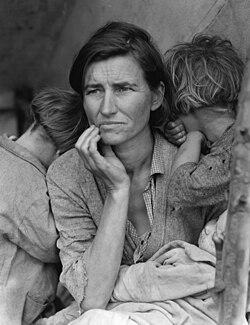
Migrant Mother
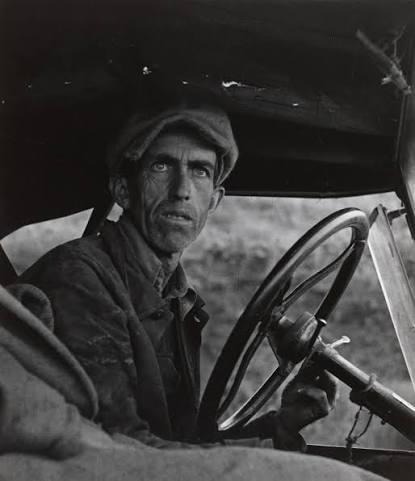
Ditched, Stalled, and Stranded
The pictures make you wonder what happened five minutes before the shutter clicked—and what happened five minutes afterward.
They make you compose a story in your mind.
Years ago, in a previous chapter of my life, I visited a young friend in the pediatric cancer ward of a hospital in Columbia. Most of the patients on that floor were under twelve, and many stayed for long periods.
As I stepped into the elevator, a young woman stepped in with me. She looked to be in her early thirties. She had long, straight hair and wore loose-fitting pants and an oversized, long-sleeved T-shirt. She carried a large bag. Stuffed animals peeked out of the top, along with a few clothes and snacks.
She never looked at me.
She looked at the elevator buttons.
When she saw the floor I had already selected, she didn’t press another button. She simply turned and stared at the wall.
I tried not to stare at her.
I knew nothing about this woman. I didn’t know who she was going to see or what news she had received. But something about her told me she had ridden that elevator a hundred times. She looked tired—deeply tired—but determined. There was a strength in the way she stood there that seemed greater than the circumstances surrounding her.
I wish I could have made a photograph of her.
Not because I wanted a picture of a tired woman carrying a bag of stuffed animals, but because I wish I could have captured that strength. I wish I could have taken a photograph that made someone who had never met her stop and wonder about her story.
Over the years, I have visited many people in their homes, and I have developed a habit of noticing the photographs they display.
Photographs tell so much about us.
And they keep so many secrets.
Most are the expected pictures—weddings, birthdays, anniversaries, vacations, graduations. In that way, the photographs on our walls are a little like the pictures we post on social media. They tend to show the good moments. Everybody is smiling. Everybody is dressed nicely. Everybody appears happy.
But occasionally a collection of photographs tells a deeper story.
Years ago, I visited a family who lived in a small mobile home. On one wall were eight photographs. As best I could tell, they were the only family photographs displayed in the house.
Each one had been made for a church pictorial directory.
You can usually recognize those photographs from across the room. Everybody is wearing their Sunday clothes. The smiles are slightly forced. And somewhere behind them is that inevitable blue background.
Eight of these pictures hung in a row.
The first showed a young couple. They were smiling and looked recently married.
In the second, they were holding a baby. Their smiles were even bigger.
The third showed the couple with a small child and another baby.
Then came the fourth photograph.
The children were teenagers now.
Nobody was smiling.
The mother looked tired. The father looked angry.
In the fifth photograph, the father was gone. Only the mother and her two older teenagers remained. She looked worried.
The sixth showed the mother alone.
She had a slight smile.
The seventh showed her with her two now-grown children.
All three were smiling.
And then there was the eighth.
The mother was gray-haired now. Beside her stood her two adult children, their spouses, and a small baby.
Everyone was beaming.
Eight photographs.
No captions. No explanations.
I never knew the whole story behind that wall, and perhaps that is what made those photographs so powerful. Somewhere between those blue backgrounds there had been love and disappointment, babies and teenagers, anger and absence, loneliness and reconciliation. Some chapters of a family’s life no camera recorded.
But you could still see traces of them.
The pictures told a story.
And so did the spaces between the pictures.
Several years ago, I read about Dale Irby, a physical education teacher in Dallas who accidentally wore the same outfit for his school yearbook photograph two years in a row. His wife dared him to do it again. Eventually it became a tradition, and for decades he appeared in his yearbook photograph wearing essentially the same polyester shirt and sweater vest.
What began as an ordinary school photograph became something else entirely.
It became a record of time passing.
The clothes stayed the same. The man did not.
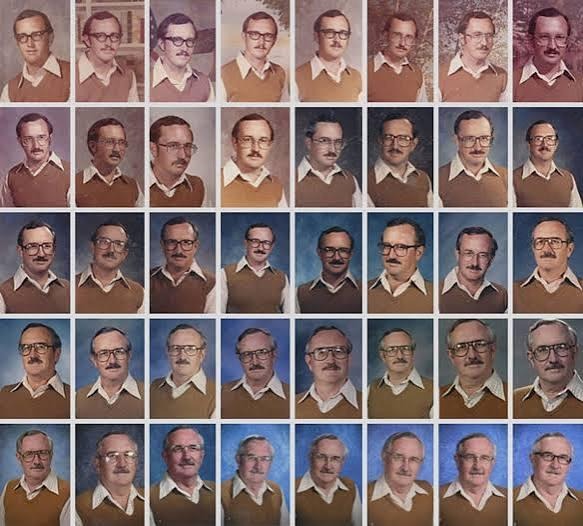
Dale Irby, Prestwood Elementary School, Dallas, TX
Maybe that is part of what photographs do for us. They remind us that the world is always changing, even when we aren’t paying attention.
Today we probably take more photographs than any generation in human history. Our phones contain thousands of them. We photograph our meals, our pets, our grandchildren, sunsets, vacations, birthday cakes, and ourselves standing in front of places we may never visit again.
But strangely, the more photographs we take, the fewer we seem to keep.
We don’t print many of them anymore. We upload them online, look at them for a day or two, and then they disappear into the enormous digital attic of our phones and computers.
Perhaps that is why Professor Mixon’s distinction between taking and making photographs has stayed with me.
I don’t really need to learn how to take more pictures.
I already know how to do that.
I want to learn how to see.
I want to notice the woman in the elevator. The changing faces on the wall. The things most people walk past without seeing. I want to learn to make photographs worth printing and putting somewhere that people might stop and look at them years from now.
Maybe they will wonder what happened just before the shutter clicked.
Maybe they will wonder what happened afterward.
Maybe they will see something in the picture that I didn’t even know was there.
Because it is a big old world, filled with people and places we pass every day without really seeing.
Sometimes all it takes is a camera—and someone willing to pay attention.
Every picture tells a story.

Hampton, my cat, whom I miss