The Death of Edith Bunker

My morning devotions and meditations took me through Numbers 20 the other day. It starts off with the words “The Israelites, the whole congregation, came into the wilderness of Zin in the first month, and the people stayed in Kadesh. Miriam died there and was buried there.”

Miriam died there and was buried there.

That’s it. No mention of mourning. No sorrow from her brothers Moses and Aaron. No family gathering to remember her. No national day of prayer. Nothing.

Miriam, in case you don’t remember, was the older sister of Moses. It was she who watched over the infant Moses in the basket hidden in the bullrushes in the Nile. It was she who convinced the daughter of Pharoah to take Moses’ mother to be a nurse to the “orphaned” baby, thus assuring his survival and his ongoing connectedness to the Jewish people. It was Miriam who danced and sang after the Jewish refugees were safely across the Red Sea, and her song is still sung at Passover celebrations around the world. Her song was a model for Mary’s song, which she sang when told that she would bear Christ.

And while there was one incident recorded where Miriam, along with Aaron, turned against Moses, for the most part when the heroes of the Exodus are mentioned in the Bible, it is always “Moses, Aaron, and Miriam.”

But when she died, there is hardly a mention of it.

When Sarah, the wife of Abraham, died, Abraham mourned and wept for her. He spent lots of time, money, and influence in securing a resting place for her remains. There’s a whole chapter about it in Genesis.

But for most of the women in both the Hebrew and Christian scriptures, there is little said about them when they die. Admittedly, there is not any reference to any of the women saints of the New Testament dying. And other than a few martyrs, there’s not much about the men. But it seems to me that these women need to be reclaimed- their life as well as their death.

I was thinking about all of this when I remembered the death of Edith Bunker. Edith, you recall, was the wife of Archie Bunker on the cutting-edge sitcom, All In The Family. She was also in one season of the spinoff, Archie Bunker’s Place. Edith, played wonderfully by Jean Stapleton, was the one who loved Archie, her daughter Gloria and son-in-law Michael. She cared for them, tried to keep them at peace with one another, took all of Archie’s verbal abuse and seemed to turn it around by her gentle spirit. She basically held the family together. When the character died at the beginning of the second season of Archie Bunker’s Place, there were a few references to her. Archie refused to accept the death benefit from her life insurance policy, and finally broke down and cried upon finding one of her shoes. But other than that, she was gone. Out of the show, out of the picture.

I’ve been thinking about the women who have made such an impact on us. Perhaps it is because this is the month of my mother’s birthday. Maybe the deaths of some dear female friends over the past year have sunk in. Whatever it is, I know this- we need to pay attention. None of them…none of us…last forever.

The Song Is Wrong

Music shapes and reflects most of my life. On great days, when the sun is shining and it’s a warm spring day, you’ll hear me singing “What a day for a daydream….” (For those of you born after 1980, that was a song by The Lovin’ Spoonful.) On hard days, sad days, you’ll hear me singing “Listen to the rhythm of the falling rain…” (Again for you folks still in the first half of life, that was a song by The Cascades. A later version was a hit by Dan Fogelberg.)

I grew up listening to hymns on Sunday morning TV as we got ready to go to church and sing some of the same hymns. The Blue Ridge Quartet, with the great bass singer J. Elmo Fagg (and we all loved to say his name) was located in Spartanburg, and showed up on WSPA every Sunday morning, starting the day with “This is my story, this is my song…”

As a teen I was into folk and rock music, but somewhere in my soul, there was a deep place for Appalachian music. And the song/hymn Jesus Walked This Lonesome Valley, a conflation of Appalachian folk and American Negro Spiritual lives in there. It has an almost mournful tune, and the words speak of having to face the trials and struggles of life alone.

Jesus walked this lonesome valley;
he had to walk it by himself.
Oh, nobody else could walk it for him;
he had to walk it by himself.

A later verse personalizes it.

You got to  walk this lonesome valley;
you got to walk it by yourself.
Oh, nobody else can walk it for you;
you have to walk it by yourself.

It is the perfect American tune, with American lyrics, expressing American values. Life is a struggle and we have to face it individually. Nobody else can do it for us.

There’s enough truth in here to make it work. We face things that no one else faces. Our struggles are ours, and each one is different from the other. A popular saying going around right now says, “Be kind to everyone you meet. They have some struggle going on that you do not know about.”

But, while we must walk this lonesome valley, we do not have to walk it by ourselves. We are not meant to walk it alone. Even Jesus did not do that. On the darkest night of his life, as he faced his impending execution at the hands of the state, Jesus asked his three closest friends to stay with him as he prayed. They kept falling asleep as he did so (it had already been a long day and night for all of them), and he was disappointed and hurt because they couldn’t be with him as he struggled with what was about to come. He did not want to be alone. A while later, after being beaten and tortured by the state, he was made to carry his cross. But he couldn’t do that alone. He needed the help of someone else, Simon of Cyrene, to carry it for him. And from the cross, he looked for his friends. He found his mother, John, his aunt, and a couple of other Marys. (John 19:25)

Jesus wanted and needed someone to be with him. So do we. Even the idea of God as a Trinity tells us that we are not made to go through this life alone. The song is wrong.

I’ll probably still sing it from time to time. It is in one of the United Methodist songbooks, The Faith We Sing. I love the tune, and even the sentiment.

But I don’t want to walk this valley alone.

Taking A Break From The How

Sometimes I get so caught up in understanding the how of things that I lose the beauty of them. As Wordsworth says in his poem The Tables Turned, “We murder to dissect.”

In the classic rock and roll song, aptly titled Rock and Roll Music, Chuck Berry laments people trying to change the music, to make it better, to make it something other than what it is. To control it rather than to sing it, dance to it, just enjoy it.

Maybe I do that too much with life.

Lest you think this is a rant against science, knowledge, linguistics, etc., be assured that I have all the curiosity about the world that most people have. Maybe even a little more, seeing as how I tend to question most things. And I appreciate what others have done to make this world a better place.

But there comes a time to just enjoy what is around us, and I am really trying to do just that. To take in the sights, sounds, tastes, sensations, smells of this world. The old saying (and song by Mac Davis) says “You’ve got to stop and smell the roses.” Unfortunately, it turns out, most roses today don’t have the sweet smell, or any odor, they used to have. In order to make them more durable, we ended up genetically removing the things that made them put out that well-known aroma. Try stopping by the flower section in your local supermarket or flower shop and sniff those beauties. Might as well sniff a package of frozen corn kernels. People today would not understand Shakespeare’s Juliet opining “A rose by any other name would smell as sweet.” As sweet as what? A plastic plant from Walmart?

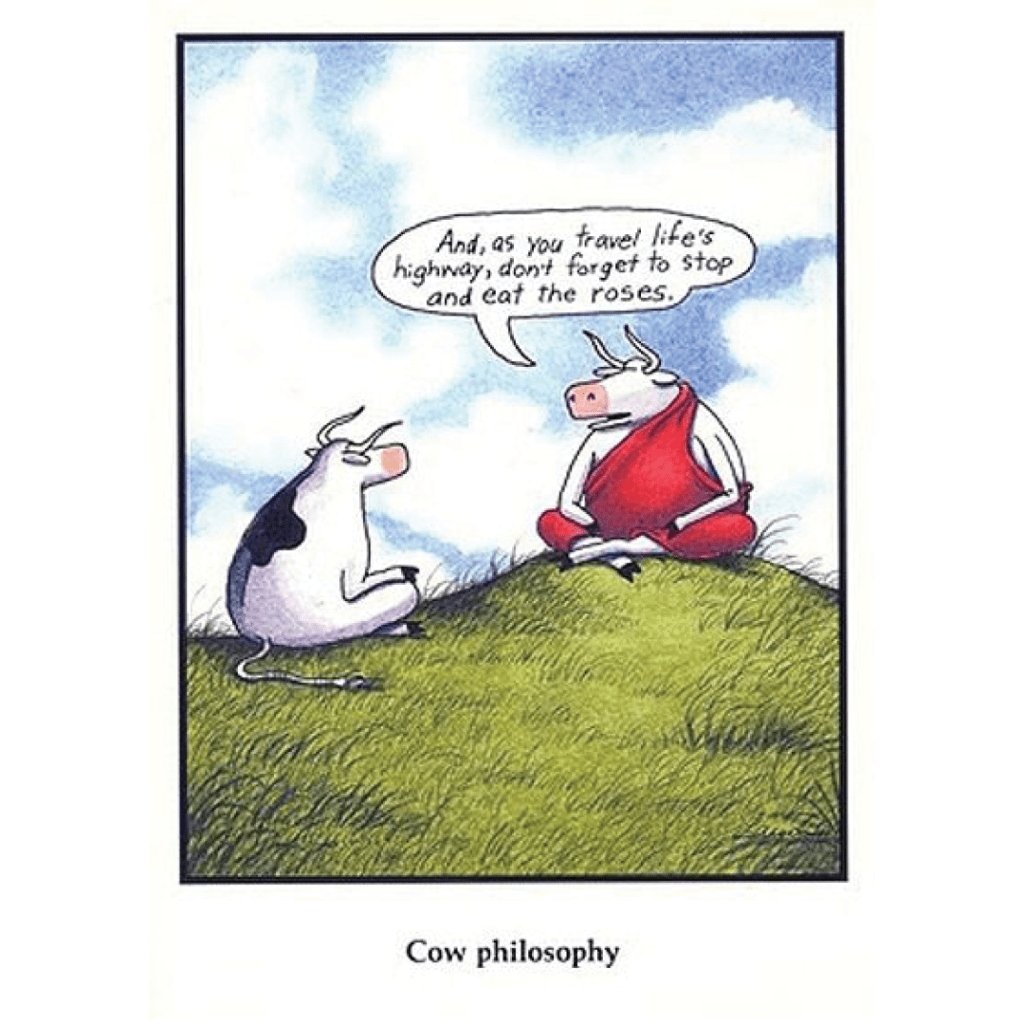
Gary Larson’s take on this was “Cow Philosophy”- “You’ve got to stop and eat the roses.” Wonder if they still taste the same?

The point of it is, every now and then we need to walk in the woods and just enjoy the experience. “Forest bathing” is what the Japanese call it. We need to hear music and let it move us rather than analyze it. We need to slow down and taste food that does not taste like the cardboard container it came out of. We need to jump in the puddle just because it’s there.

As Wordsworth wrote:

One impulse from a vernal wood

May teach you more of man,

Of moral evil and of good,

Than all the sages can.

Excuse me now. I think I’ll go take a walk through Lucas Park.

Ridin’ Along On A Carousel

Steve Vassey’s Watchin’ for Rainbows has a reflection on carousels. (He uses the alternate spelling carrousel, which is fine. He’s published; I’m not.) He compares it to life- some go through laughing with the wind in their hair, others with a grim determination to make it through this tough time, and still others scared, eyes closed, holding on for dear life.

While reading it, I kept hearing in my mind the song by The Hollies, On A Carousel. (Lyrics and a link to the song are below.) I decided to look up the lyrics and found at least twenty different songs with the title Carousel. There were dozens more that referred to carousels. Artists and groups like Melanie Martinez, Travis Scott, Miranda Lambert, Blink-182, and Abba all had songs titled Carousel. And then there was an entire Rodgers and Hammerstein musical Carousel. The American songbook songs If I Loved You, June Is Bustin’ Out All Over, and You’ll Never Walk Alone came from it.

Almost all the Carousel songs speak of heartbreak, frustration, and being unable to get off the carousel. Vassey says we can choose how we ride this thing.

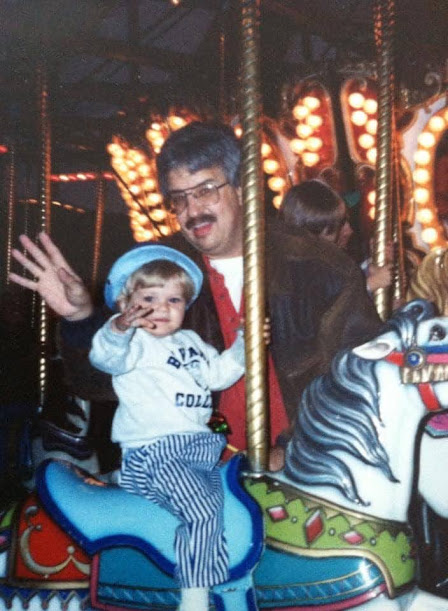
One of my favorite photographs of my niece Megan comes from when she was about 2. She’s riding the carousel at Columbiana Mall, in Columbia, SC. I am standing beside her, making sure she doesn’t fall of the horse she chose. She’s waving at the people standing around the carousel as she goes by because she thinks they are waving at her and cheering her on. In fact, they were. She was enjoying the ride, smiling, sometimes laughing, and not crying or screaming like some of the other small children. And people were cheering her on. Even though they did not know her, they were happy she was enjoying the ride.

There’s a lesson here somewhere.

PS- Thirty years later she has grown into a beautiful, responsible, intelligent, and compassionate woman. And though we do not get to see each other much, I can’t help but believe people are still waving and cheering her on.

On A Carousel– written by Graham Nash, Allan Clarke, Tony Hicks

Riding along on a carousel

Trying to catch up to you

Riding along on a carousel

Will I catch up to you

Horses chasing ’cause they’re racing

So near yet so far

On a carousel, on a carousel

Nearer, nearer by changing horses

Still so far away

People fighting for their places

Just get in my way

Soon you’ll leave and then I’ll lose you

Still we’re going round

On a carousel, on a carousel

Round and round and round and round and round

And round and round and round with you

Up, down, up, down, up, down too

As she leaves she drops the presents

That she won before

Pulling ducks out of the water

Got the highest score

Now’s my chance and I must take it

A case of do-or-die

On a carousel, on a carousel

Round and round and round and round and round

And round and round and round with you

Up, down, up, down, up, down too

Riding along on a carousel

Trying to catch up to you

Riding along on a carousel

Will I catch up to you

Now we take our ride together

No more chasing her

On a carousel, on a carousel

On a carousel, on a carousel

Noun or Adjective?

Is the word “Christian” a noun or an adjective? I know, it is used as both. Dictionary.com says it is both. But, as all-knowing as the internet is, I beg to differ.

As a word, it started in the town of Antioch, in what is today known as Turkey (in the first century C.E. it was part of Syria). Paul and Barnabas, two early followers of Jesus, had gone to that town to teach the new followers of Jesus. There they were first called Christians. And the word meant “little Christs.” That was because they acted like Christ. So I think the word is primarily a noun.

A noun is a name given to a person, place, or thing. (By the way, whenever I hear the term “person, place, or thing” I hear Linda Ronstadt and the Stone Poneys singing Different Drum.) An adjective is a descriptor attached to the noun. “A red car”- “red” is the adjective, “car” is the noun.

However, it seems that Christian is used more as an adjective today than a noun. We have Christian music, Christian books, Christian movies, Christian license tags, Christian jewelry, Christian t-shirts, and even use the term “Christian nation”. But it seems hard for me to think of music, books, movies, t-shirts, etc. being “little Christs.” Jesus said that those who followed him would need to take up a cross every day (a cross is something that not only kills the bearer, but it redeems the world), and I just don’t see a movie doing that. Nor a song. Nor a roll of peppermints. And especially I don’t see any nation doing that.

The term has been co-opted in our society today and come to mean politically conservative. This is strange because the conservatives of Jesus’ day were the ones who crucified him. They were the ones who stood for law and order, who wanted the ways of the Empire to rule, and wanted “that old time religion.” Out among the general public, the term Christian has come to be associated with judgmentalism, condemnation, and greed.

There are lots of examples of other things. Hospitals, colleges, children’s homes, homeless shelters, places protecting abused people have all been started in the name of Christ. There are a lot of St. Joseph, St. Mary, St. Jude hospitals. Haven’t seen a Friedrich Nietzche Clinic for the Indigent yet. But these seem to be overlooked by most of society today.

I have found that when I use the term Christian for myself, most people make some pretty strong false assumptions about me. Without going into all the details, let’s just say they don’t fit me.

Instead, I use the term “follower of Jesus.” Which is an older term used to describe the disciples of Jesus. Before they were called Christians, they were called Followers of the Way. This was based on Jesus’ statement that he was the way, the truth, and the life. So I use that term. I follow Jesus. I go where he goes, I do what he does. Or, at least I try.

And follow is not a noun or adjective. It is a verb.

Names

I found an old copy of The Virginian. For those of you who may only know it by the old TV western, The Virginian was written by Owen Wister and published in 1902. It had the iconic line in it, “When you call me that, smile.” Later it was adapted to “Smile when you say that.” It was not meant to be a funny line. It was a threatening line based on calling someone a name.

Names mean something. Parents will spend a lot of time deciding what to name their child. That name often gives an image to other people of who you are. Some of those images are true, others are far from it.

After my parents divorce, when my mother finally decided to trust men again, at least a little, she dated a man named Dex. Dex is a cool name. When she told me she was dating someone named Dex, I couldn’t wait to meet him. (I was off at college.) I imagined he was a trendy, modern type of guy. The kind who drove a pony car, never wore a tie, and was always ready with a great remark. I was home one weekend and ready to meet him. IM told mom I thought it was a cool name, Dex. She said, “Yeah, it is. It’s short for Poindexter.”

Poindexter! That changed  my image immediately. I now thought of someone with a pointed nose, oversized glasses, and a pocket-protector. He drove a four-door sedan that was 8 years old, and had no idea about rock ‘n roll music.

Turned out he was neither of the images I had. He was a good guy, treated my mother well, wasn’t super-cool but wasn’t a complete nerd. I know today people would think of Dexter, the TV show serial-killer-of-serial-killers.

Names mean something.

I’ve met a lot of Methodist ministers named John Wesley _____. Did those first two names lead them into ministry? Martin Luther King, Jr., named for his father, named for the great reformer. And what did Jr. become? The great societal reformer.

I’ve met lots of Joshuas, Davids, Matthews, Lukes, and Johns. I’ve yet to meet a person named Judas. Lots of Marys. No Rahabs.

Several times names were changed in the Bible. Abram, “Exalted Father”, became Abraham, “Father of Multitudes.” Hoshea, “Savior”, became Joshua, “God saves.” By the way, in Hebrew, the name Joshua and Jesus are the same. Simon, “One who listens,” was christened by Jesus with a new name, Peter, “Rock,” as in foundation.

My parents named me Michael Bernard. At first I thought I might have been named after an older cousin, but found that was not the case. It was just a popular name. As a matter of fact, for the first 45 years of my life Michael was the most popular boys name in America. That was more of a curse than a blessing. When I would be in a crowded place and someone would call out “Mike!” I would turn to see who it was. Usually it was someone calling another Mike. Michael means “Lover of God” and Bernard means “Bold as a bear.”

Frederick Buechner wrote that Moses asked voice at the burning bush, “Who are you?” and the voice gave the answer YHWH (Yahweh, or The Lord), thus giving a name to the One who was above all names. Buechner said God hasn’t had a quiet moment since.

The apostle John wrote in the Revelation that God will give us a new name. (Revelation 2:17) I wonder what mine will be. It really doesn’t matter though, as long as God smiles, a good smile,  when he says it.

Holy Ground

I’ve been wondering why God told Moses to take off his shoes because he was standing on holy ground there at the burning bush. Why would you need to take off your shoes?

I’ve studied the commentaries and read what others have written and haven’t found anything that rings true.

But I have an idea.

All of creation- the earth, sky, seas, etc.- were made by God and belong to God. The psalmist says this in Psalm 24. (By the way, it includes ALL the people.) I was raised by teachers who told me that the earth basically belonged to Satan, which was why he could offer it and all the kingdoms of the earth to Jesus. They did not remember, it seems, that Satan was also called “The Prince of Liars.” They also taught me, along with many preachers, that one day God would destroy all of creation and create a new, revised one. Creation 2.0.

But I also heard something in a song that we sang in church, and it was what I really believed. Still do. I would sing with all my heart and voice, “This is my Father’s world…” And I swear that at times “in the rustling grass I hear him pass, he speaks to me everywhere.”

But we ten to separate humankind from the rest of creation. We are somehow above it, which is why we can use it, abuse it, even destroy it with little or no remorse.

We have lost touch with the rest of creation. We think of Francis of Assisi as being cute when he referred to nature as his brother and sister, mother and father. But he wasn’t being cute. He knew we are all one family. We are made of the same thing that the earth is made of. We are made of what makes the ground below us and the stars above. Joni Mitchell, a modern troubadour of truth, sang it well- “We are stardust, we are golden. We are billion-year-old carbon. And we’ve got to get ourselves back to the garden.” There’s a reason why, even in our biggest cities, especially in our biggest cities, we put in lots of parks.

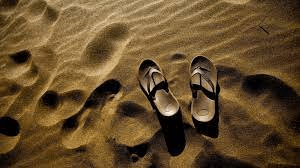
Taking your shoes off puts you directly in touch the the rest of creation. I heard a Native American speaker (Cherokee, I think) say that before Europeans came to this continent, when the people would pray they would stand in a circle and not hold hands, because they knew they were already connected through the earth they stood on.

I’m not thinking we have to take off our shoes when we want to pray or when we want to be in God’s presence. But whenever we want to pray, want to be in God’s presence, want to hear God’s word to us today, maybe we should dive deeply into this world. Get back in touch with our brothers and sisters in creation. Walk through the forest, wade in the ocean, live in the city with the poor, stand in the muck of the battlefield and pray for peace.

Because when we do, we are standing on holy ground.

50

some reflections on my college homecoming

I just returned from my fifty-year college reunion at Brevard College. (Note: At the time I was there, Brevard was a two-year school. It is now a four-year school and is beginning to include some masters level degrees.) I was in the class of 1973. Yep, I am old. But I don’t feel that way.

While I have been to the college, town, and area many times over the last half-century, I have not gone but to one reunion. So, this was a big one for me.

In some ways, it was disappointing. Out of a class of around 170, about 25 showed up for one part or another. I spent time with my friend Rick and his wife, and saw my first ever college roommate, Thurman, for the first time in fifty years. I had hoped to see some of my other friends- Jean, Tom, Hal, Bob, Eric, Rick, Connie, Debra- but alas, they were not there. I knew a few of the people who did show up, though none were friends back in the day, nor now. A few came up and spoke to me and we told the major details of life- where we are living (Florence), what we did for a living (clergy), if we were retired (yes), and how many grandchildren we have (none). The school had made nametags for us with our photos from the yearbook, to help us remember who each person was. People would go up and look at your nametag, then your face, and say something. For me, the thing I heard the most was, “You still have a lot of hair!” My claim to fame. I would start to say, “Yeah, and I can occasionally drive at night, too!” But I usually just said something like, “Your smile has not changed. Life must have been good to you.”

One of the many reasons I went to Brevard College was that I was the only person I knew going there. I was ready to try to be someone other than who I had been in high school, and this would be my canvas.  Brevard- the faculty, staff, administration, students, and community- encouraged it. So, I began to travel my own path. That almost didn’t work out for me when “traveling my own path” meant coming home at Christmas and getting my grades with a 1.8 GPR. A lot lower than it was when I entered. I also had a letter from the Dean of Students saying if I did this again. I didn’t get to come back.

By the way, my mother was incredibly good about it. She looked at the grades and letter and said, “Mike if you want to go off for a year and waste a year of your life and all the money you have worked so hard to save for college, then come back here and be a lint-head, that’s okay with me. But you need to know, you’re not coming back HERE.” I got the message.

I returned to Brevard, made appointments with each of my professors, told them I didn’t know how to be a student, and every one of them helped me to learn how. Not just how to pass the courses, which I did, but how to be a lifelong learner. It was one of many second-chances I was given at Brevard.

As I said, we were all encouraged to travel our own paths. Mine did not include many people. I just seemed to walk a path that was less crowded. I don’t believe that everyone else was just following along with each other, but they did seem to have more companions along the way. Nevertheless, those in attendance, for the most part, tried to make conversation with me. One woman just could not place me. She really tried, asking if I were in music, or sports, or arts, etc. She really wanted to remember who I was. I told her not to feel bad, I was mostly in the background of things back then. However, a few people came up, looked at my name tag, then looked at my face, and walked away. They probably didn’t know me back then. Or maybe they did.

I fell in love a few times during those two years. I fell in love with the mountains- the views from the crests, the quietness of the wooded paths, the always-changing but always-the same light on them. I wanted to walk every path in that part of the Pisgahs, and I managed most of them. I fell in love with words- their power to move, to recall, to bring both tears and laughter, to give a vision of what could be. I fell in love with ideas- how the world might be better, how much good there was already in it, and what was important in life. And being 18 and 19, I fell in love with a beautiful woman. And being 18 and 19, proved I was a real jerk at it.

I noticed a few other things this time up there. Cathy and I walked through some of the stores in Brevard. Some of the art stores and outdoor outfitter stores. There were things that years ago I used to wish I could have but could not afford. Today, I could buy just about anything I wanted, but there was not much that I wanted. I noticed that in times past, when I would go up to the mountains I would want to do and see as much as possible. My thought was, I may never pass this way again. Now I do not feel that way. Instead, I wanted to do a few things and enjoy them deeply. William Least Heat Moon’s first book was Blue Highways, which he called a “wide map” of America (he traveled over the country on the smaller roads). His second book was PrairyErth, in which he walked over all the roads and lanes in Chase County, Kansas. He called the second one a “deep map.” I have moved to the deep map time of my life.

I noticed that I really missed the smell of fall in the mountains, the hopefulness of new college students (the ones working the alumni weekend were great ambassadors for BC), and the gratitude for all the things Brevard offered me.

Over the last fifty years I have sent maybe a dozen students to BC. They were students who, like me, had some potential but needed a place to travel their own paths. I hope they found theirs, and that when their time comes to go back, they, too, will be grateful.

Windows

I love listening to Rudy Mancke. Not only does he have a great voice, very calming, but he has tremendous knowledge and love for this world. The former award-winning host of NatureScene and the current host of the daily SCEPR daily one-minute broadcast NatureNotes gives us insight into this world around us that we might not know if it weren’t for him. He answers questions, identifies plants and animals, makes observations about the change of seasons, and occasionally reads poems that make us see the natural world with new eyes. Sometimes I think his NatureNotes is just stream-of-consciousness. He just seems to go where his mind wants to go. He’ll say something like “I walking by the Congaree River and I thought about the tendency for rivers to eventually have their way….” And from there he’s off for the next 60 seconds. I would not be surprised to hear him say one day “I was looking out the window the other day and I thought “Windows! What a great way to see what’s on the other side of the wall without actually having to go to the other side of the wall. Before windows, you had to go around the wall or through a door to see the other side. But now, all you have to do is look through the window!”

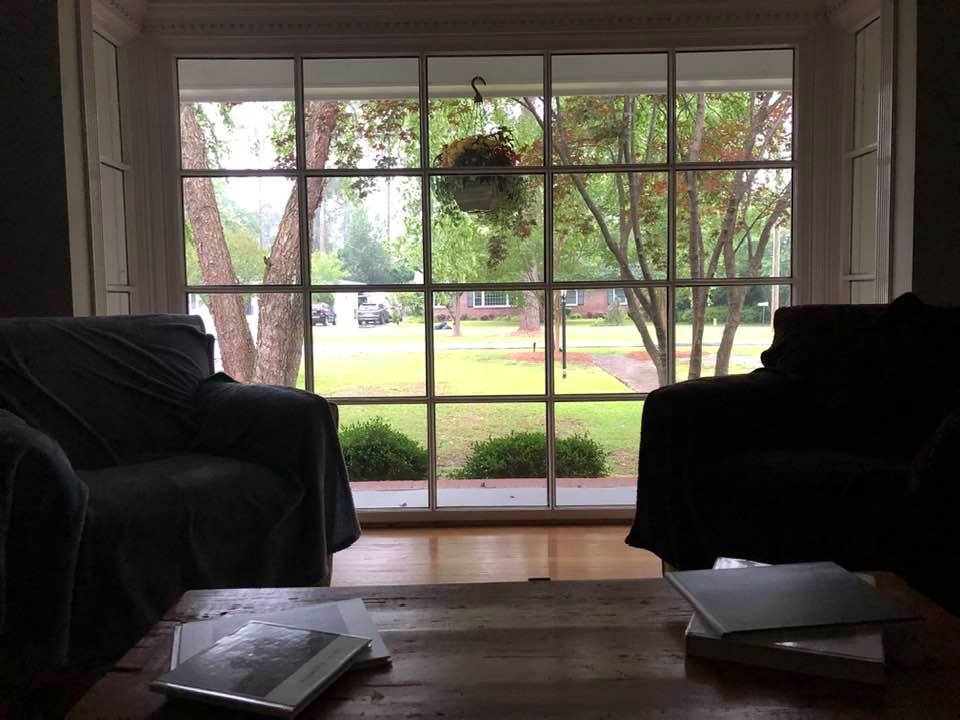
Which actually is the point of this wanton rambling of mine. Windows not only help us see what’s on the other side, they shape what we see. I have a lovely bay-style window in the front of my house. It gives me a view of the front yard with its trees, lamppost, walkway, shrubbery, and cats. I can see the people walking down the streets early in the morning and the kids in the neighborhood playing after school. Parts of my world pass by that window every day and I see it framed by the panes of glass.

The window in my study looks out at the wall of my neighbor’s home. That view never changes. There is a brick wall, a window, an electric meter, and some vines that never lose their leaves. If I were to view the world through that window alone, I would think it never changes.

Years ago I was in the hospital in Garmisch-Partenkirchen, Germany. From the window there I could see the Alps that surrounded the town. There was the Alpspitze, a very dramatic, pyramid-shaped mountain, and the Zugspitze behind it, the highest peak in the area. You could just make out the ski runs, and the cogwheel train, along with the beautiful alpine village at the base. I believe the view helped me to recover faster.

Compare that to the time I spent in isolation at McLeod Hospital in Florence, SC during a bout with COVID. The room, which was barely larger than the bed I was in, had a window that looked out at a blank wall. Nothing else. That view, along with my isolation, did not make me a very congenial patient. To be fair to McLeod, the hospital was full and every available space had to be used. Later I was placed in a spacious room, with a window that viewed the expanse of the Pee Dee region. I became a better patient and began to heal faster.

There are all kinds of windows in our lives. Some are physical, like the ones I just described. Others help us to see in other ways. All of them shape our lives more than we know. If we watch lots of news shows that tell us about conspiracy theories as if they were real, we begin to see the world with suspicious eyes (to paraphrase Elvis Presley). If we watch crime, war, and violence, we see the world as a harsh place. If we see acts of compassion and kindness, if we look at the advances in medical science and the increased lifespan of most people, if we see the work toward peace and justice, we view the world quite differently. A friend in one of my churches says, “Every day is a good day.” He sees the world that way, and it is for him.

Some folks like to pray and see the world through religious icons. I have not been able to do that very well, but I know some for whom an icon is a window through which to see the world. Those who know me very well know that for the last few years, I have been studying the lives of the saints. Through their lives, I see God and the world in new ways. Francis of Assisi helps me see God in all of nature around me. Teresa of Avilla lets me see God as a Divine Lover, and Brendan gives me a view of the world as a place to venture into the unknown.

Rudy Mancke helps me see the wonder and intricacy of my own backyard. I wonder what people see when they look through the window of my life?

Long Nights – A Meditation on Psalm 131

I read a psalm every morning as part of my morning prayers. I go through them starting at 1 and ending at 150 and then starting at 1 again. I was up early this morning (December 20, 2022), before the sun came up, reading Psalm 131. Here’s the text:

O Lord, my heart is not lifted up;
    my eyes are not raised too high;
I do not occupy myself with things
    too great and too marvelous for me.
But I have calmed and quieted my soul,
    like a weaned child with its mother;
    my soul is like the weaned child that is with me.

O Israel, hope in the Lord
    from this time on and forevermore.

This psalm may be perfect for today and tomorrow- the longest nights of the year. There is a sadness in this psalm. The author does not raise their eyes too high.; they do not think about things ‘too great and too marvelous.’

Instead, they sit in quietness and calm. The author uses the metaphor “like a child weaned from its mother” and goes on to say that their soul is like a “weaned child that is with me.”

When a child is weaned, when they no longer feed on their mother’s milk, something of the intimate bond between the mother and child is broken. The love and need each have for the other is there, but the nourishment for the child comes from somewhere else. While it is necessary, it can be a disquieting time.

For many, these long nights can be hard. Missing loved ones who have died, seeing dreams you had for this past year not come to be, watching your body become less responsive to health, feeling the pain of broken relationships, and often acknowledging your own culpability in hurting yourself and others. All the while the rest of the world seems to be lifting their eyes high, gazing on things great and marvelous. Our soul seems disconnected from us. It sits beside us, on the couch, not saying anything, just looking ahead.

The psalmist does not abandon us there. “O Israel” the psalm continues. ‘Israel’ literally means ‘one who struggles with God.’ That’s us. From time to time we all struggle with God. We want to know why things are the way they are, and if they will always be that way. The psalmist says, “You who struggle with God, hope in the Lord…” Hope is not wishful thinking. It is not fanciful desires. It is not shaking the small box under the Christmas tree and saying “I hope it’s a bicycle.” Hoping in the Lord is placing your trust in something….someone….you cannot see, and moving forward as best you can.

Are you struggling this season? Does your soul seem to be separated from you? Are you struggling with God? That’s okay. Do not despair. Hope in the Lord from this time on. And forevermore.