St. Maximilian Kolbe, August 14

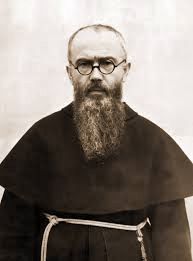
Today, August 14, is the Feast Day of St. Maximilian Kolbe. He was a Polish priest. As a young man, he had witnessed his father murdered by the Russian authorities for fighting for an independent Poland. During World War II, he started a newspaper that stood against the Nazis, and later started a radio station that broadcast against them. He was captured and put into the concentration camp at Auschwitz. While there, he was subjected to beatings and torture for ministering to the inmates. Near the end of July 1941, an inmate escaped. To discourage these attempts, the deputy camp commander picked ten men to be starved to death in an underground bunker. As they were being taken away to be slowly killed, one of the men, Franciszek Gajowniczek, cried out, “My wife! My children!” Kolbe volunteered to take his place.
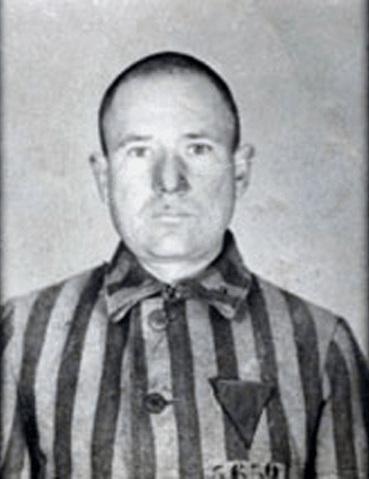
Kolbe constantly led the men in the cell in prayer. Every time a guard came to check on them, he would either stand in the middle of them or kneel with them in prayer. After two weeks of no food or water, only Kolbe and three others remained alive. The guards wanted the bunker emptied so they could use it to torture others. The remaining four were given injections of carbolic acid. Kolbe, it is said, held out his left arm and calmly took the injection. He died on August 14, 1941, and was cremated on August 15 (the Assumption of Mary date). Gajowniczek survived and lived until 1995.
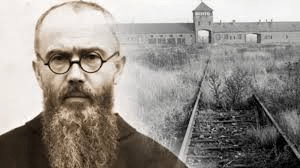
The story of Kolbe’s life has much more in it than I reported here, and is worth studying. He is the patron saint of amateur radio operators, journalists, and political prisoners.

To be canonized, there had to be a miracle attributed to him. While there was one, the real miracle was his life.

I said a prayer in his name this morning as I listened to news reports of “Alligator Auschwitz” in Florida, and how other states, including my own, South Carolina, are vying to make more of them.

May God forgive us for what we do.

A Penny For Your Thoughts?

The cost of thoughts is about to go up. The US Treasury Department has announced that after the latest order of blanks for the penny is used up, they will not be producing them anymore. The expected time to stop minting them is in early 2026.

The reason is that it costs 3.69 cents to produce one. A nickel costs 13.78 cents to produce. While not the 269% increase that a penny costs, it is still 176% of the worth, so it may be on the chopping block soon. A dime costs 5.2 cents and a quarter 14.68 cents. The seldom-used half-dollar coin costs n even 34 cents, and the rarely used dollar coin 12.43 cents (probably the best deal, but we don’t seem to want to carry them). The US Mint produces other coins, too, but they are more for collecting and investing, rather than circulation. If you were walking around with one each in your pocket, it would cost 83.78 cents to make the $1.91.

Although Mr. Trump sent out a directive to stop the production of the penny, he was not the first president to attempt to do so. President Obama expressed support for eliminating the penny, as did the late John McCain.

As pennies become more and more rare, businesses will begin rounding off to the nearest nickel. My suspicion is that they will always round up, rather than lose the fractions of dollars that rounding down would cause. In addition to the slight but significant loss that consumers will experience over time, our language will also change.

Some of you are old enough to remember pay phones. There used to be a saying, “Here’s a nickel. Call someone who cares.” (Over time, it became a dime, then a quarter.) When the phone companies decided to start charging 35 cents for a call, you couldn’t easily say, “Here’s a quarter and a dime. Call someone who cares.” It did not roll off the tongue as easily. Now, it seems, a penny for your thoughts, putting your two-cents worth in, a penny saved is a penny earned, penny wise and pound foolish, penny-pincher, a bad penny always turns up, and worth every penny will go away from the common idioms.

Most people in the US make everyday purchases using credit or debit cards, though cash apps are on the rise. Cash is being used less frequently. Even though most businesses now charge between 3 and 4 percent of the bill to cover the cost of using a card, people still use them. As one friend said, “I get cash back on my card.” When I asked how much, he said, “Two percent.” Do the math. I prefer to pay with cash because…well….I am a troglodyte.

I will miss the penny when it is gone. I am old enough to remember when there was penny candy, penny ante poker, and a few nails at the hardware store could be bought for one cent. Picking up the pennies on the ground for good luck (if it was face down, be sure to turn it over three times before putting it in your pocket), wrapping enough of them to get a half-dollar, and putting one under a table leg to keep it from wobbling. All gone. I’ll miss it all.

And that’s my $.02 (now rounded up to a nickel).

Memorial Day

Monday, May 26, 2025, is Memorial Day.  It is the 160th year celebration of this holiday. Memorial Day began on May 1, 1865, in Charleston, SC, as a way to honor those who had died in the war to preserve the Union.  A group of recently freed enslaved people and others found graves where 257 bodies of unnamed Union soldiers from the war were buried. The graves were in disrepair and disregard, near the Hampton Park Race Course (beside the current Citadel). In gratitude for their sacrifice in helping to preserve the Union and bring an end to slavery, they cleaned the graveyard, placed flowers on the graves, and held services of prayer and thanksgiving for those who now lie in the earth. Over 10,000 people attended.

Since that time, we have honored those who have died in our seemingly never-ending wars. A service at the National Cemetery in Florence will be on Monday at 10 a.m. There will be other services throughout the country. I  encourage you to go to one. Each year, I attend the service here. It is very moving, and I am grateful to God for all who have given themselves to preserve the Union.

Several years ago, I ran into Will Malambri, then pastor at Central UMC, at the service. He was there with his son. After the service, we talked about the previous day’s worship at our churches and bemoaned the small attendance. (It’s usually one of the lowest-attended days in the church year.) Will said he started to stand up at the beginning and say, “I’d like to welcome all of you who do not have a house at the beach, the lake, the mountains, or the river!” We both laughed because it’s true. We started this holiday to thank God for those who gave their life for us, making it public and large, something to show our gratitude as a community and nation, not just as individuals. But slowly, like most holidays in America, it has become just another day off, and a day to have special sales.

I encourage you to make it different this year. Offer God praise, lift up in prayer those who are grieving, pray for the leaders of our country and of the world that they will soon decide to follow Jesus, the Prince of Peace, rather than Mars, the god of war. 

And Monday, find a cemetery and look for a grave with a small American flag on it. Go and stand beside the grave and offer a prayer. You may not have known that person, but we all owe him or her more than we can repay.

And please, pray for the day to come when we will not have to pray these prayers anymore.

St. Patrick- A Meditation

Today is St. Patrick’s Day. There are all kinds of celebrations happening around the United States, and around the world. Many have to do with Irish culture more than St. Patrick. A few do honor him. Most are just a great way for us to party, drink Guinness, eat corned beef and cabbage, wear green, and be thankful that somehow all of us are Irish. Oddly enough, most of the things we do to celebrate did not start in Ireland, but in America.

The Chicago River dyed green for St. Patrick’s Day.

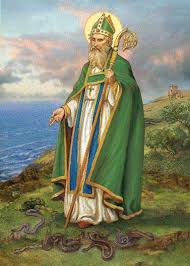
Patrick had a lot of myths grow up about him- he was Irish (he was born in Britain); he brought Christianity to Ireland (he, in fact, was converted while in Ireland); he chased the snakes out of Ireland (Ireland has been snake free since it became an island).

There are a few things that most historians agree on regarding Patrick. He was born somewhere in Britain, sometime around 390 CE. Sixteen years later he was taken captive by Irish raiders, taken to Ireland, and sold as a slave, where he became a shepherd for his owners. He was held a slave for six years, during which time he became an ardent follower of Jesus. (Note: his parents were most likely Christians, and Patrick may have been baptized early in life, but there is no indication that he took it seriously.) After six years of slavery, he escaped and went back to Britain, where he became a priest. He stayed in Britain for 16 years (until he was 38), rising in the ranks of the Catholic church. He then returned to Ireland, to the people who held him captive as a slave, and brought the gospel of Jesus to them in new ways. Many became followers of Jesus, and the country itself changed.

In my meditation time this morning I was reading about having “a great heart.” There is a Buddhist term, bodhichitta, which means “a heart that is noble and awakened, filled with compassion for others so that you feel the pain they feel.” I think it is what Jesus telling us in the Beatitudes in Matthew 5. Otherwise, they do not make sense. I’ve been thinking about people with great hearts. People who see beyond the pain that others have caused, and long for them to find the peace they know, even if it is costly. Stories I read of Corrie Ten Boom, David Wilkerson, Elisabeth Elliot shaped my early life in following Jesus. Watching Martin Luther King, Jr., and Nelson Mandela spurred me on. Patrick, too, leaves me awestruck. Honestly, I do not think I have a heart that wants the best for those who have hurt people. But I want to have that heart.

I find myself singing Johnny Clegg’s Great Heart almost every day. Though it’s not Irish, but African, I think Patrick would like it. He had a great heart.

And I know it is the only way things change.

Lewis and Clark and Calvin and Hobbes and…

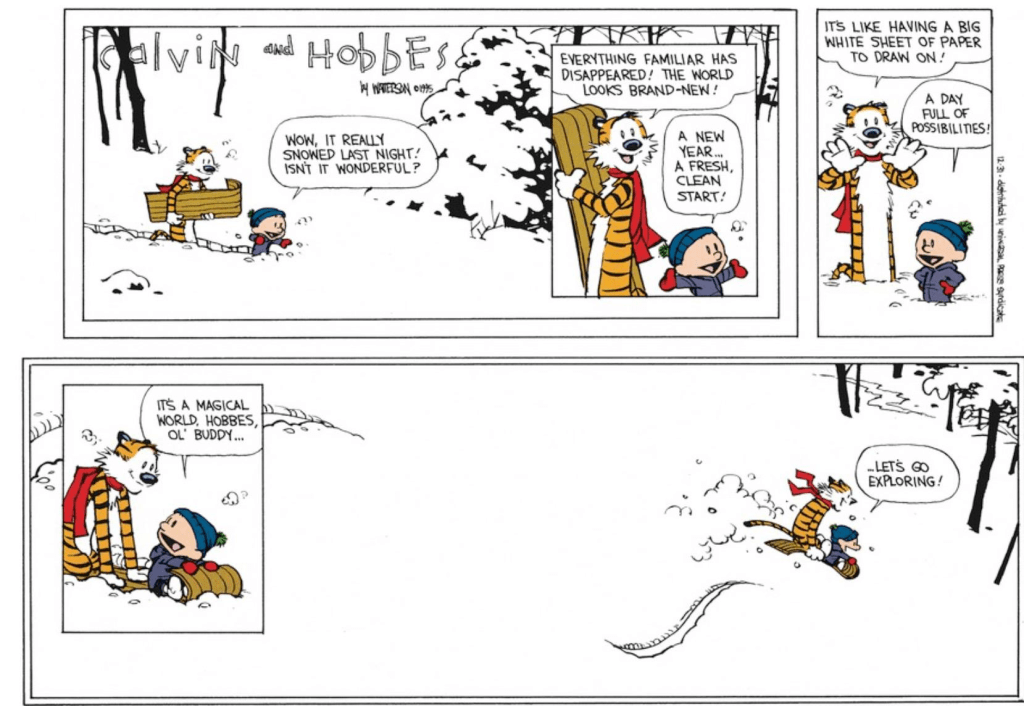
On December 31, 1995 (can it be that far back, almost 30 years?) the final Calvin and Hobbes comic strip was published. Calvin, the perpetual six-year-old, and his imaginary-but-very-real tiger friend are going out sledding on a perfect winter morning. As they marvel at the possibilities, they end up sledding off into the future with Calvin saying “Let’s go exploring!”

They came to mind as I thought about another couple of explorers today (I am writing this on May 14, 2024). Two hundred twenty years ago today, Meriwether Lewis and William Clark set off with their companions from Camp Dubois (Camp Wood), Illinois, to explore parts of the newly acquired land, the Louisiana Purchase, and to find a water route to the Pacific Ocean. Over the past few years, I have read several books about Lewis and Clark and watched several documentaries about them. I believe most of us, especially those of us in the United Methodist Church, are on the edge of a new land. While many want to go back to the old, familiar ways, some are like Calvin and Hobbes, or like Lewis and Clark, or (dare I say it) like Paul and Timothy and Silas. We are ready to go on to new lands, see what God has out there, and learn what new things the Lord has for us.

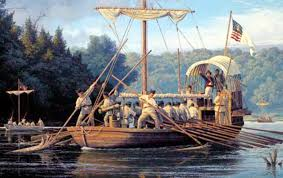
Corps of Discovery setting off, May 14, 1804.

There are some lessons from Lewis and Clark I think would serve all who want to explore what’s out there. Here’s what I’ve picked up-

  1. Have a partner. There’s a popular saying “If you want to travel fast, go alone. If you want to travel far, go with others.” There was a reason why Jesus sent the 12, and then the 70 (or 72) out in pairs. We need each other. People alone in the wilderness or in the new land will die much quicker than those with a partner. That’s even true in life in general. Married people, or people with a partner, live longer than single people. Don’t go alone.
  2. Actually, a small group is better than a couple or a large group. Lewis and Clark had 33 people who traveled with them, the Corps of Discovery. Each one had some special skill or gift that added to what they needed. No one was superfluous. (Only one died on the trip, Charles Floyd. He died from a ruptured appendix, and probably would have died if they had been in Philadelphia instead of what’s now Sioux City.) They could have taken more people, but then it would take more energy to keep up with the Corps, rather than exploring and moving forward. Small groups are better than large ones. Floyd Monument — Sioux City Public Museum
    • Bluff where Charles Floyd was buried
  3. It’s good to have a general goal or destination but be prepared to find things you did not know about. Lewis and Clark and the Corps thought that they could canoe to the Pacific. They did not know about the Rocky Mountains. They had to adapt to new things almost daily. Living with ambiguity was a necessity.
  4. Learn from the people you meet along the way. Though Lewis and Clark and the Corps were “discoverers” they were not the first people out there. There had been generations of people living in the “new land” and Lewis and Clark were willing to learn from them, as well as share with them their knowledge.
  5. Sometimes you may have to split up for a while, but if you do, do it with grace and plan to meet later. On their return trip from the Pacific, the Corps divided at Traveler’s Rest on June 30, 1806, with one group going north and another south. The plan was to explore new areas and meet where the Yellowstone and Missouri Rivers come together in North Dakota. The separation was risky, but they were able to cover more area and share with each other when they met again more than a month later.
  6. Always keep in mind that the destination is not the final goal. There is always new land to explore, and new truths to discover. Imagine what our lives would be like if we said that races should continue to be kept apart, that women should be held in subservience, that children in poverty were meant to be there, and that people dying of hunger are part of God’s will. One of my professors in seminary told me that Christians were called to move from the center of society to the edges, to find not only the people there but find the Lord there. What I have found is that when I think I have arrived at the edge, there is another edge further out. And as scary as it sometimes is, I hear the voice of God saying “Come on. Don’t stop. You can do it.”

Wherever you are in your life, maybe today’s a day to think about who you are traveling with, why you are going, and what you will see and do along the way.

See you out in the new land!