Ask. Seek. Knock. A movement towards intimacy.

Almost every Sunday I ask if there are any “prayer concerns” from the congregation. (I can do that because my congregations are small. Larger churches do it but in other areas- small groups, Sunday school classes, etc. And, like most places, people mention others- friends, families, community members who have special needs. Healing, comfort, peace. Occasionally reconciliation. They also mention larger issues. The need for rain in our communities in South Carolina, too much rain in the Midwest and Florida. War in Ukraine and Israel and Gaza. Gun violence…well…everywhere.

Rarely do they ask for prayer for themselves, but it does happen from time to time. “I’m having surgery…. I need a job…. My child is travelling off to college….” I’m not a fan of “unspoken prayer requests.” You do not know how to pray, what to pray. It reminds me of someone who may be hurting or mad but will not tell you why. It also reminds me of seeing people years ago on the “Christian TV” shows where they would have a huge pile of written prayer requests on a desk or table, the preacher would lay his hand on them and say something like “Lord, you know all these requests. Meet the needs of these brothers and sisters.” Later they would say, we prayed for 1200 people today. To me, that is like putting my hands on a globe and saying, “Lord, fix this place,” and then proclaiming that I have prayed for over eight billion people. (And I did it without mentioning a single name.)

I have been in smaller groups where people did pray for themselves. Most often it was for “things”- healing, comfort, guidance, peace. All good gifts from the Giver of Good Gifts. But after a while, it seems we do not go any further. Our prayers become a “shopping list” at the Divine Supermarket. (By the way, years ago Larry Bryant wrote a song with that title. Others have recorded it, but his version is the best. It will make you laugh, and probably make you uncomfortable, too. Here’s a link.)

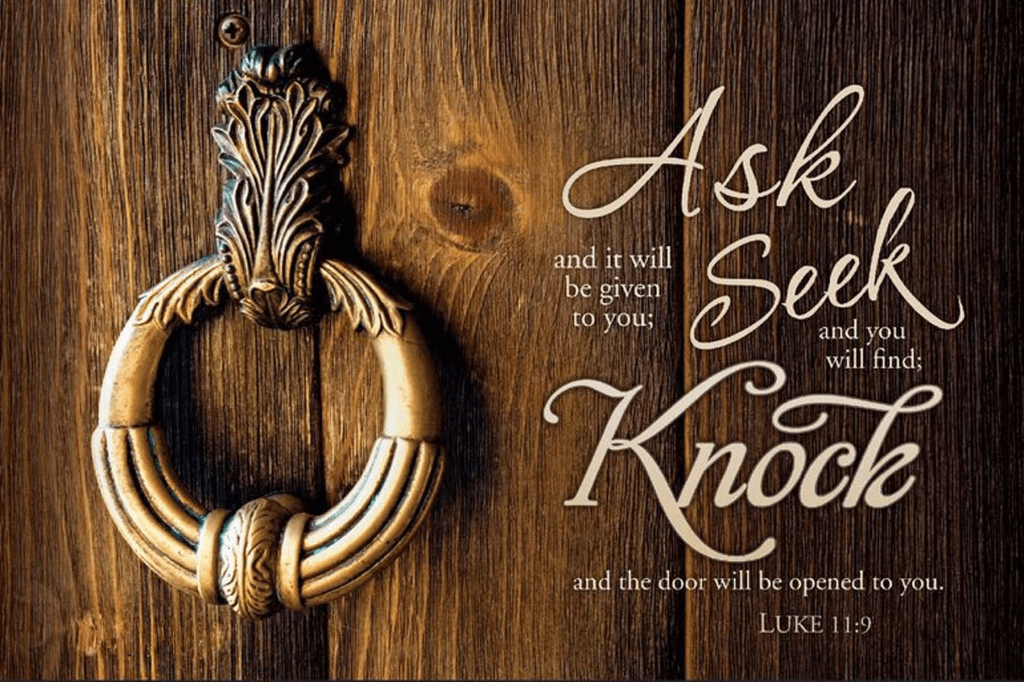
In the Sermon on the Mount, Jesus said “Ask, and it will be given to you; search, and you will find; knock, and the door will be opened for you. For everyone who asks receives, and everyone who searches finds, and for everyone who knocks, the door will be opened.” (Matthew 7:7-8) Most people see that as Jesus saying the same thing three times- that is, ask, seek, and knock are all the same. Andrew Murray, in his classic With Christ in the School of Prayer, says that they are three different things.

Asking is requesting something- a gift. Healing, food, comfort, peace. The emphasis is on the gift. Seeking is looking for a person. Most of the instances of the word seek in the Bible refers to seeking God (“You will seek me and find me when you seek me with your whole heart.”- Jeremiah 29:13; “Seek the Lord while he may be found.”- Isaiah 55:6; etc.). Seeking moves towards the Divine Being rather than the gift. I believe even Jesus’ teaching to “seek first the kingdom of God and God’s righteousness” refers to being in relationship with God. And knocking, according to Murray, is a form of entering into a dwelling with another. You knock on the door, it is opened, and you go in. It is dwelling or living with the one you have sought.

It seems to me that these three point towards a movement towards intimacy. We move from the gift to the giver, to being in a relationship with the giver.

For many of us, our prayer life has stayed at the ask phase. Maybe it is time for us to move a little closer.

A Meditation  for June 24

Do you remember the advertising slogan “Only (fill in the number) shopping days until Christmas”? It pretty much went out of fashion in the early 1970s. It was then that stores started opening on Sunday afternoon. Now, except for Hobby Lobby and Chic-Fil-A and a few others, most stores are open every day, all day. And with online shopping with overnight delivery à la Amazon, there are almost no times when you can’t get what you want immediately.

But it used to not be that way. You had to wait and plan and work and hope. And then, one not so surprising morning, you would wake up and there would be a new world for you, just waiting to be unwrapped.

By the way, that slogan was first used by Harry Gordon Selfridge, a manager at Marshall Field’s in Chicago and the founder of Selfridge’s in London. The television series Mr. Selfridge is a great show about him.

So…what does that have to do with June 24? June 24 is the Feast Day of St. John the Baptist. It is considered to be his birth date. Most of the saints have their Feast Day on the day of their death (the day they entered Heaven), but John the Baptist and Mary the Mother of Jesus are the only two who are celebrated on their birth day.

June 24 happens to be 6 months before Christmas Eve. Though the actual day of John’s birth is unknown, it is celebrated on this day because it foretells the coming of one who would introduce a new world later. John came before Jesus to get people ready. In the Hebrew Scriptures, the prophet Isaiah says

A voice cries out:
“In the wilderness prepare the way of the Lord;
    make straight in the desert a highway for our God.
 Every valley shall be lifted up,
    and every mountain and hill be made low;
the uneven ground shall become level,
    and the rough places a plain.
Then the glory of the Lord shall be revealed,
    and all flesh shall see it together,
    for the mouth of the Lord has spoken.” (Isaiah 40:3-5)

In the Christian Scriptures, John is baptizing people in the Jordan and the Jewish leaders come to find out who he was. The apostle John (don’t confuse the two) records this in John 1-

This is the testimony given by John when the Jews sent priests and Levites from Jerusalem to ask him, “Who are you?” He confessed and did not deny it, but he confessed, “I am not the Messiah.” And they asked him, “What then? Are you Elijah?” He said, “I am not.” “Are you the prophet?” He answered, “No.” Then they said to him, “Who are you? Let us have an answer for those who sent us. What do you say about yourself?”  He said,

“I am the voice of one crying out in the wilderness,
‘Make straight the way of the Lord,’ ” as the prophet Isaiah said. (John 1:19-23)

Not many places or people celebrate this Feast Day, but in those places where they do, they often build fires in the evening, sing, dance, eat, and share things with the needy. In some places, people go to worship, then come out, find a nearby body of water (river, lake, pool, ocean), and jump in, fully clothed. It is reminiscent of John’s baptism of people.

I have a suggestion- do things that show a new world is coming, and parts of it can be seen now. Do what John told people to do- share what you have with those in need. “Whoever has two coats must share with anyone who has none, and whoever has food must do likewise.” It’s a little too hot to build fires where I am now, and I don’t want to jump in anything fully clothed. But you know, I can share what I do have. So can you.

And, by the way, don’t just give away what you don’t want or what is worn out. After all, if your brother or sister needed a shirt, would you give them one with a hole in it?

Then, take some time to dance, sing, eat, pray, and look forward to a day in the near future when a new world will be waiting for you to unwrap it.

Some Thoughts on Flag Day, June 14

I am writing this on Flag Day, June 14, 2024. June 14 has been declared Flag Day since 1916, when President Woodrow Wilson declared June 14 (the date in 1777 that the Congress adopted the Stars and Stripes as our national flag) Flag Day. In 1948 Harry Truman signed into law Congressional legislation designating the same and calling on the President to make an annual Flag Day declaration. You can read President Biden’s Declaration here. A portion of it reads “ I urge all Americans to observe Flag Day and National Flag Week by displaying the flag and honoring all of our brave service members and revering those who gave their last full measure of devotion defending our freedoms.  I encourage the people of the United States to observe with pride and all due ceremony those days from Flag Day through Independence Day, set aside by the Congress (89 Stat. 211), as a time to honor the American spirit, to celebrate our history and the foundational values we strive to uphold, and to publicly recite the Pledge of Allegiance to the Flag of the United States of America.”

Our flag is used and misused in so many ways. It always amazes me that the same people who object to the flag being burned don’t seem to mind when they go to Myrtle Beach and see it used as a bikini or bathing suit.

We recite the Pledge of Allegiance, which begins with “I pledge allegiance to the flag of the United States of America and to the republic for which it stands….” ends with “with liberty and justice for all.” Then see the flag used as a weapon against fellow citizens, even used alongside other flags that speak against all we want to stand for.

I think the flag is misused more today than ever before.

July 3-5, 1970, I attended the second Atlanta Pop Festival at the Middle Georgia Raceway in Byron, Georgia, with some friends from high school. A quarter of a million people showed up. In the middle of the raceway was a giant flagpole with a huge American flag flying from it. On the first day some people had lowered the flag, turned it upside down, and raised it again. (This was during a time of protesting against our government’s policies, especially in regards to Viet Nam.) Leaders on the stage asked that it be turned around correctly, saying “We are here to show peace, love, music and unity and if the flag is flown upside down, that will be the only thing we see on the news.” They quickly set it aright.

One of the ways people showed their disdain and disagreement with the government back then was to burn the flag, which upset most of us. Strangely, a lot of those people who were upset called themselves Christians, but never seemed to be upset when people burned crosses.

I’ve come to think there are worse ways to disrespect our flag than burning it.

A few come to mind. Flying it upside down when you disagree with the rule of law. As mentioned above, using it physically as a weapon against other people. Flying it along with flags that were representative of groups or countries that fought to destroy us and harm the world. Wearing it as a badge of honor while dishonoring the people who died for what it stands for.

On the other hand, I’ve seen it flown in ways that make me proud. When seeing people working through the rubble of the Twin Towers, with the hope of finding more living victims, or recovering the bodies of those who died, bringing a little peace to the families and to the country. When flying above the rescue centers after natural disasters. When people wave them together and not at each others. And it brings tears to my eyes when I see all those flags flying in front of all those tombstones on Memorial Day.

Cathy and I have a small American flag that we fly from time to time outside our home. We fly it as it should be flown- not upside down, not touching the ground, not mixed with other symbols. Just a simple flag flown with the hope that one day, one day soon, there will be liberty and justice for all.

Lewis and Clark and Calvin and Hobbes and…

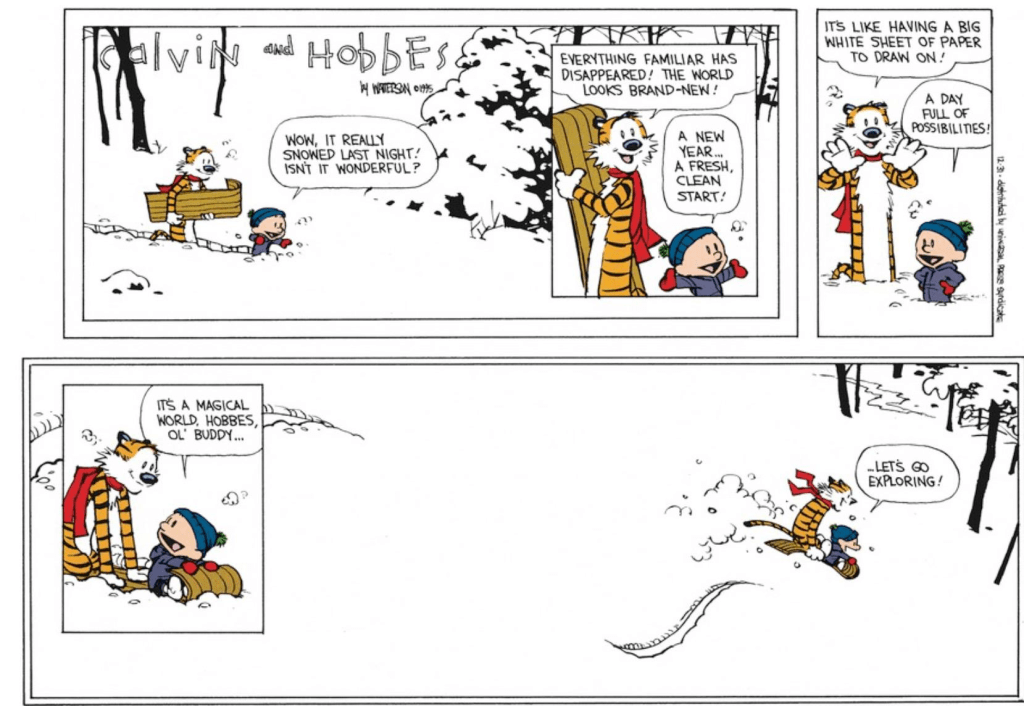
On December 31, 1995 (can it be that far back, almost 30 years?) the final Calvin and Hobbes comic strip was published. Calvin, the perpetual six-year-old, and his imaginary-but-very-real tiger friend are going out sledding on a perfect winter morning. As they marvel at the possibilities, they end up sledding off into the future with Calvin saying “Let’s go exploring!”

They came to mind as I thought about another couple of explorers today (I am writing this on May 14, 2024). Two hundred twenty years ago today, Meriwether Lewis and William Clark set off with their companions from Camp Dubois (Camp Wood), Illinois, to explore parts of the newly acquired land, the Louisiana Purchase, and to find a water route to the Pacific Ocean. Over the past few years, I have read several books about Lewis and Clark and watched several documentaries about them. I believe most of us, especially those of us in the United Methodist Church, are on the edge of a new land. While many want to go back to the old, familiar ways, some are like Calvin and Hobbes, or like Lewis and Clark, or (dare I say it) like Paul and Timothy and Silas. We are ready to go on to new lands, see what God has out there, and learn what new things the Lord has for us.

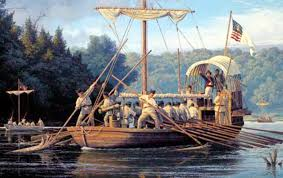
Corps of Discovery setting off, May 14, 1804.

There are some lessons from Lewis and Clark I think would serve all who want to explore what’s out there. Here’s what I’ve picked up-

  1. Have a partner. There’s a popular saying “If you want to travel fast, go alone. If you want to travel far, go with others.” There was a reason why Jesus sent the 12, and then the 70 (or 72) out in pairs. We need each other. People alone in the wilderness or in the new land will die much quicker than those with a partner. That’s even true in life in general. Married people, or people with a partner, live longer than single people. Don’t go alone.
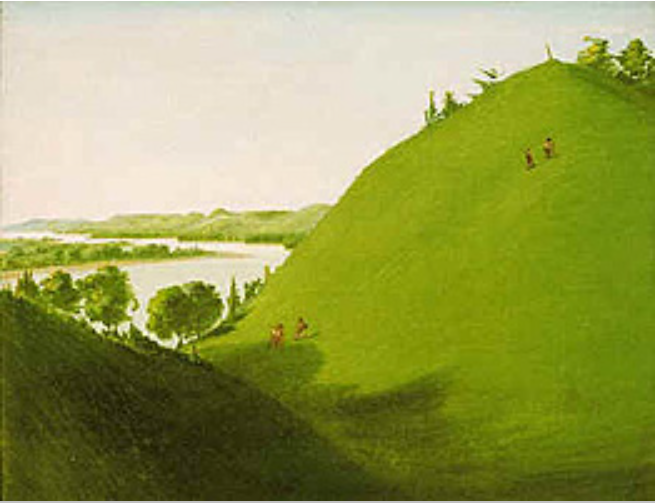
  2. Actually, a small group is better than a couple or a large group. Lewis and Clark had 33 people who traveled with them, the Corps of Discovery. Each one had some special skill or gift that added to what they needed. No one was superfluous. (Only one died on the trip, Charles Floyd. He died from a ruptured appendix, and probably would have died if they had been in Philadelphia instead of what’s now Sioux City.) They could have taken more people, but then it would take more energy to keep up with the Corps, rather than exploring and moving forward. Small groups are better than large ones. Floyd Monument — Sioux City Public Museum
    • Bluff where Charles Floyd was buried
  3. It’s good to have a general goal or destination but be prepared to find things you did not know about. Lewis and Clark and the Corps thought that they could canoe to the Pacific. They did not know about the Rocky Mountains. They had to adapt to new things almost daily. Living with ambiguity was a necessity.
  4. Learn from the people you meet along the way. Though Lewis and Clark and the Corps were “discoverers” they were not the first people out there. There had been generations of people living in the “new land” and Lewis and Clark were willing to learn from them, as well as share with them their knowledge.
  5. Sometimes you may have to split up for a while, but if you do, do it with grace and plan to meet later. On their return trip from the Pacific, the Corps divided at Traveler’s Rest on June 30, 1806, with one group going north and another south. The plan was to explore new areas and meet where the Yellowstone and Missouri Rivers come together in North Dakota. The separation was risky, but they were able to cover more area and share with each other when they met again more than a month later.
  6. Always keep in mind that the destination is not the final goal. There is always new land to explore, and new truths to discover. Imagine what our lives would be like if we said that races should continue to be kept apart, that women should be held in subservience, that children in poverty were meant to be there, and that people dying of hunger are part of God’s will. One of my professors in seminary told me that Christians were called to move from the center of society to the edges, to find not only the people there but find the Lord there. What I have found is that when I think I have arrived at the edge, there is another edge further out. And as scary as it sometimes is, I hear the voice of God saying “Come on. Don’t stop. You can do it.”

Wherever you are in your life, maybe today’s a day to think about who you are traveling with, why you are going, and what you will see and do along the way.

See you out in the new land!

Count Your Blessings, Name Them One By One

On our trip back from Dayton to view the eclipse, Cathy and I had a flat tire in Caryville, TN. On Tuesday morning I stood in the parking lot of the Hampton Inn, looking over Cove Lake, waiting on the auto service from AAA to come change the tire for us. As I drank my coffee on that crisp, cloudy morning, I remembered to “give thanks in all circumstances.” My mother had taught me that when I was little, using the little song “Count Your Blessings.” (Later, I was reminded by Monty Python with the song “Always Look On The Bright Side of Life.”) So I decided to see how many blessings I could count from this event. Here goes:

  1. This happened to us, and not to other people who might have had a harder time with it (people older than us, families traveling with children, people with a business schedule to care for, etc.).
  2. It happened on this end of the trip, and not the other, when we did not have to worry about getting anywhere on a schedule. If it had happened going out, it would have been a bit more of a problem.
  3. It happened in the parking lot of the Hampton Inn, and not out on the interstate highway. That would have been a real pain in the butt.
  4. It happened during the night while we were spending the night there, so we could wait until the next morning to get it repaired.
  5. While it punctured my tire, it did not deflate it. A small metal rod went through the tread and not the side wall. It made a noise as we drove to get something to eat and that’s how we discovered it.
  6. We had AAA coverage, so I didn’t have to figure out how to use the jack (though I could do it).
  7. I had a beautiful view and decent coffee (unusual for a motel) to drink while waiting.
  8. We did not have to worry about the cost of replacing the tire if needed. We had saved money up for emergencies.
  9. The young guy in the tow truck (from Dan’s Towing in Andersonville, TN) was more than helpful. He also told us where we could get the tire repaired or replaced.
  10. The tire store was only 7 miles away and we did not have to get on the interstate to get to it.
  11. The repair guy at JR’s Tires in LaFollette, TN, was able to get to us immediately and it took only 20 minutes. (I recommend them!)
  12. The tire did not need to be replaced. It was patched, which was a lot cheaper.
  13. We met some nice people at the Hampton Inn, from Dan’s Towing, and JR’s Tires.
  14. Cathy got to play with a cat, Kevin, at JR’s Tires.
  15. We got home later than planned, but everything was fine.

Whenever unexpected things come our way, Cathy and I look at each other and say “We’re on an adventure!”

Always look on the bright side of life….

Grace Is For Everyone

A Visit to Grace United Methodist Church, Dayton, Ohio

(NOTE: I usually don’t blog or post reviews of churches, since they can be so different from each other and I may not know any of the history, culture, or setting. But I post this one because I think there are some things we all can learn. I know I did.)

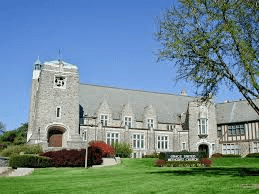
Cathy and I were in Dayton on Saturday, April 6. We stayed at a BnB in the Dayton View Historic District. While looking for our BnB we saw Grace UMC, a large, imposing, gray stone building on the hill. We decided to attend the next morning for worship.

The church had good info on its website, so we knew when worship began. We were walking to the church, a couple of blocks away, and trying to figure out where to enter (it was not quite obvious). A car pulled up, and a woman rolled down the window and asked if we were looking for the entrance. We said yes, and she told us how to get there. Even better, she drove into the parking area and waited for us. She introduced herself, Roberta, and escorted us into the building. She asked about us and told us some about the church. She walked us through the historic building, introduced us to people in the hallways and rooms, including the pastor, and then went with us to the sanctuary. She sat with us and introduced us to the people around us.

The building itself is incredibly beautiful- stained glass windows, ornate wood carved chancel, lots of art in the hallways, very neat and clean. The people were dressed comfortably, which was good for us (we were wearing jeans and pullover shirts). Some were in coats and ties, dresses, suits, while others were in jeans and t-shirts. Didn’t seem to matter to anyone. We noticed immediately that it was not only a multicultural congregation, but also people from across the economic spectrum. That does not happen by accident or chance. That must be worked on. Cathy mentioned that to Roberta, and she said, ‘Well, Grace is for everyone.” We heard that phrase a few times. I do not know if it is their official motto or mission statement or logo, but everyone seemed to know it. And when they said it, it wasn’t as if they were trying to sell you a product (like “Ace is the place with the helpful hardware folk…”). It was more like, this is who we are. I mentioned to one person how much the church was involved in the community and she said, “Yes, Grace is for everyone.” I talked to the bus driver in the parking lot who drove to the VA home and the homeless shelters to pick people up, and thanked him for what he did. He said, sort of off the cuff, “Well, Grace is for everyone.”

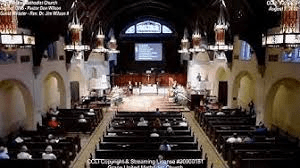
The service was traditional. The music was from the hymnal, words to the hymns and the common prayers were on a large screen, as well as projection of whoever was speaking or leading worship. The music was very good, and I particularly liked that when the musician was playing the organ for the prelude, the projectionist showed both his hands on the keys and his feet on the pedals (split screen). Special music included a violin solo, and a vocal of Lord of the Dance, both well done

The pastor, Steve Putka, was dressed comfortably- button-up shirt, slacks- walked into the congregation asking for praise reports. “What are you thankful for?” was how he put it, and people shared their thanks for many things. The Scripture, rather than being read, was told by one of the laity (turns out it was David, Roberta’s husband). The woman sitting behind us told us that they had been doing this for a while and she loved it. David told the story almost word for word from the gospels- not his version of it, but what it said. He acted out a little of it for emphasis (it was the story of Thomas after the resurrection). He did a great job of making it real.

The pastor’s sermon was good, applicable, down to earth. He talked about how Jesus included everyone, even those who doubted. Which is good news for me, for sometimes I have my doubts. And he invited everyone to take part, even if you doubted, in the communion. They used those little individual hermetically sealed cups with grape juice on one side and a small cracker on the other. These were passed out to the congregation. He said that he used to hate those things, but had come to accept that for a while, this was the best we could do.

Personally, I do not like those cups. But as I looked around the congregation, I saw several people wearing masks, and I realized that this was one way of making them feel comfortable and welcome. And that trumps my own preference any day.

I noticed that for the most part, the liturgy had inclusive language. Not exclusively, but it was noticeable to me. It was done in a way that did not sound forced, but natural.

At the end of the service the woman behind us leaned forward and said, “You may want to go ahead and leave, and that’s okay, but most of us sit quietly through the postlude, thinking about how we will live out what we’ve heard for the next week.” Cathy and I sat, thought, and prayed.

After the service they were having a meeting to talk about becoming a reconciling congregation. So Cathy and I left, went to the balcony to see the beautiful architecture from above, and walked back to the BnB.

Pastor Steve was fairly new there (came in July of last year). He obviously loves the people and is leading them in some great ways. But he also has some wonderful people in the congregation who have caught the vision of Grace, both the church and the theological concept, being for everyone. If I lived in Dayton, I would be back and would be a part of the congregation. If they would have me. Of course, they would have to, because Grace is for everyone.

The sanctuary would probably seat 700, and I’m estimating that there were about 175 people there. A few people told us of the days years ago when it was filled with families and children and all kinds of things were happening. They pointed with pride to the wonderful building they have. But the wonderful thing was not the building. It was the people. As we left, I thought, the glory days are not behind them. They are ahead.

After all, Grace is for everyone.

Holy Saturday

For some reason, in my younger days and up through my late 20s, older people would say that today, the day between Good Friday and Easter Sunday- was the day to plant your garden. I used to think there was some agricultural/scientific reason behind this. Easter, coming when it does (Easter comes the first Sunday after the first full moon following the vernal equinox – note: Eastern Orthodox celebrate it a week later), made the weather right for planting seeds in the ground. However, that turns out not to be true, especially for tubers. Tubers planted today will probably rot in the earth, and the Saturday is called Rotten Saturday by some.

The weather is so variable that seeds and plants may or may not grow.

So why did they do it?

Many say it was because their ancestors did- their grandparents, and the grandparents of those people, and so forth for generations back.

But why did they do it?

Here’s my theory, and I do not know how to prove it. But here goes.

Those early farmers listened to the story of the death, burial, and resurrection of Jesus and believed there was something universal being told there. Jesus died and was buried, lay in the earth that Saturday, and was raised on Sunday. So they put their seeds and plants in the ground on Saturday just to see what would happen. And a tradition began.

While I am no farmer (and farmers are people outstanding in their field- sorry, I couldn’t resist!), I have had a few gardens in my life. Square-foot gardening is my favorite. Planting seeds on Holy Saturday sometimes produced good results. A few times it did not. Neither was the result of faith, but due to the weather and some other things (like my attention to the garden).

But there is a deeper lesson here for me. Maybe for you, too.

On this day, some things within me that have died, or are just seeds or seedlings, need to be planted in the ground, and allowed to stay until they come up on their own.

Things faith-

  • Faith that people, whoever they are, are basically good, that our inner core is not evil but kind.
  • Faith that our work together will make a difference; that a few people standing together to make a better world will attract more people.
  • Faith that compassion does not equal weakness and that charity does not promote laziness.

Things like hope-

  • Hope that our country will get over its selfishness and decide to live and work together for the common and greater good.
  • Hope that my life will have some kind of meaning, will help the world be kinder, gentler, more accepting.
  • Hope that relationships I have hurt and/or broken in the past will be healed, reconciled, and restored.
  • Hope that I can live out the remainder of my days in better health and learning new things in this wonderful world.

Things like love-

  • Love for those who have hurt me and for those I have hurt.
  • Love for the world that used to be and for the world that is yet to come.
  • Love for my neighbors that I know, and the neighbors I do not know- both those near and far.

Someone once wrote those things- faith, hope, and love- last forever. Today I think I’ll plant them in the garden of my heart, and wait and see what comes up.

Good Friday

I have often wondered why this day is called Good Friday. Oh, I know the “official” reason- it’s the day Jesus died to show the depths of God’s love for us, to overcome our sin and separation from God and from each other. Some people say it was the day that our penalty was paid, but over the years I have begun to think this whole judicial way of looking at our relationship with God and each other is, well, at best, inadequate.

In most ways, the term Good Friday does not seem to fit. It’s the day that showed how we- the human race- can be so creative in torturing and murdering those who threaten our way of thinking. (I shouldn’t really say the day. As it turns out, a cursory look at our history shows it’s one of the many days we do that.) The depth of our depravity, it seems, has no bounds.

But maybe it is Good in that we are told the ultimate truth- that the real way of life is sacrifice. And what Jesus did on that day is a model for us all.

Paul, an early follower of Jesus, wrote to other followers in the city of Philippi and said that we should have the same mind, or attitude, as that of Jesus. He gave up all that it was to be God, became fully human, and died a horrible death on a cross. Paul concludes by saying “Therefore, every knee shall bow in heaven and on earth and under the earth, and every tongue should confess that Jesus Christ is Lord, to the glory of God the Father.”

There was a popular little praise song years ago that went:

He is Lord, He is Lord!

He is risen from the dead and he is Lord!

Ev’ry knee shall bow, ev’ry tongue confess

That Jesus Christ is Lord.

As nice as it was to sing that chorus, it subverted the Scriptures. The reason, Paul says, he is Lord is not because he rose from the dead, but because he died on a cross.

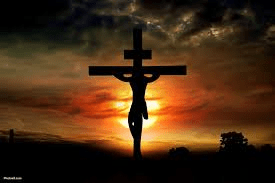
The way of sacrifice is the way of life. Jesus taught it. Jesus lived it. And Jesus died to prove it. Jesus also told us that if we want to be his followers, we must do it, too. It is one of the few “no option” things Jesus told us. “If anyone wishes to come after (follow) me, they must deny themself, and take up their cross daily and follow me. For whoever wishes to save their life will lose it, but whoever loses their life for my sake, that is the one who will save it.” (Luke 9:23-24)

Maybe that is why it is called Good Friday. Because we can see clearly what it will cost to be truly human, to be what God made us to be. There is no guessing about it. Now we know. And as hard as it may be, I think it’s Good.

Mary’s Story

NOTE: Today, March 25, is the Feast of The Annunciation. It is when we celebrate the angel Gabriel coming to Mary, asking her if she’ll bear Christ into the world, and her answer being yes. This year (2024) it also occurs during Holy Week, when we celebrate Christ’s triumphal entry into Jerusalem, his last supper with his disciples, his passion and death on a cross, and his resurrection on Sunday. Several years ago I wrote a story that brings the Annunciation and Holy Saturday (the day between Good Friday and Easter) together, looking at everything from Mary’s point of view. I wrote it for Christmas, but I think it is appropriate for today and this week.


It was early Saturday morning when I went looking for Mary. Yesterday, Friday, had been the worst day of both of our lives. The past few days had been more than horrible. She had seen her first-born son die, and I had watched as my best friend, and the man I thought was God incarnate, give his life away uselessly on a cross. We had seen it all, some up close, other parts from a distance, but we had been there, side by side, watching it, thinking it would all change in a minute, knowing that something different, something wonderful, would happen.

But it didn’t. He died.

On Thursday night he had been taken away by the soldiers and brought before this mock trial in front of Pilot and Herod, since they were both in town. Now he’ll show them, I thought. After all, he had done that with the authorities before. We watched as he was beaten, and I held Mary as the tears ran down her face, seeing her son wear a crown of thorns, and people who he had fed and healed yell ‘crucify him.’ Crowds can turn so quickly. We had seen it before. We knew he would turn the crowds back to him. We followed behind as he was taken out to the hill to be crucified. Mary kept whispering, not to me but to herself, “I know he’ll come to save him. The Lord won’t let him down. God will come any minute now.” I felt it, too, but my hope died with each step he took. When they nailed his hands and feet to the cross, I heard Mary scream as if it were her hands that the spikes were piercing. She called out to God to come and save her son, and for a moment we thought he would. The skies got dark, the wind blew, and the earth shook. “Now God will come to us and save him,” Mary screamed through her tears.

But he didn’t.

You could tell the moment he died. His spirit had left his body. It just hung there empty, a shell of what used to be great, high on the cross for all to see. The wind stopped blowing, the clouds grew lighter, the earth stopped moving. Everything was back to normal. And we just stood there, looking at the body hanging on the cross. When a soldier rammed his spear into the side to make sure he was dead, when that spear entered his heart, Mary was leaning against me and I felt her heart break, too.

A few minutes earlier, before he had died, he had looked at his mother and said, “Mom, John will take care of you.” Then he looked over at me and said, “John, watch after Mom.”

So, while friends took the body off the cross, I held her close to me. Then, when the body was lying on the ground, she walked over to it, held it close to her, as only a mother can, and brushed the hair out of his eyes. Our friends wrapped his body and took him away to be buried before we had time to prepare him with the oils used for burial. It was getting dark, the Sabbath was about to begin. I took Mary back to Bethany to stay at home of Mary, Martha and Lazarus. She didn’t go to the temple or the synagogue that night. She just sat there, numb. I left the house to stay with others.

This morning I found her in the courtyard, sitting on a bench, leaning against the wall of the house. I looked at her and she looked old beyond her years. For the first time, I could not see the young girl in her anymore. She must not have been more than 48, but she looked like she was 90, older than Sarah, Abraham’s wife. She was gaunt and wrinkled and hunched over and frail. You could tell she had not slept at all.

“How are you?” I asked.

“It seems like it was only yesterday,” she said, answering a question that I did not ask.

“Mary….it was yesterday,” I said. “He died yesterday.”

“No….not that…..it seems like it was only yesterday when the angel appeared to me.”

“What angel?”

“The one that told me I would have this boy if I wanted. That I could bear him into the world, but the choice was mine.” This was a story I had not heard, so I asked her to tell me about it. Maybe it would help her deal with her grief. I had said I would care for her.

“I was just a young girl, barely past the age of becoming a woman,” she said, “when I met Joseph. He was a few years older than me, and was learning his father’s trade as a carpenter. We used to steal glances at each other in the synagogue in Nazareth. We were almost immediately attracted to each other. We would ‘accidentally’ bump into each other in the market, and our hands would touch and I could feel a spark fly between us. This went on for months, and I thought I would die if I didn’t get to be with this handsome young man. I don’t know why, but something was happening between us. Finally….and I don’t know how he did it…..his father talked with my father and a marriage was arranged between us. We were engaged! We were promised to each other!” Mary’s face brightened as she recalled that time, her back straightened up, and it looked like some of the wrinkles left her face.

“The marriage ceremony was planned for 6 months later, so family would be able to save and take the time to get there. And each day just drug on forever. I thought they would never end! I could hardly wait for the day to come when I would be his wife. What could be more wonderful than marrying the person you love, spending the rest of your days with them!”

I know, I thought. I had never married, but I had felt that way before, wanting to spend every day with a certain person. But that didn’t work out. He was dead, now.

“Then it happened,” Mary said. “One evening, about 4 months before the wedding, I was behind our house in Nazareth. It was a bright, clear, star-filled night, when suddenly there was a brilliant light that flashed, almost blinding me. I thought at first it was some sort of lightning, but when my eyes could focus again, there was a giant of a man standing before me. I couldn’t tell if he was 7 feet tall, or if he just seemed that way because everything else seemed small in his presence, including me. There seemed to be some light that shone from within him, some sort of reflection of the light that had just flashed before me. He was dressed in a robe that reached the ground, but didn’t seem to be dirty anywhere. He had dark brown eyes that didn’t so much look at you as look INTO you. He stood there for a moment, and I began to back away, not looking back up at his face. “

“Then he spoke. His voice was deep. He had no question in his voice, no wavering. He said, ‘Don’t be afraid, Mary. I am Gabriel and I come from the throne of God. God has seen you and chosen you. You will have a child, a boy, and you are to give him the name Jesus. He will be great and will be called the Son of the Most High. The Lord God will give him the throne of his father David, and he will reign over the house of Jacob forever; his kingdom will never end.’”

“ ‘How can this be?’ I asked. ‘I’ve never….been…with a man.’ He told me that the Holy Spirit would do something wonderful, something miraculous in me, and that way I would know it was God’s son. Then he just stood there, like he was waiting for me to say something, those dark eyes looking into my soul. It was as if he had to have my permission for this to happen.”

“What did you think?” I asked.

“Everything went through me,” she said. “What would my family think? Would they believe me? What about Joseph? Would he still marry me? How can this happen? In a just a second, I thought of all the things that might happen because of this. Then I thought, say yes! Because who knows what tomorrow may hold! So I looked at the man…the angel….and said….yes. As a matter of fact, that’s what I taught my son for all those years growing up- always say yes, because who knows what tomorrow may hold.”

I had heard Jesus say something like it several times, and now I knew where it came from, He had put it this way, “Why do you worry about tomorrow, what you shall eat and drink and wear…. God loves you so don’t worry about tomorrow….who knows what tomorrow may hold. So that’s where he got it from, his mother.

“So what happened next?” I asked, trying for a moment to get her mind away from yesterday and the terrible things we saw. “Was Joseph excited?”

“No,” Mary said, laughing at the memory. “It wasn’t funny then, but it seems so now. He was furious, just knowing that I had…been…with another man. All this stuff of flashing light and angels seemed like a lie to cover up my sin to him. Even my parents agreed and were ashamed of me. But he loved me, and though he was hurt, didn’t want to shame me in public. He was going to break the engagement privately and send me away. But then that same man, the angel, showed up at his house and helped him to…uh…see the light. And though he didn’t understand it he decided to go ahead and marry me, but not until after the child was born.”

“What about your parents?” I asked.

“When I got to where I began to show,” she said, looking down at her stomach, “they sent me away to see my cousin Elizabeth. She was old, but somehow she was pregnant, too. And my parents knew that if I was around folks would talk. So I went off to stay with her for a while.”

“While I was there Caesar Augustus decided to have a census and a taxation of the whole empire. And to make it harder for everyone, he said everyone had to go back to their ancestral homes to be registered. So Joseph came and got me and took me to Bethlehem, because that’s where his family was from. His great, great, great, great, great granddaddy was King David, you know.” I had heard this from Jesus, that he was the ‘son of David.’ As a matter of fact, that’s what the people had yelled just six days earlier as we rode into Jerusalem, “Hail the One who Comes in the Name of David!”

“You ever been to Bethlehem?” Mary asked me. “I’ve been through it,” I said, “not much there. A Podunk of a town.” 

“You’re right,” she said. And when you fill it with people who are descendants, there’s no place to stay. When we got there I was about ’12 months pregnant’ and about to pop. Joseph couldn’t find a room at the only inn in town. The only shelter was a cave used as a barn for the animals. There I had Jesus, and Joseph put fresh hay in the feeding trough, and that’s where my son slept for the first time. It wouldn’t be the last time he would not have a place to lay his head.”

“Yeah, he told us who followed him to be prepared to have no place to stay,” I said.

“Shepherds showed up and told us what seemed like incredible stories of the angels appearing to them, but we both knew what that was all about. Jerusalem’s only 6 miles from Bethlehem, so when the time came a week later, we were able to go to the Temple and present him there, something we could not have done if we were back in Nazareth.  As we were coming out of the temple, an old priest named Simeon came over, looked at my baby, and said ‘this child will be a light for the Gentiles and glory for Israel. Then he looked at me, and a strange look came on his face, and he said ‘and a sword will pierce your heart, too.’ …. How did he know?” Mary said, looking down at her feet, tears coming again.

“Tell me more. I’ve not heard these stories,” I said.

“We went back to Bethlehem, and stayed there for a while. Then came the time of the massacre…” She did not have to tell me more. I had heard stories about Mad King Herod and his ordering of the execution of male children. “…so we escaped to Egypt. After a few years we heard that Herod had died, so we went back to Nazareth. Jesus was your typical boy growing up, obeying us most of the time, but occasionally going his own way. He got lost in Jerusalem one year when we went there for the Passover,” she said, a smile coming over her face. 

“Yeah, I heard about that,” I said.

“But I gave him a talking to that he never forgot,” Mary said, “and was no trouble at all after that. As a matter of fact, he was an incredible son. Joseph died young…” Mary said, a shadow coming over her face. Jesus had never spoken to me about his earthly father, only about what he called his ‘heavenly father,’ a term he used with great familiarity. I wanted to know, but didn’t push Mary about how Joseph had died. She was already in enough pain. “….and even though Jesus knew he didn’t want to be a carpenter, that didn’t seem to be what he was born for, he took over the family business until one of his younger brothers could do it and provide for us. We were all very poor, but we worked together. Then the day came when he took me outside the home, and said ‘Mom, it’s time for me to do what I was called to do.’ I remembered what the angel had told me, and I gave him my blessings. You know the rest of the story.”

Yeah, I knew it. As a matter of fact I had lived most of it. The healings, the feedings, the miracles, the teachings, the crowds. It was so exciting. We never thought it would end this way.

I looked over at the old woman sitting on the bench. Finally I asked the question that had been building up in my heart and mind. “Mary, if you had the chance to do it again, would you say yes? You know, knowing the joys, but also the heartache and the pain, knowing what would happen, knowing about….yesterday…..would you have born Jesus into this world?” I wasn’t really asking for her. I was asking for me. You see, Jesus had told me something strange one day, something I didn’t quite understand, not sure that I really do now. He told me that I…that all of us who followed him…had to ‘bear’ him into the world, to carry him within us, sort of like having a life within that is part of you but is still not yours alone. Almost like having a baby inside, but a grown up one. I know it doesn’t make much sense, but it seems like he was saying that somehow he could live in us and in this world through us. But I saw what happened yesterday. I’m not sure I could handle it. So I had to know. “Mary, would you say yes again?”

She looked up at me and nodded. “Yes,” she said, “because who knows what tomorrow may hold.”

We just sat there for a few minutes, not saying a word. Finally I said, “Get some rest today. I’ll get the ointments so that tomorrow morning we can go and properly prepare his body.” “Okay,” she said, and leaned back against the wall and closed her eyes. 

I walked away, leaving her in the courtyard. I thought, “Would I say yes? Then I thought, “Who knows what tomorrow may hold?”

Spring Cleaning (March 14, 2018)

Note: In looking back over my writings and blogs over the years, I realize I have had several different blogs. To get all my writing in one place, I am porting them over to this one. The date in the title is the original date of publication.

Every year around this time I do a Spring cleaning of my home study, closets, dresser, and chest of drawers. Clothes I have not worn much are separated from the ones I wear a lot and put in a box for House of Hope. Books that I know I will never open again are removed from the shelves and sent on their way to their next home. Trinkets, toys, ephemera are all looked at and decided whether I need to keep them or not. And things that are broken, damaged beyond repair, or just too dirty to use any more are either tossed or sent on to HOH. At the end, I have a room that is clean, freed of clutter, and feels comfortable.

I repeat this in the Fall.

It’s amazing how much stuff builds up, and how cluttered my life can become if I do not do this cleaning regularly.

A couple of things I have discovered- 1. I am able to find what I am looking for much more quickly after the cleaning; and 2. I have room for something new.

My heart is the same way. It gets cluttered, filled with things not needed, or even harmful. Broken dreams, hurt feelings, secret (and not-so-secret) sin, clinging to things that were good once but no longer are. It gets filled regularly with stuff so there’s no room for something new, something creative, something helpful. And there’s no room for Jesus. Or if Jesus is in there, he’s getting pretty cramped. There’s no room for more of him.

The psalmist said in Psalm 51, “Create in me a clean heart, O God.” I have to give God permission to clean my heart. To remove all that is not needed anymore, all that is harmful, all that clutters up my life. And, I have to cooperate with God in it. I’ve seen a couple of those shows about hoarders, and even worked with some at Salkehatchie camps. They cling to everything as if their life depended on it. Until we let it go, and throw it away, we really don’t have room for real life, which is Jesus.

This is not a “once and done” thing. Just as we have to regularly clean our homes, we need to regularly ask God to clean our hearts. Is it time for a Spring cleaning over your way?