Whoa, oh Listen to the Music

If February 3, 1959, was the day the music died, then February 9, 1964, is the day it was reborn.
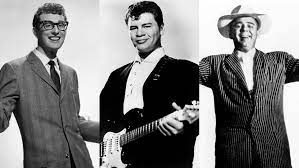
That first date is the day when rising rock stars Buddy Holly, Richie Valens, and J.P. Richardson (The Big Bopper), along with their pilot, were killed in a plane crash near Clear Lake, Iowa. Buddy Holly was the most well-known, having written many hits and covered songs by others. Every Day, Maybe Baby, and It’s So Easy are three that get covered today by popular singers. Valens, known for La Bamba and Donna, was considered the founder of Chicano rock. The Big Bopper is most remembered for Chantilly Lace, but wrote songs that became hits for others (White Lightning and Treasure of Love were two for George Jones.)

I was not quite six when their small plane went down, and do not remember it. The most I learned about it was from Don McClean’s American Pie, which came out in 1971. But I did learn some of the music when I was a young teen in Milledgeville, Georgia. WMVG is an AM station located in that central Georgia town. Back in the mid 1960’s they had an hour of rock music, from 4 until 5 in the afternoon, called Teen Time, and they would allow young teens to come in and cue up and introduce the 45 rpm records in their library. It was mostly whatever was the latest hits that could be heard (or seen) on American Bandstand, but they also had some of the classics of Buddy Holly, The Big Bopper, Richie Valens, Bill Haley and the Comets, and others. My best friend from those days, Ray James, and I would occasionally get to be in that booth and introduce the songs. The music may have died in 1959, but it had since been reborn and was growing up fast.

I got to watch it being born (at least in the USA) and grow up as I grew up.

February 9, 1964, was a Sunday. I was living in Tallahassee, FL, where my father was a graduate student at FSU (Go Seminoles!). I was in the fifth grade at Carolyn Brevard Elementary School. Television had become the nation’s medium for just about everything. I remember sitting in silence in my classroom just a few months earlier when the television was rolled in, and we watched the shocking reports of the assassination of President Kennedy. It seems odd now to bring that kind of news before fifth graders, but our teachers knew this would be a defining moment in our lives. As we watched the news on TV, we also watched the tears coming from our teacher’s eyes.

Entertainment and story-telling was also shown by this electronic box in our living rooms. Bonanza, I Love Lucy, The Twilight Zone, and Gunsmoke kept us glued to our seats.

The crowning show, though, was the variety show The Ed Sullivan Show. Ed was the host of a show that featured famous opera singers, plate spinners, ballets, comedians, and a mouse called Topo Gigio. We always hurried home from the evening church service to catch Ed Sullivan.
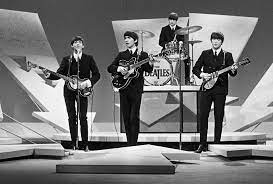
And on February 9, 1964, five years and six days after it died, the music was reborn with these words- “And now, ladies and gentlemen The Beatles!” Most news reports the next day were about the crowds. There was constant screaming from the teenagers in the audience. And there were some comments about their “puddin’ basin” haircuts, later called a Beatle haircut. (I always thought it looked a little more stylish Moe of the Three Stooges hair style.) What I remember most was the music.

They started with All My Loving, then Til There Was You, and ended the short set with She Loves You (Yeah, Yeah, Yeah). They returned in the second half of the show and played I Saw Her Standing There and I Want to Hold Your Hand.

The British Invasion began and the American response to it. I got to see a lot of it live. The Rolling Stones, Gerry and the Pacemakers, The Kinks, Led Zeppelin from across the pond. The Beach Boys, The Byrds, Buffalo Springfield, Credence Clearwater Revival, Jefferson Airplane, and The Grateful Dead from our side.

We cannot forget Elvis, who preceded the Beatles in fame and notoriety, but he never really pushed the boundaries. The Beatles did.

I read an article that said the music that was popular when we were fourteen is the music that defined us. Mine began a few years earlier.

Recently I was riding down the road listening to Sirius XM radio and realized I hardly ever listened to anything but music from that era in my life. So, I asked two younger friends to make me a list of twenty-five albums they thought were essential for someone to hear if they wanted to know about their generation’s music. One friend is 45, 25 years younger than me. The other is 20 years younger than him. I am working my way through my 45-year-old’s music, and it is amazing how good it is. I cannot wait to start on 25-year-old’s list.

In 1697 William Cosgrove, a playwright, wrote “Music hath charms to soothe the savage breast.” It also has the power to ignite the imagination, make the feet dance, the eyes cry, and hands reach out in compassion.

To quote The Doobie Brothers:

Don’t you feel it growing, day by day
People getting ready for the news
Some are happy, some are sad
Whoa, gotta let the music play

What the people need is a way to make ’em smile
It ain’t so hard to do if you know how
Gotta get a message, get it on through
Oh, now momma don’t you ask me why

Whoa, oh listen to the music
All the time.

All the time.

Holey, Holey, Holey

The artwork of the Alutiiq and Yup’ik tribes rarely contains hands. But when they do, most of the hands have holes in them.

The Alutiiq and Yup’ik are Alaskan native tribes in the Kenai area. They have lived in that area for several thousand years, and, for the most part, have been self-sufficient. They live off the land, farming, fishing, and catching game for their food and clothing. Like many ancient peoples, their artwork not only tells their history, but it reveals some of their understanding of nature and the cosmos.

So, why no hands?

Part of the reason is that hands indicate a way of controlling the world. We use our hands to grasp, bend, subdue, mold, and shape the world around us. They think of themselves as being in the flow of nature, not in charge. So, they attempt to live in harmony with the world, and do as little to manipulate it for their use as possible. Compare that to those who see a vast wilderness and begin planning on how to exploit it for commercial gain.

Native peoples of North America have many proverbs and sayings about our being a part of the world. “Walk softly upon the earth and she will bless you with her grace,” is one that comes to mind. Famed naturalist and the father of our national park system, John Muir said, “Indians walk softly and hurt the landscape hardly more than the birds and squirrels, and their brush and bark huts last hardly longer than those of wood rats”.

I remember a conversation from when I was a young child with an incredibly old Cherokee woman in the mountains of North Carolina. She told me, “When you gather with your family and friends to pray, I notice you like to hold hands to show that you are connected to each other. When our family prays, we do not do that. We know that we are already connected by the earth we stand upon.”

Back to hands.

So, when they do depict hands, why the holes? And why do so many of the Alutiiq and Yup’ik have holes tattooed on their hands?

According to those who have asked the tribes, there are three main reasons.

First is so that part of the things they harvest for their use- plants, fish, animals, returns directly back to the earth, honor the creature by reconnecting it to the place of its creation.

The second is for sharing. They do not believe that anything belongs exclusively to an individual, but all is given for the good of the community. Holes in your hands keep you from grasping anything for yourself.

And third is that the holes are a type of portal to the other dimensions of the universe. That through those holes pass the wisdom from the past and the hope for the future. And that world is to be viewed through that. It is a very sacramental part of their understanding of the world.

Dali’s painting of the Last Supper reflects some of that. The world, past present, and future, is viewed through the sacrificial body of Christ.

I like to think of this when I receive the sacrament of Communion, that I am receiving it from hands with holes in them. And when I offer it to others, I pray that my hands will be the same.

We could all use more holey hands.

The Lonely Highway

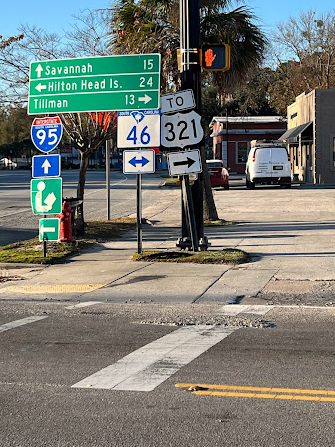
It starts in Hardeeville, just off the South Carolina-Georgia border, and runs 271 miles up to Bowling Green on the North Carolina border. I read an article on the “loneliest highway” in each state in America and decided to see what the one in my home state was like.

“Loneliest highway” is not just a subjective term. There is a measure- AADT- the average annual daily traffic. The lower the number, the fewer cars. The article gave details on the five loneliest, then just listed the rest of the states.

I asked my friend Joel to ride the road with me. Being a United Methodist minister, and the son of a United Methodist minister he had lived in many of the areas we were going to pass through. So we headed down to Hardeeville to spend the night before making the drive the next day.

Though Hardeeville is the southern terminus of this road, it is by no means a lonely place. After checking in to our motel we went to eat down the road at the Okatie Ale House. The highway was packed as was the restaurant. Good food! We recommend it.

The next morning, after a light breakfast, we headed out. The first few miles had quite a bit of traffic, and there was road construction going on. The highway was being widened. Seemed odd for a highway deemed low AADT, but we realized that the area down there was booming with new people, mostly retirees from up north. The cost of living is much less, the climate is mild, and the people are friendly. Who can resist?

But soon 321 began to live up to it’s reputation. We rarely passed another car in either direction. After going through the crossroads community of Tillman, we were on our own until we got just outside of Columbia.

The road was actually quite pretty. And remarkably clean. Years ago when Lou Holtz came to USC he noticed how much litter was on the highways in SC and started a campaign to clean up our roads. I do not know if it was because of him, but it seems our highways are much better these days.

As we drove through the small towns, Joel told stories. “Over in that direction was where I lived in high school….See that old building? It used to be a general store where I went to get Cokes and peanuts….The lady who lived in that house was the gossip of the church. I never had to worry about getting information out to people. I just told her….” There was a lot of love and respect coming from him, even for the people who had given him or his father a hard time.

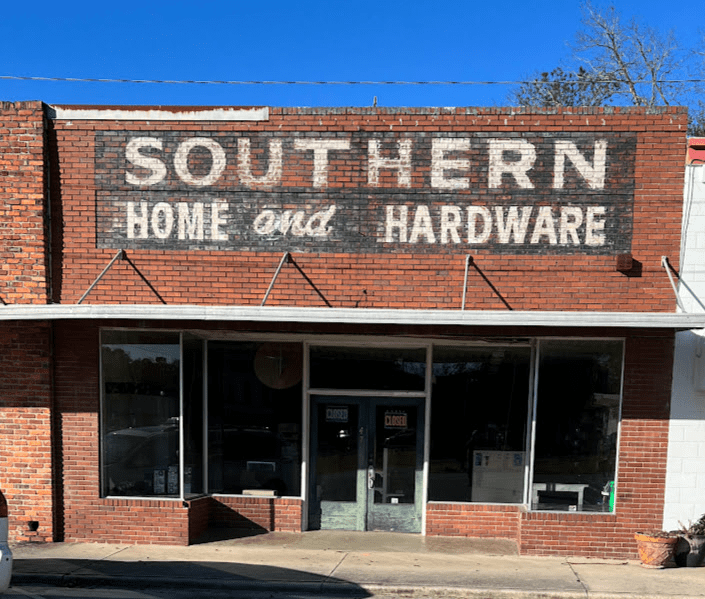
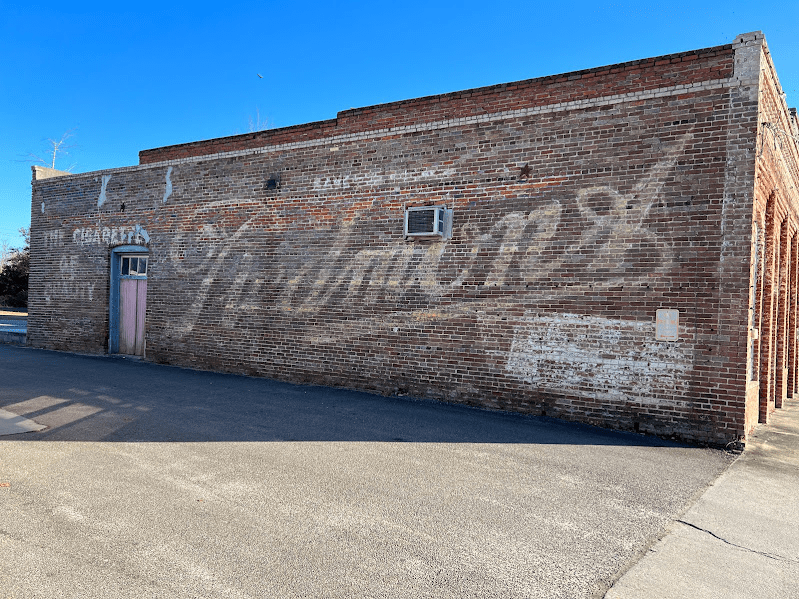
For several years I have been collecting photos of “ghost signs,” that is, advertising signs that were painted on the sides of old buildings years before and have faded, but you can still read and see them. I picked up several along this trip, and some in good shape.

Traffic picked up at Swansea and stayed that way until we got through Columbia, then it back to the lonely highway again.

On the north side of Columbia we picked up Neil, another clergy who had lots of connections up around Winnsboro. So we got another set of stories. “This is where we used to come for family reunions….Over here is where I learned to fish….My ancestors settled this land…”

We stopped in the community of Blackstock. Blackstock was the home of Bull Durham, the baseball player, for a while after he retired from baseball and silent movies. While taking photos around one of the old buildings a local man stopped by. Turns out he was the barber in the area, so we got to hear a few stories from him.

The day-long trip ended mid-afternoon at Bowling Green.

A few lessons learned-

  • Lonely highways can be beautiful, even in South Carolina.
  • There’s a lot more to the state than most people realize. You just have to slow down to see it.
  • And most importantly, it’s always best to travel with a friend or two. You never know what you might learn.

See you out on the road!

The Case Against Discernment.

Discernment and discern are words that have been thrown around a lot in United Methodist Churches for the past few years. I keep hearing it and each time I want to quote  Inigo Montoya from The Princess Bride- “You keep using that word. I do not think it means what you think it means.”

Years ago we used it to talk about understanding or figuring out something we were supposed to do. Maybe a vocation, a move, a new direction in life for individuals. Or for a church, it was for a new ministry, or a change in staff, or a change in worship times and styles. Either way, it was done with lots of prayer, study, thought, and commitment. It was never to be hurried.

Our friends in the Quaker Church (Society of Friends) have been doing this for years. They describe the process this way:

Quaker decision-making is grounded in the belief that when several people come together to labor in the Spirit they can discern a truth that exceeds the reach of any one individual. In making decisions Friends do not simply vote to determine the majority view, but rather they seek unity about the wisest course of action. Over time Friends have developed ways to conduct meetings that nurture and support this corporate discernment process.

To be effective, Quaker process requires that everyone come ready to participate fully by sharing their experiences and knowledge, by listening respectfully to the experiences and knowledge brought by others, and by remaining open to new insights and ideas. This powerful combination of grounded experience and spiritual openness, rationality and faith, allows a deeper truth to emerge. When everyone present is able to recognize the same truth, the meeting has reached unity. The clerk’s job is to sense emerging truth and labor with those present to put that truth into words.

(from the American Friends Service Committee)

The United Methodist discernment process at the moment is more akin to the workings (or lack thereof) of the US House of Representatives. Rather than seeking unity, we seek victory. Which means there is always a winner and a loser.

In this form, ultimately everybody loses.

Many of our churches have gone through a “discernment process” about staying in the UMC or leaving the denomination. It centers around the ordination and marriage of LGBTQ individuals. (Currently, the UMC Discipline prohibits both, but some Conferences enforce this rule and others do not. South Carolina does.) Pastors who have already left the denomination with their churches have been calling former parishioners and friends in their former churches, telling them the things they need to do to get their church to disaffiliate. Meetings are held to discuss plans on how to get one side to win. And when one does, and the other has lost, the losers are often invited to join a different church, one that is aligned with their vote.

We often use the word discern with the term “will of God.” Which is odd for a few reasons. Often the will of God is not something that is figured out but revealed. It often goes against popular belief and understanding. And it was never something to be voted on. That term most often ends up being used to justify the status quo and our own prejudices. It seems to be the way of the church most times.

And we use it to try to understand the will of the Church. Which is what the Quakers do. But they place unity over victory. Even if it means a loss for them. To borrow a term from another book, the choice was between the way of the Dragon and the way of the Lamb.

This really isn’t a screed against discernment. It’s just asking us to choose the way of the Lamb.

January 25

A month ago most of us were unwrapping gifts and making noises of excitement, surprise, and gratitude. “Ooh,” would come from our mouths, followed by “Aah,” “It’s just what I wanted,” or “What a great gift!” Wrapping paper was strewn all around and bows were haphazardly slapped on the backs of cats and dogs as they walked by. (I was busy doing other things which you can read about here, but I know that’s what most of you were doing.)

A mere thirty-one days later, most of those gifts are sitting in some place where we may see them, use them, but do not gush over them. Special gifts quickly become common. “Constant gratitude for common gifts is uncommon,” Edward Hays writes.

Four years ago I was very sick. I could not walk to the bathroom without help. I kept getting weaker and weaker, and the doctors did not know what was wrong. When they finally found out and did the things I needed- surgery, medicines, rehabilitation- I began to get better and was so grateful for…well…everything. The feel of clean sheets, the taste of cold milk, being able to walk to the mailbox, feeling the sun on my face, the sound of rain hitting the HVAC system outside my study window, getting texts and calls from friends. All of it brought so much gratitude to my heart. And I could not stop saying prayers of thanksgiving for all that had been done for and to me.

In her book Pilgrim at Tinker Creek, Annie Dillard tells the story of a blind 22-year-old girl. She had an operation, and suddenly she could see! But she closed her eyes for the next two weeks because of the brightness of the world. When she finally opened them she just kept saying repeatedly, “Oh God! How beautiful!”

I understand why we can’t be in a constant state of overwhelming gratitude. The emotional energy it drains from us would keep us from doing anything else. I love a good party, especially a surprise one. But afterward, I am worn out and need some rest.

Still, we need to find ways of experiencing the joy of the gifts we are constantly surrounded by. The dullness to our senses and our spirits robs us of the fullness of life. We miss so much of what is around us. Last night Henry McMaster, the governor of my fair state, quoted Joni Mitchell’s song “Big Yellow Taxi.” “Don’t it always seem to go that you don’t know what you’ve got ‘til it’s gone.” It’s when we lose those gifts that we realize that we could have been more grateful.

So, on this month after Christmas Day, I think I’ll give special attention to all of the normal, common, everyday gifts in my life. And do my best to be thankful.

Something That Will Last

(Note: I wrote this several years ago. I had not published it on my blog)

While walking one morning I passed a cement truck and workmen laying a new sidewalk at a home. Memories came flooding in.

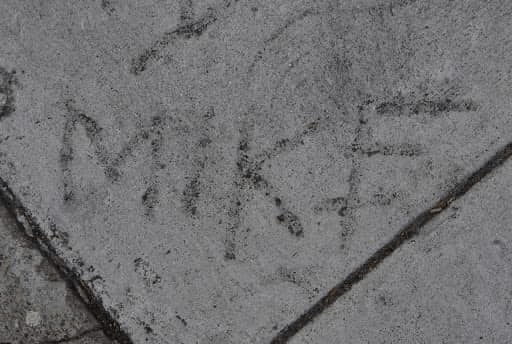
Inman Elementary School, 1962. The school bell rings at 2:30 and 200 screaming first through sixth graders run out the doors, heading towards home. Suddenly they all stop, silent, eyes wide, mouths agape. There before them are two large cement trucks, 6 workmen, and 40 yards of freshly laid, smooth-topped sidewalk in front of the school. We all stand for a minute in complete awe and silence. Then, suddenly, 400 little hands grab 200 sticks, and begin to write over 200 names in the sidewalk, destroying the hours of work done by those hard working men. You could hear their groans.

We all want to make a mark in something that will last.

Some build financial empires with their names forever emblazoned on them. Others build great buildings. Others form political dynasties. And others work on families. Scratching our names into something that will last.

But none of it does. It never does. Finances fade, buildings fall, empires tumble, and families end.

Jesus said “Do not store up for yourselves treasures on earth, where moths and vermin destroy, and where thieves break in and steal. But store up for yourselves treasures in heaven, where moths and vermin do not destroy, and where thieves do not break in and steal.” (Matthew 6) He also said that only what we do for others will be known in heaven (Matthew 25).

I was back in Inman several months ago. Not a trace of that sidewalk remains.

Christmas Day 2023

This Christmas was a little different for Cathy and me.

We had planned to visit her sister and brother-in-law on the 23rd, then my sister and her family on the 26th. Christmas Day itself would be a stay at home day.

Which is unusual for me.

For many years I have always gone to church on Christmas Day. Even when it did not fall on Sunday. I just feel that celebrating the birth of Jesus ought to have some sort of worship involved. Nothing fancy, but gathering with other followers of Christ, reading the stories from Matthew and Luke, singing a few carols, offering prayers, and sharing with each other. And since I was pastor of the church, I had a key to the sanctuary.

I would tell the staff they did not have to join me, but they were certainly welcome. I would invite the congregation to come, kids in pajamas, adults in sweats, however they wanted to dress, around 10 in the morning. I would break out my guitar and we would sing. (I have a special gift of singing- the louder I sing, the louder everybody else sings.) Kids would share what their favorite gift was, and then we would talk about the gift of Jesus. It usually lasted about 30 minutes, then we all go back to our regular celebrations. This was done regardless of the day of the week Christmas fell on.

At each church I served it always started off small, sometimes with people telling me I should not be doing it. After all, they said, isn’t Christmas about family? I would tell them it was, but it wasn’t about theirs (or mine). It was about a family in a cave with a baby in a manger. The first year a few people would show up. But each year it would have more and more. For many it became part of their family tradition.

But now I am retired, and while I still serve as pastor of two really good small churches, they are a forty minute drive away from my home. So, this year, for the first time in decades, we were going to be home all day. I was really missing being in church.

We did not get to meet with family, either. Cathy’s sister has cancer and is getting chemotherapy. It has lowers her immune system. The week before Christmas we had some kind of respiratory illness, so we decided not to visit her. This was very hard for Cathy. She and her sister are joined at the hip. They are not only sisters, they are best friends, and they start and end each day with phone calls or texts to each other. She was missing her sister something awful.

And, because of the illness and some of the reactions to my cancer treatments, we decided we could not make the two and a half hour drive to see my sister and her family. Paula and I have always gotten along with each other, but there were many years when we didn’t get to see each other often. However, the last few years we have become quite close. I am loving how we are getting along now. And her children are a joy for me as an uncle. Her husband David is a wonderful guy and I am so glad he’s a part of our family and we are a part of his. But I wasn’t going to get to see them, either.

So…no worship, no family, no special meals on Christmas.

Then Cathy hits me with this.

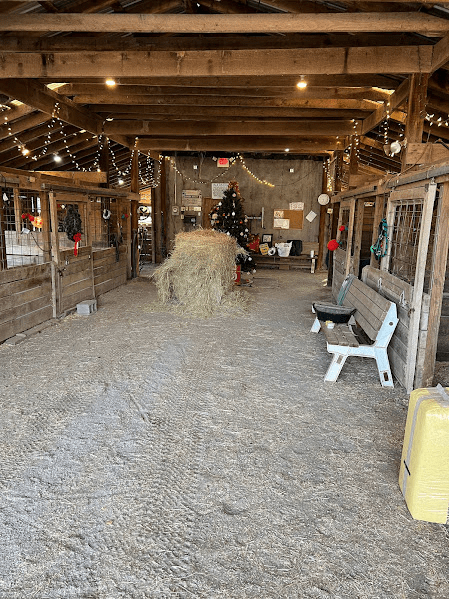
“I’ve got to go to the horse farm and take care of the horses Christmas morning.” Many of you know Cathy volunteers with the Florence Area Humane Society. They have a farm for abused horses and other large animals, and she goes out to feed, clean, and groom them. It is a place of joy for her. “No one else is going to be out there on Christmas day, and someone has to feed the horses.” She’s right, of course. For those who live on farms or who have animals, caring for them does not take a holiday. And though that is not my particular calling, I did not want her to go out there alone on Christmas Day.

So, we get up early on December 25, grab a cup of coffee and head out to the farm.

Turns out we were not alone. Jane, the director of the FAHS, and Tom, another volunteer, were there just beginning to take care of the animals. They had the same idea as Cathy, not knowing that anyone else would show up. Cathy hands me a pitchfork and points to a stable where the horse had just been taken out to pasture, and tells me to muck it out. I start pitchforking horse poop into a wheelbarrow, while Cathy takes care of some of the other animals.

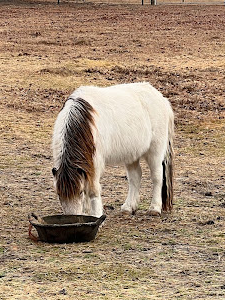
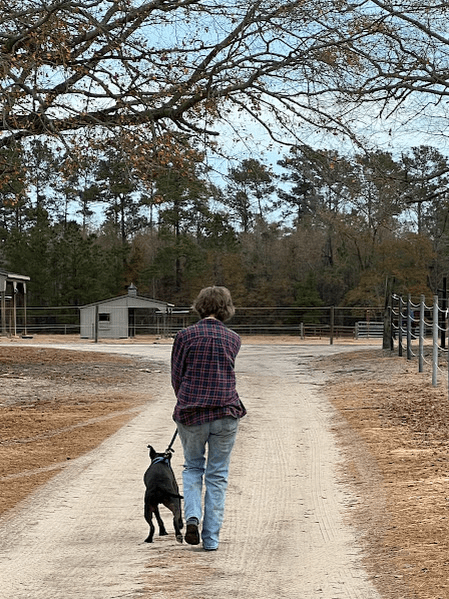
She knows them all by name. There are some horses, including a small Shetland named Sam; a donkey who starts braying when you start the golf cart up (because he knows food is on the way); a bunch of new puppies that had come to the regular shelter and there was not room for them; and Rocco, her favorite, a pit bull that was rescued from being a bait dog. When I approach the animals, they shy away. Most of them had been abused, and mostly by men, so it is understandable. But Cathy has them all- horses, dogs, donkey- coming to see her.

I finish mucking out the stable and go to where she is feeding the dogs. She hands me the hard rubber chew toy. It has dog poop all over it. “Here,” she says. “Clean this.” It’s Christmas morning and I’m on poop patrol at the farm. As I’m washing the chew toy, I wonder if Joseph had to do this kind of thing.

A car pulls up and three more people get out. Ernst, Patricia, and their college student son Patrick. They start helping. We talk as we work with the animals. Patrick is in his last year at Clemson and we talk about hiking trails up in the area. They were worried about the animals, so they showed up “just in case.” And a few minutes later a couple of more volunteers showed up, not knowing that anyone else would be there.

We finished up faster than we had planned. Cathy spoke to each and every animal, all the people spoke to each other, we wished everyone a merry Christmas, and went home.

That evening I was thinking about the day. I didn’t have church, didn’t read aloud the Christmas story, and wouldn’t see my family. But I was in a stable on Christmas morning. And made it a little better for some of God’s creatures. And while I did not see the Holy Family, any shepherds, or magi, I do think I saw a few angels.

Let’s Be Careful Out There!

Today, January 8, is the anniversary of the death of Galileo Galilei, who died in 1642. Although he was not the first to posit it, he said that the earth was not flat. (It had been pretty much proven by lots of people from the Egyptians to the Greeks and the Romans for a few thousand years.) He also argued for a heliocentric universe, saying that the sun does not rotate around the earth, but that the earth rotates around the sun. Both of these (along with some other scientific theories) got him into trouble with the Church of the day. They argued that the Bible clearly stated the earth was flat and that the sun and stars rotated around the earth.

Eventually the Church threatened to burn Galileo at the stake if he did not recant. So he did. Not out of scientific understanding or religious belief, but out of fear of a painful and horrible death.

He anguished over his decision for the rest of his life.

(Note: In 1992, 350 years later, the Catholic Church admitted it was wrong.)

Every year on this day I take some time to think about the things the church (or at least a large part of the church) argues about in the culture where they believe “the Bible clearly states” whatever they believe. In the past it has been support of slavery, genocide, subjugation of women, child labor, destruction of the environment, and taking of land from native inhabitants.

I know that the church has also done much good (public hospitals, education, promoting democracy, helping the poor, etc.), even having people within the church fight against the sins listed above. But that does not negate the fact that we still do some pretty bad things, and we still persecute those who stand up for something different.

While by no means being a loud voice crying out in the wilderness, calling for justice, peace, caring for the poor, and inclusiveness, I have spoken what I know God wants for our world. And have had some pretty surprising pushback from church members. Not threatened to be burned at the stake (at least, not yet) but some things I never thought followers of Jesus would do.

In Cayce, I had put on the marquee “Join Us In Praying For The President.” This was during the Obama administration. I had phone calls threatening me with violence, and threatening to tear down the sign. This was from people who claimed to believe the Bible. Well, all of it except for 1 Timothy 2:1-2. And Romans 13:1-7. And… Well, you get the point.

In Florence, I received several letters from an anonymous author threatening me and by implication my church with violence. I think the term used was “destruction and death will be brought upon you.” The letters were turned over to the police, and since the US mail was involved, they eventually went to the FBI. It was specific to me and my church. No other United Methodist Churches received similar letters, and none of the churches in Florence, regardless of denomination, did. The FBI said it was probably just a crank, but encouraged us to be careful. The trustees of the church, who are empowered to care for the safety of the church, wisely decided to hire an off-duty police officer to be at the church on Sunday mornings. Nothing ever happened of violence.

But I wonder how much money our church and lots of other churches have had to spend on safety. Money that could be used for other good things.

Most of the threats do not come from the world outside of the church. The world outside pretty much ignores the church these days unless it figures it can be used for political purposes. The threats come from within. And they come from people who believe that “the Bible clearly states…”

Back in the early 1980’s one of my favorite TV shows was Hill Street Blues, a cop show about a police station located on Hill Street in a large city. Almost every show started with the police officers getting their daily assignments from Sergeant Phil Esterhaus (Michael Conrad). He always ended his session with “Let’s be careful out there!” Esterhaus was not referring solely to physical safety. He was also referring to how they interpreted and used the law. It affected real people.

Sometimes I think every church service should end with the words, “Let’s be careful out there.”

The Painting and The Vine

Leonardo DaVinci’s famous painting, Mona Lisa, lies protected deep within the Louvre Museum in Paris. Guards surround it and thick glass covers it to keep air and light from destroying this ancient work of art. Crowds of people come to look at it and try to get a photo through the dark glass that encases it. It has not changed It has not changed in over 500 years. The same enigmatic smile, the same background. Those who looked at it in the early 1500s saw the same thing I saw when I was there (without, of course, the dark glass case, the guards, and the people with cameras).

Outside of the museum, in one of its courtyards, is a vine that has been growing for years, perhaps since the museum was founded in 1793. Not many people notice the vine, but it is carefully attended by a gardener. While the vine is the same vine it has always been, it does not look the same as it did in the past. It is living and growing.

For those of us who are followers of Jesus, our relationship with Jesus often becomes like that of the painting. We have not changed, we have not moved, we have not grown. We worship, study, pray to, and serve not a living God, but a portrait of what that God was like back when we first came to Christ. We turn a living relationship into a set of closely guarded and protected rules and dogma.

Yet Christ is alive and our relationship with him should be like that of the gardener and the vine. (As a matter of fact, Jesus said something about him being a vine and we the branches- a living relationship.) We should be growing, expanding in grace, serving in new ways, and welcoming people to the family of Christ who are different from us. 

Here’s a quick way to tell if you’re worshiping an idol, or in a relationship with a living God. As in all things be honest. Answer these questions: 1. How have you changed in the last year? 2. What do you believe now that is different from what you believed when you first came to Christ? 3. Would those who know you best say you are changing in ways that make you attract people to Jesus?

What is true of our relationship with Christ is also true of our relationship with the people around us. As a matter of fact, Jesus said that the way we treat others is the way we treat him.

So, on this first day of a new year, I ask myself, am I growing in my relationships, or are they pretty much the same as they always were?

The answers will tell a lot about whether my relationship is with a painting or a living vine.

(Credit Where Credit’s Due Department: the idea for this came from Selling Water By The River by Shane Hipps. I highly recommend the book.)

Word For The Year 2024

The Oxford English Dictionary, the preferred dictionary for all weight-lifters, recently announced their Word of the Year 2023. It is rizz. It is taken from the word charisma, which is obviously too long for many people to pronounce today. Also, you cannot further murder the English language by easily turning it into a verb or adjective. You can “rizz someone up” or “be all rizzed up” but it’s harder to say “I used my charisma to charm someone into doing something I wanted,” or “they were overwhelmed by the charisma of the event.” So now my 20-pound OED will have a few more grams added to it for the sake of ease.

As most of you know, I am a logophile, a lover of words. After all, that’s our primary means of communication. Even other forms of communication- music, art, interpretative dance, smoke signals- are interpreted back into words. They not only inform us, they shape us and the world around us.

Davenport

Some words stick around but are rarely used. When was the last time you used the word “davenport” to refer to a piece of furniture?

A word we need to bring back is crapulous. It doesn’t mean quite what you think (definition: to feel ill from overeating or binging), but it is a great word for an election year. And it seems we just break into laughter when someone uses the term bipartisan these days.

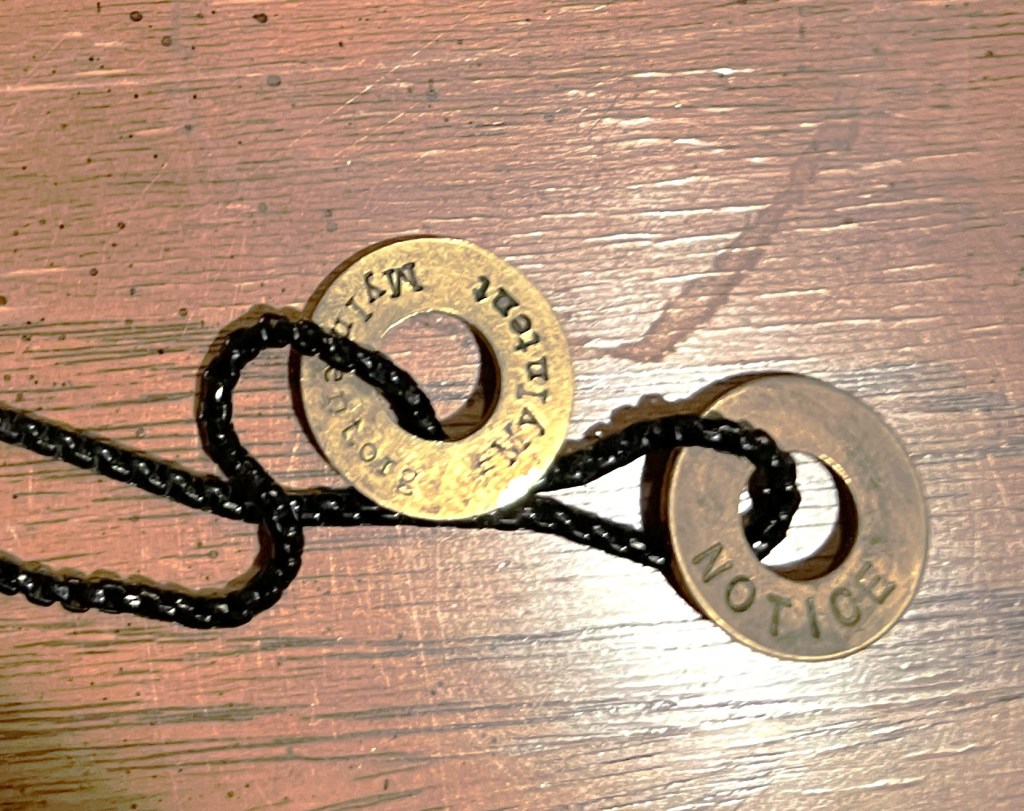
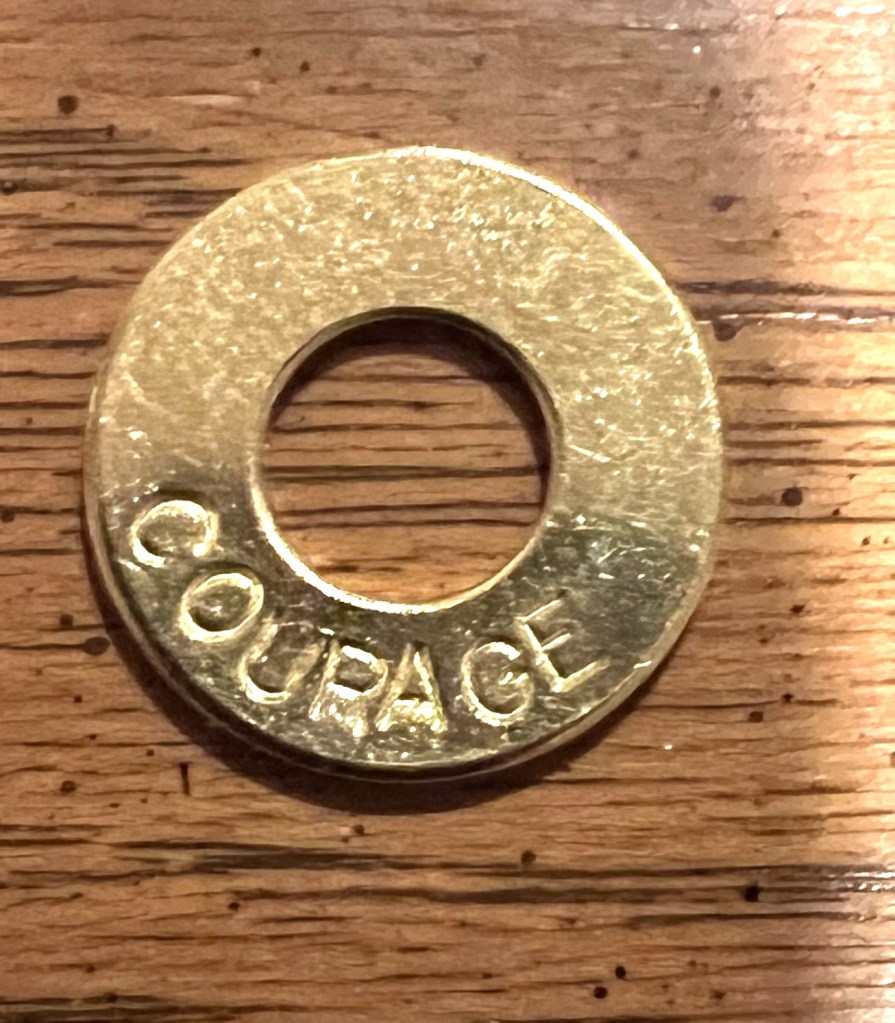
If you have been around me much for the last 10 years you will notice that I often wear a chain around my neck with two brass washers on it. Each washer has a word on it. One was suggested by my wife Cathy, when I asked her to describe me in one word. I’ll not tell you the word, so you can just imagine what it it, but I wear it to try and live up to what she sees in me. The other has a word that I choose for the year, something I work on or try to live up to. For instance, in 2022 the word was Listen. I wanted to listen more- to people, to nature, to the Spirit. In 2023 my word has been Notice. I decided I needed to pay more attention to what was around me. It has been an interesting year.

I’ve been thinking about my word for 2024. I’ve decided it will be Courage.

By nature, I am a people-pleaser. I do my best to help people get along with each other. I am not very good at confrontation. When I do that, I often feel like I am condemning others- not just their ideas or opinions, but the person themselves. Telling them that they are not worthy of recognition. Maybe that’s because I have often felt that way myself. So, instead of “speaking the truth in love” I do my best Rodney King. (For those of you under 40 years old, Rodney King is an African-American who was caught after a high-speed car chase and then beaten unmercifully by the police. Riots ensued. And seeing even more destruction going on, King made a plea to “get along” rather than saying something like “we need to find a way to prevent this kind of brutality.”)

This next year so much hangs in the balance in our country. We have a significant number of people who have given up on democracy and are ready to turn to a dictatorship. So, what I will need is courage, along with wisdom to speak in winsome ways. Even the prophets of the Hebrew Scriptures always ended up giving some hope. Courage is my word.

The purpose of this rambling is not to express my politics, though obviously I do. It’s to get to this question: What is your word for 2024?

PS- If you want to order a word for yourself, go here.