Today is St. Patrick’s Day. There are all kinds of celebrations happening around the United States, and around the world. Many have to do with Irish culture more than St. Patrick. A few do honor him. Most are just a great way for us to party, drink Guinness, eat corned beef and cabbage, wear green, and be thankful that somehow all of us are Irish. Oddly enough, most of the things we do to celebrate did not start in Ireland, but in America.
The Chicago River dyed green for St. Patrick’s Day.
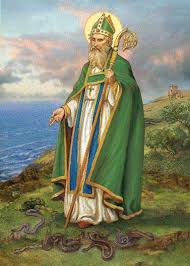
Patrick had a lot of myths grow up about him- he was Irish (he was born in Britain); he brought Christianity to Ireland (he, in fact, was converted while in Ireland); he chased the snakes out of Ireland (Ireland has been snake free since it became an island).
There are a few things that most historians agree on regarding Patrick. He was born somewhere in Britain, sometime around 390 CE. Sixteen years later he was taken captive by Irish raiders, taken to Ireland, and sold as a slave, where he became a shepherd for his owners. He was held a slave for six years, during which time he became an ardent follower of Jesus. (Note: his parents were most likely Christians, and Patrick may have been baptized early in life, but there is no indication that he took it seriously.) After six years of slavery, he escaped and went back to Britain, where he became a priest. He stayed in Britain for 16 years (until he was 38), rising in the ranks of the Catholic church. He then returned to Ireland, to the people who held him captive as a slave, and brought the gospel of Jesus to them in new ways. Many became followers of Jesus, and the country itself changed.
In my meditation time this morning I was reading about having “a great heart.” There is a Buddhist term, bodhichitta, which means “a heart that is noble and awakened, filled with compassion for others so that you feel the pain they feel.” I think it is what Jesus telling us in the Beatitudes in Matthew 5. Otherwise, they do not make sense. I’ve been thinking about people with great hearts. People who see beyond the pain that others have caused, and long for them to find the peace they know, even if it is costly. Stories I read of Corrie Ten Boom, David Wilkerson, Elisabeth Elliot shaped my early life in following Jesus. Watching Martin Luther King, Jr., and Nelson Mandela spurred me on. Patrick, too, leaves me awestruck. Honestly, I do not think I have a heart that wants the best for those who have hurt people. But I want to have that heart.
I find myself singing Johnny Clegg’s Great Heart almost every day. Though it’s not Irish, but African, I think Patrick would like it. He had a great heart.
Having watched the inauguration and seeing Mrs. Trump hold two Bibles for her husband (one given to him by his mother, the other belonging to Abraham Lincoln), but Mr. Trump not putting his hand on either of them while he was being sworn in as President, I’ve been thinking about Bibles and how we use them in public settings.
There is no requirement to use Bibles for anything in public life. George Washington used one, but Thomas Jefferson did not. Neither did Teddy Roosevelt or Calvin Coolidge. John Quincy Adams used a book of law. Truman, Eisenhower, Nixon, George H. W. Bush, and Obama each swore the oath on two Bibles. Biden’s Bible had been in his family since 1893.
Members of Congress do not use a Bible for their official swearing in, which they do en masse. However, many of them have a second, unofficial swearing in while holding a Bible, mostly as a photo op. Same goes for members of the Supreme Court. If you are called to give testimony in a court you are not required to place your hand on a Bible, though some do give you that option.
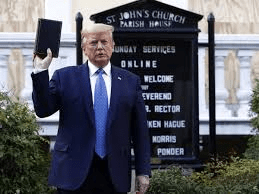
We all remember June 1, 2020, when Trump gave a speech from the Rose Garden encouraging governors to use National Guards to rule the streets and quiet protest, or else he would send in military power to do it, then walked to St. John Episcopal Church and held up a Bible for people to take photos. He did not make a speech there. He just stood and held the Bible.
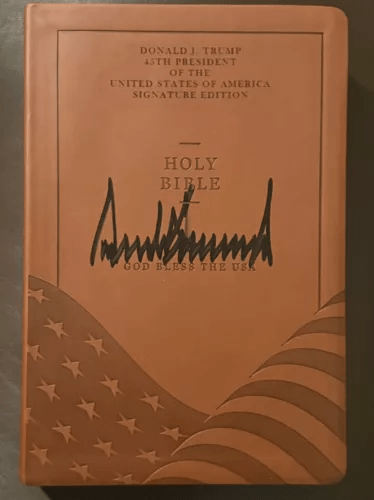
And, we also remember how during the last campaign, he sold a special edition of the Bible as a fundraising tool. By the way, he had those Bibles printed in China at about $3 each and sold them for $59.99. Reported production and shipping costs for the Bibles was $342,000. He hoped to make $7 million but ended up with just around $300,000 for a loss of about $42,000. (You can buy one on eBay autographed by Mr. Trump for $4,700. Or you can get a Bible for free at just about any church you visit.)
It has always seemed odd to me that people would think placing your hand on a Bible would make you more likely to keep your oath or tell the truth. As far as I know, there has never been anyone struck down (“smote” in the King James vernacular) for lying or breaking an oath after swearing on a Bible. And almost all of us can list in great detail the number of people who actually preach from it, declare it to be God’s Word, and swear by it who have not done the simplest things it proclaims.
I have never had the opportunity to ask any of the leaders of our country who have used Bibles in their publicity shots which part of it they believe. The part about stoning adulterers (Leviticus 20:10-12)? Or the part about all debts being forgiven every seven years (Deuteronomy 15:1-2)? How about the part about welcoming foreigners to your land (Matthew 25:31-40)? Or selling all you have and giving the money to the poor (Matthew 19:21-24)?
I have an idea. Let’s do the one thing Jesus said about it. “Let what you say be simply ‘Yes’ or ‘No’; anything more than this comes from evil.” (Jesus, Matthew 5:37)
I swear on a stack of Bibles that this would be best.
Okay, I’m about to lose more friends, because today I’m going to say something that will really tick people off. And that is- I like the cold weather!
There. I said it and I’m sticking to it. A lot of you…okay…well…all of you…are complaining about the cold. Except for my friend Jeff. He’s from Erie, PA. He says, “You call this cold? You don’t know cold!” Many of them are longing for the blistering heat of summer. And that’s okay. It will come around soon enough.
But I like the cold. And here’s why.
It gives me an excuse, if I need one, to put on sweats, make a pot of coffee or mug of hot chocolate, sit around the house, and read books, do some writing, maybe watch a movie. Note- I do that anyway, but I don’t feel near as bad about it when it’s cold outside.
If I do decide to go outside, I breath in and am reminded that I am alive. I feel the cold air enter my lungs, and sometimes I see it come back out. I like bundling up in layers of clothing until I resemble the Michelin Man. And I like making eye contact with those other brave souls who are out walking dogs, checking the mail, getting some exercise. We all know who are the hardy ones in the neighborhood.
And you can always put on more clothes in the cold, while you can only take off a certain amount in the heat.
And it gives me the chance to check in with my friends via text to make sure they are okay. I know I could do that anyway anytime, but it seems less weird for me to check in on them when it’s cold. This in itself is good and warming to me because it reminds me of how many friends I have.
I pray for those who have problems with cold weather- the homeless, people without adequate warmth, the sick. And for those with no one to cuddle up to. I try to do things to help them- donating coats, gloves, hats, small heaters, electric blankets. Except for the cuddling. They are on their own.
So, pardon me while I bundle up and go out for a short walk. I love it! Baby, it’s cold outside!
Well, it’s time for me to tick off a few people, disappoint a few, and most likely lose a few “friendships.” I put that in quotes very intentionally. After listening to today’s inauguration speech, I am more convinced than ever that Trump is president of the United States, but he is not my leader.
I do not say this because of his speech, which, by the way, was the most frightening I have ever heard. I say it because I am a follower of Jesus, one who accepts him as Lord of my life. And for the last 44 years I have become increasingly convinced that you cannot be a person who calls Jesus Lord and serve anyone or anything else.
Let me take you back to my early teen years, when I first decided to follow Jesus.
A side note: you will notice that I rarely, if ever, refer to myself as Christian. That term, which was originally used as a mocking term to describe followers of “The Way” who were being persecuted, has been co-opted by the right-wing political groups in America. “Christian” and “Follower of Jesus” seem to have two different meanings these days. I go with the second.
In my early teens I was pretty much lost in this world and a young ministerial student told me about Jesus. I fell in love with Jesus and decided I would follow him. I remember Jesus saying that you could not serve two gods, that there could only be one. So I took him literally at that and for years I would not say the Pledge of Allegiance. After all, after all, if I pledge allegiance to one thing, it takes precedence over all else. My allegiance was to Jesus.
Then there came a time when people began to convince me that you could have more than one god. That it would be like flags on a flagpole- which one was on top. (Oddly enough, most of those people would say that the national flag should always be on top, with the Christian flag underneath.) I tried that for a while, thinking that I could love Jesus and country, just as long as I loved Jesus just a little bit more.
But a few decades ago, I began to see disturbing things happening in the name of Christianity. It built up to today when those things showed themselves in the awful prayers that were said at the inauguration. There was hardly anything said in them about what Jesus said was important. And the inaugural speech actually spoke against the very things Jesus said was crucial. “…I was hungry and you gave me food, I was thirsty and you gave me something to drink, I was a stranger and you welcomed me, I was naked and you gave me clothing, I was sick and you took care of me, I was in prison and you visited me…” (Jesus, Matthew 25). It became clear again to me that you cannot partly follow Jesus. He said that in many ways.
I do think that today we saw what will be the end of democracy in America. The good news is that followers of Jesus have lived (and suffered) through times like this many times over the centuries. But the faith continues on. Many great nations, and a few empires, have come and gone in the last two millennia. And as much as I hate to see it, it appears that ours is on the way out. But the people of God, the followers of Jesus, will continue on.
So, while the speech was frightening and the prayers appalling, it has made me more committed to my leader than ever before.
I’ve spent the last couple of weeks looking for Advent. Not the season, the four Sundays, and the weeks before Christmas (This year actually from December 1 to 24) celebrated in the orthodox churches or the older but less celebrated Celtic Advent, the 40 days before Christmas (which I am celebrating this year). What I have been looking for was an Advent Calendar.
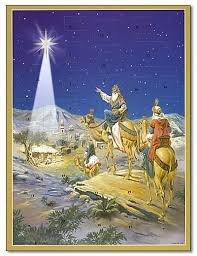
The first I remember seeing was when I was a young teen, in 1965. It was a large, flat, cardboard picture of the Bethlehem Christmas scene with 28 little “windows” that you would open, one each day up until Christmas Day. There would be a Scripture reference in the window, and I would have to look it up to read it. They would be prophecies from the Hebrew Scriptures and verses from the Christian Scriptures leading up to the birth of Jesus. It was a way of telling the story slowly, so I remembered it better as time passed. Each day my mother would ask me (and sometimes my younger sister Paula) to tell the story so far, and we would, as best as we could remember. Then we would open the next window and learn the next part. By the time we got to Christmas, we knew the story and could tell it to anyone who wanted to hear us. As a bonus, it helped us to learn to read some harder words since many of the Biblical words were not usual ones for us.
The next one I remember had an additional treat. Each window opened to a section of a larger picture on the backing piece of cardboard. So we learned the verses and began to see the picture, one piece at a time.
It wasn’t too many years later that I began to see Advent calendars where the window was more of a door, opening to a little box that had something in it in addition to the Scripture. Most often it was a piece of candy. Occasionally it would have a tiny toy. It wasn’t long before kids were looking for the candy and toys and skipping the Scripture.
This year I decided to give the children in my churches Advent Calendars. I wanted the kind that would tell the story of the birth of Jesus. Maybe help them learn the story.
I could not find any! I did find all kinds of “Advent” calendars. I found some that had candy and verses from A Visit from St. Nicholas (The Night Before Christmas). I found them with Sponge Bob and Patrick. There were some with various kinds of chocolate and instead of a verse, there was description of the chocolate (and where you could order more). There were at least four different Taylor Swift ones, with a trinket from her various world tours in each window. My favorite spice store in Minnesota had one with sample packs of various spices and recipes for each day. (I was tempted to get that one for me!) Another had chocolates filled with various kinds of liqueurs. Then there was one that skipped the chocolate and had 25 mini bottles of various liquors, with a goblet style glass safely ensconced in the middle. And there was the literary one where you unwrapped a book each day (another one I was tempted to buy for me).
But not one with the Christmas story.
I went online to Hobby Lobby, that bastion of conservative Christian capitalism, knowing that they would have one. Nope. At least, not online. Disney and others, sure. Jesus? Nope. But I took a chance and went to their store. Sure enough, they had some. Only one style, same picture on the outside, small chocolates in the windows. But the Scriptures are there. And the price was good. So, I bought enough for my kids and headed out.
I’ve been thinking about this. Christmas used to be about the birth of Jesus. Jesus is just sort of a side story, now. Same with Easter. Even secular holidays have gone the way of consumerism. Memorial Day used to be a day of remembering people who died in the various and never-ending wars we have. Now, it’s a great time to go shopping. By new mattresses and sofas. Veteran’s Day- great time to buy a new car, and veterans get an additional discount. Independence Day? Celebrate your freedom to buy new grills and deck furniture. Now, Advent seems to be gone for the most part. I guess we still have Lent. But watch out! As long as you’re practicing self-discipline, it would be a great time to join a gym and work on that beach body!
Meanwhile, I’ll look out my real window each morning during this Celtic Advent season, and hope to see signs of Jesus in this world today.
As many of you may know, Cathy and I rarely miss a Sunday worshipping in a church somewhere. Most of the time- almost all of the time- it’s at whatever church I am currently serving as pastor (currently Brown’s Chapel and Vox Memorial United Methodist Churches). But if we go off on vacation, we try to find a church to attend, usually a UMC if there’s one nearby. Lots of my friends who are clergy do not do this. This is not to cast dispersions on them. Most say “I never get a break, a chance to slowly enter Sunday, to drink my coffee, read the news or listen to good music. Just to relax. I worship in my own way. Just not in a church.” Even more after retiring do not attend a church in person (they may occasionally watch online). I understand that, too. They have seen the dark underbelly of the church. Most entered the church with the idea that it would be a community of people seeking to follow Christ and make a difference in the world in his name. Too often what they found was a group of people intent on having their way with the “blessings of Christ” given to their already determined values and actions. And many of my clergy friends have been beaten up “in the name of Jesus” by so-called Christians. Especially lately. So I understand that, too.
But Cathy and I love corporate, in-person worship. We love the singing, the quiet times, the caring for each other, the prayers, hearing the Scriptures, and most of the sermons. But being a pastor makes it hard for me to have that each week. It’s hard to get “lost in wonder, love, and praise” when you are wondering if the musicians are ready or if the temperature will ever reach that point where no one will tell you it was too hot or too cold that day. So, when we are away, we look for a place where we can just join in with everyone else.
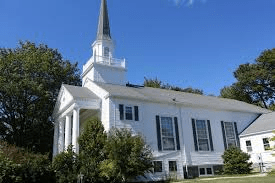
October 13, 2024 was a Sunday. Our seventeenth anniversary. We were in Bar Harbor, Maine, visiting Acadia National Park and the surrounding areas. We started the day with will Maine blueberry pancakes at the Jordan Restaurant (highly recommended!) and then made our way over to the Bar Harbor Congregational Church. (There was not a UMC in the area.) We had seen a lot of Congregational Churches in the towns as we traveled up the coast of Maine, and I was not very familiar with them. Turns out they are part of the UCC, United Church of Christ. Their building was an old historic building in the village and we looked forward to seeing inside. But when we arrived there was a sign saying they would be meeting at Reel Pizza next door.
Reel Pizza is a pizza parlor there in Bar Harbor where you sit in a small movie theatre. There are theatre seats with a small table in front of you for your pizza. I assume you watch movies while you munch on the pepperoni and mushrooms. A nice couple of women greeted us as we walked in, gave us a bulletin, and we found our way to a couple of seats. We all found out later that the water sprinkler in the sanctuary had gone off for some reason in the night and the sanctuary could not be used. The good people at Reel Pizza offered their place. Before the service everyone was talking with their friends around them about being there. I leaned forward and told the guy in front of me “I bet the communion today will be different.” He said, “Popcorn and soft drinks coming soon.” The theatre was about half full, with people of all ages scattered about.
In their bulletin Bar Harbor Congregational stated that they were an “Open and Affirming Christian community within the United Church of Christ, actively expressing Jesus’ inclusive embrace of all people. We welcome those who seek to follow Jesus including persons of every age, gender, race, national origin, faith background, marital status and family structure, sexual orientation, gender identity and expression, mental and physical ability, economic and social status, and educational background to share in the life, leadership, employment, ministry, fellowship, worship, sacraments, rites, responsibilities, blessings and joys of our church family.” I looked around and it seemed to be an eclectic group of folks. Some looked like homeless folks who might have wandered in looking for free pizza. Others looked like wealthy people who owned some of the mansions along the shore. Some covered in tattoos, others dressed very casually, some dressed in hiking clothes, and others in boat gear. They all seemed to get along and were happy to see each other. And we felt welcomed but not overwhelmed, which was good.
A young woman stood up at the front and picked up a violin. She started playing a medley of Scottish fiddle tunes. I immediately thought, “This is where I am supposed to be.” There was a welcome from one of the lay leaders, then a time of silent reflection. A poem by Mary Oliver, West Wind #2, was in the bulletin if you wanted to use it for your reflection. The congregation then rose and sang the traditional hymn, From All That Dwell Below The Skies. A responsive call to worship, with emphasis on Christ choosing us (not the other way around), then singing a version of the Hispanic song De Colores. It was not the version I had learned in the Walk to Emmaus, but it was good and brought back good memories. There were prayers of all sorts- some responsive, some led by the pastor, some by the lay leader. The Gloria Patri, with a few adjustments to the words making it more inclusive, was sung. There was a children’s sermon. The leader taught the children and the congregation to sing the chorus to Leonard Cohen’s Anthem Ring the bells that still can ring,
Forget your perfect offering,
There is a crack, a crack in everything,
That’s how the light gets in.
Leonard Cohen in a children’s sermon, a first for me.
The pastor brought a very good sermon on the Mark 10 story of the rich young man asking Jesus what he needed to do to inherit eternal life. Rather than point to what most of us preachers do with that story- say we need to put our riches in their proper place- Rev. Rob Benson said the question itself was wrong. He remined us that there is nothing that we can do. That eternal life is a gift, given to us freely. (Romans 6:23) There is nothing we can do. It’s a gift.
There was more music. A flutist played Mozart’s Exuberance, the traditional hymn Be Thou My Vision was sung by the congregation, and the service ended with the singing of a South African hymn “Thuma Mina” (Zulu for “Send Me, Lord”).
Somewhere in there things broke open for me. I don’t know whether it was the music, being in a beautiful place in the country, being with my wife of seventeen years, seeing a church that expresses what I know is true of God’s kingdom, or being reminded that God loves me freely. Whatever it was, I had a sense of being in the presence of the Divine, and tears just started flowing.
Celtic spirituality has a term called “thin places.” Those are places where the dividing line between heaven and earth is very thin. Most people think of it as a particular place. Iona in the Scottish isles, the rim of the Grand Canyon, or the Cathedral of St. John the Divine. Mine was Reel Pizza that day. Seeing something of what church could be, being reminded of God’s gift to us all, and having the beauty of the music of all sorts made the line between heaven and earth very thin.
Everyday I have people tell me that this idea of a church where all are welcomed and accepted as they are is not Christian and will not last. But I know better. Because I was in Reel Pizza, and saw it there.
Freddie Owens was executed tonight. Owens murdered Irene Graves on November 1, 1997 at a Speedway convenience store in Greenville, SC. She was a 41-year-old mother of 3 children. Owens was 19. On March 6, 1999, he was sentenced to die. He was pronounced dead at 6:55 pm, September 20, 2024.
I saw an interview with one of Ms. Graves’s children, Ensley Graves-Lee, who was 10 at the time. She was asked if she thought Owens was guilty, and she replied that the State of SC had done its best. She did not seem happy about the impending death of her mother’s killer. Nor did she seem sad. She said when it happened she was a minor and had no control over things then, and now she is an adult and has no control over what was going on now. She spoke of how she and her two older brothers missed their mom and how hard it was growing up for them. My heart ached for everyone.
I have never supported the death penalty. I know some who have Biblical reasons they quote to support it, and I know many who quote the same Bible to argue against it. I’m not going to get into that right now.
Some see it as a deterrent to murder. It is not. Norway, Sweden, Iceland, Portugal, Germany, Denmark, Canada, Australia, New Zealand, and the United Kingdom have abolished the death penalty. They all have very low murder rates, New Zealand being the highest at 2.4 per 100,000 people. Most of them are less than one. Overall, the United States has a murder rate of 6.9 per 100,000 people. This is an average, since in our country some states have the death penalty and some do not. Twenty-seven states, including South Carolina, have the death penalty. The average murder rate in them is 7.3. Mississippi’s is 23.7, Louisiana’s is 21.3. South Carolina’s is 11.8. In 2022 we had 2,374 murders. While Owens is the first execution in 13 years, I doubt that it will lower our rate. I have had people tell me that if we were to execute more people it would lower the rate. Evidence says otherwise.
Twenty-three states have abolished the death penalty. The murder rate in them is 4.7, much lower than the other states, but still higher than much of the rest of the industrialized world.
I have known quite a few people who have been affected by murder. Family members, friends, neighbors, co-workers, schoolmates. Living in South Carolina, with our love of firearms, violence, and disrespect of others, it’s hard not to know someone who hasn’t been touched by a murder. Some of the murderers have been put to death, and I have talked with the families, friends, and co-workers of the victims. I have seen two responses. One is forgiveness. On one level I understand it. They have known themselves to be forgiven, and they know that to bear anger, hatred, and revenge will continue to hurt them. As hard as it is, they find a way to forgive. A few have even spoken to the murderer and let them know. They do not say they are not hurting. But they decide to carry with them the memory of the loved one, but not the anger. That part I struggle with, because…well…I have never had that happen to me.
Then there are others who long to see the murderer die. Many are angry that their death will be “easier” than the death of their loved one. They long for more than death, but agony for the perpetrator. And I have sat with them and listened and prayed. Some have said to me that the death of the murderer will finally give them relief. But it does not. The death of the other person cannot replace the years of love, friendship, laughter, hugs, and so many other things they will miss. After visiting with the victim’s families following the execution, when they can talk about it, the thing I hear them say most is, it wasn’t enough.
As you know, I am a bibliophile. Blame it on my mother. I remember sitting by her on the couch when I was young, as she read books to me, pointing out the words as she read them, sometimes pointing to the pictures that went along with them. I became fascinated by the worlds they contained. Of course, the early Dick and Jane readers helped me to get started, but Mom quickly moved on to Winnie the Pooh. I could see the Hundred Acre Wood, smell the trees, flowers, and grass, and walk along with Christopher Robin, Pooh, Piglet, Owl, and Eyeore. It was not long before Mom helped me get a library card for the Inman library, which was in a side room in the fire station in the small town. It was within easy walking distance for me, even as a young boy, and I would visit there several times a week to trade in my old books and get some new ones. There was always a stack to be read somewhere in the house on Littlefield Street.
As I grew, I became a voracious reader, consuming almost everything I could find. Biographies of people who invented things- Morse, Edison, Carver- made me curious about how things work. Pioneers in compassionate living- Barton, Nightingale, Wilkerson- prompted me to be kinder. Classic literature showed me the power of words. The only book I refused to read when I was in school was Silas Marner. This was at the beginning of my rebellious teens. (Years later my sister gave me a copy and I read it. Sorry I waited so long.)
I not only like to read, I like the physical books themselves. I like to feel the heft of them in my hands, be able to easily flip back and forth between pages and chapters. I like the way they smell. I have tried using e-readers, Kindle, Nook, and others. I understand why some people prefer them. You can carry whole libraries in your pocket. But I prefer something that takes up space on my shelves.
I also prefer buying used books. Not only is it better for the environment (since it does not use up any more resources than it already has), there’s something of history in them. Knowing people have read them, thought about them, argued with them makes them more alive to me. Of course, the authors that are still living do not make any residuals from them, and that bothers me, because I want them to keep writing. Still, I prefer used.
I like them for another reason, too. I write in my books. I underline, write in the margins, put notes on the flyleaves, and generally mark them up pretty good. (Librarians hate me!) And I love to see where other people have done that. You can see what they thought was important, mistaken, or worth remembering. Years ago, a retiring minister friend of mine gave me a set of Clarke’s commentaries on the Bible. First editions, they had been owned by a series of Methodist ministers in South Carolina since they were printed in the early 1800s. There were notes from sermons that were preached during the Civil War, newspaper clippings from the turn of the century, and a treasure trove of other information that had accumulated in them. I kept them for years and then passed them on to a younger clergy.
Good used-bookstores are hard to find these days. Which is a shame. I would walk into one with the idea of finding a copy of Walden, and come out with it, plus Browning’s Sonnets from the Portuguese, Watson’s The Double Helix, and (just for fun) Waterson’s The Days Are Just Packed. You would find things you didn’t know you needed.
Now, most used-bookstores are online. Alibris, Better World, Thrift, and others have extensive collections. You can almost always find what you are looking for, but you don’t find much else. There’s not a lot of browsing available. But that’s where I have to get most of my books now.
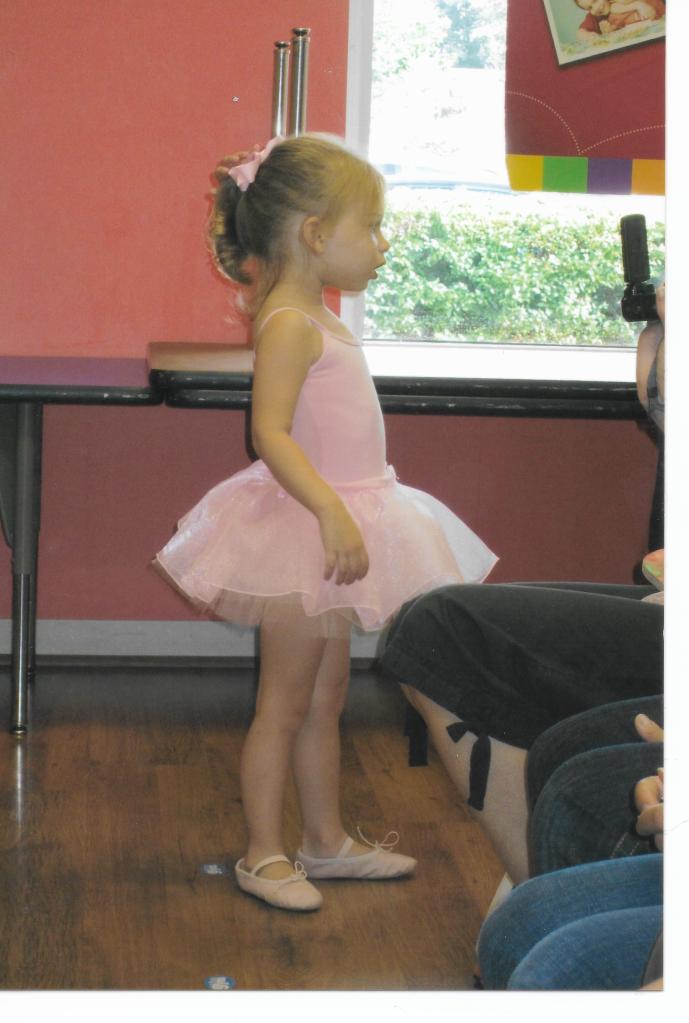
We have a new bishop coming to the South Carolina Conference of the United Methodist Church, Leonard Fairley. I read that he published a book of poems, Who Shall Hear My Voice? I ordered a used copy online. Poetry may be the best way to get to know a person when you can’t meet them face to face. The book was in good shape, and it (unfortunately) did not have a lot of markings in it. (It does now.) But there was something that struck my attention. Between two poems was a photograph of a young girl in a pink tutu. There was no writing on it to indicate who she was or where it was taken. The back of the photo has some identification of the company that developed the photo, including the year 2011. The book was published in 2009. Someone was using this photo as a bookmark. It was between two poems, one titled Phoenix Rising and the other Flower Unknown. Those two titles seem appropriate for the placement of this little girl. I wonder who she is. Did she continue her dancing? It’s thirteen years later now, so is she in college? Was she the child of a Methodist clergy up in North Carolina (where Fairley was serving at the time of the publication)? What is her story?
Maybe I’ll make up one about her. Who knows, it may end up on a shelf in a used-bookstore one day.
For the last couple of months, during this severe drought we have been having in my part of the world, every Sunday we would pray for rain. Well, it seems our prayers were heard. With a vengeance.
I have been thinking about this whole idea of praying for rain, or for any particular change in the weather. I remember the summer of 1986. It had not rained in months. Crops were drying up. Cattle were dying. Governor Richard Riley asked those who were praying people to pray on their Sabbath one weekend in July. I was serving Wood’s Chapel UMC, in the country outside of Greer. I announced that next Sunday we would be taking time to join others in praying for rain. The next Sunday, before worship, I was walking down the hall when I felt something hit me on the back of the head. I turned around and there stood Fannie Wood, the 4’10”, 80-year-old treasurer, her long grey hair in its tight bun on her head, holding an umbrella she had just whacked me with.
“Fannie, why did you hit me?” I asked. “Where is your umbrella?” she responded. “Fannie, it hasn’t rained in months,” “If you’re going to pray for rain, bring an umbrella!” “Yes, ma’am,” I said, rubbing the back of my head.
Back in seminary one of my classmates, a delightful woman from the Pentecostal Holiness Church, told me of praying for rain for her father’s land. He was a farmer, and they needed rain. She said it rained on his property, and not on anyone else’s. She said even when he had lots that were separated from each other, and surrounded by the farmland of his neighbors, it still rained only on his land. “Don’t you think you might have prayed for the neighbors, too?” I asked. “They didn’t ask me,” she said.
When I served the rural church in Oswego, we had an informal early service, attended mostly by hunters, farmers, and people who were going from Sumter to Mr. B’s restaurant in Lydia for lunch. Almost invariably during our prayer request time, some farmer would ask that we pray for rain (they did not have enough) and another would ask that we pray that the rain stop (they had too much). “It’s the battle of the opposing prayer requests!” I would think, but not dare say. “Let’s see who is the most righteous. After all, the prayer of the righteous availeth much.” (According to James 5.)
While the Bible does speak about the weather, it doesn’t say much about praying for it. The only times it clearly does is in 1 Kings, and it is referenced in the aforementioned James 5, and that was mostly just to show who was boss.
The drought here has been bad. Corn did not tassel, beans dried up. Who knows what the cotton will do. All our lawns are crunchy, and for a while, the Little Pee Dee River, which is not really little, dried up. It was affecting farmers, people who worked outdoors, older people, and people without adequate air conditioning. So, we prayed.
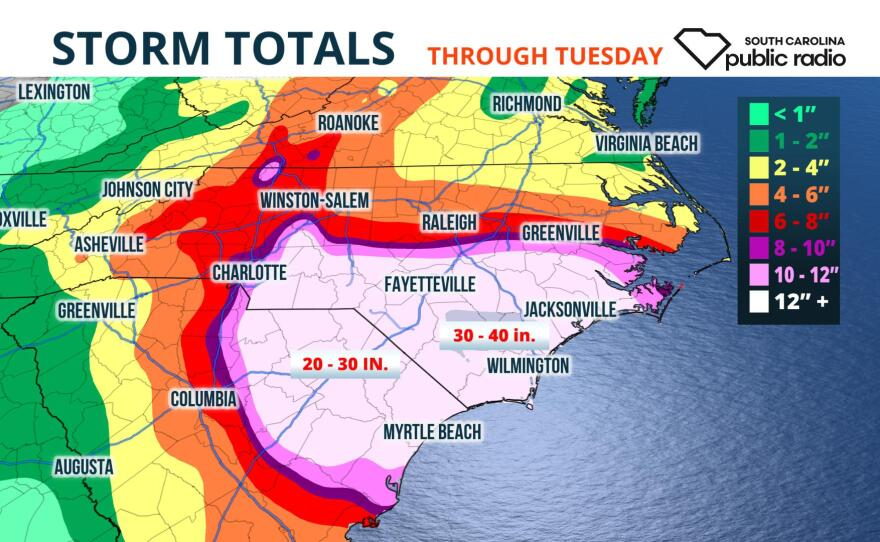
There has been about 18” of rain fall on my yard over the last three days. Fortunately, I am on high ground. My front yard has puddles, but no flooding. People in my neighborhood who live near Jeffries Creek have found their sewer systems backing up and flooding into their driveways and yards. Out in the country, where most of my church members live, none of them have flooded homes yet, but some are getting close.
Maybe we prayed a little too fervently.
I am not sure that we should be praying for the weather directly anyway. Remember when Pat Robertson, famed televangelist of the 700 Club, prayed for a hurricane to avoid his Virginia Beach headquarters? He said that his prayers caused God to redirect the hurricane. So, God moved it away from Pat and his multimillion-dollar site, and decided to destroy some other people’s homes? I cannot imagine any of them being attracted to Pat’s god. Besides, Virginia Beach does get hit by severe weather, but not as much as South Carolina beaches. This is due to geography, not to righteousness.
Maybe instead of praying for rain (or snow or clear weather) we should pray for something more important. Like praying that we will wise up about the things we are doing that are affecting our climate. And maybe even go as far as to do something about it. Global warming and deforestation, among other things, are changing the weather. And most often, not for the better.
And praying for those who are affected by it. What can we do to help the farmers, the elderly, the sick, the poor? Those who are hit by extremely high tides, floods, and winds? It seems that the Bible, both the Hebrew and the Christian Scriptures, speaks more about that than changing the rain gauge.
And maybe pray to learn how to find joy in whatever weather we have. My niece Megan, a young woman who is very insightful and wise, lives in Mankato, MN. They get a lot of snow. And it becomes a slushy mess for a long time. She once wrote, “If you can’t find joy in the snow, you will have less joy, but the same amount of snow.” Same goes for rain.
I am glad for the rain. We did not need so much of it all at once, but it will hopefully replenish the water tables. And the Little Pee Dee will flow again. And I am grateful to God for whatever comes my way. So, I will try to help those around me and those I see in need on the news.
That well-known poem by the reclusive poet of Amherst has popped up on several sites, along with commentary from most folks. In case you are not familiar with it, here it is-
If I can stop one heart from breaking, I shall not live in vain; If I can ease one life the aching, Or cool one pain, Or help one fainting robin Unto his nest again, I shall not live in vain.
It may be one of the most quoted poems by preachers, surpassed only by the one about the old man and the violin (The Touch of the Master’s Hand by Myra Brooks Welch). By the way, Dickinson did not title the poem, nor most of her 1800 poems we have knowledge of. She simply wrote them in her (for the time) unusual style.
I understand the meaning and the sentiment, but I have begun to think she might have been, if not wrong, at least not open to a wider understanding of the human soul.
The poem begins by protecting what we think of as fragile, the human heart. The heart, our metaphorical one, as well as our physical one, is actually strong. We think of it as fragile because it hurts so much when it does have problems. And I am not sure any of us can protect someone from having a broken heart. It is in the very brokenness of our hearts, minds, souls, bodies that we are most human. It is the thing that binds us together and causes us to support one another, to stand up against injustice, and to work for the inclusion of all people.
I dare say that none of us know what it is like to go through life never having our heart touched and hurt. And, if we are honest, we also admit that we ourselves have been the cause of someone else’s heartbreak. Realization of the first- our own heartbreak- keeps us connected to the rest of humanity. Realization of the second- our agency in breaking someone else’s heart- should drive us to our knees and to humility. I’ve seen lots of people admit the first. Few the second. But those who do somehow come out on the other side with a heart of flesh, not stone.
My heart has been hurt a few times. So I hurt when others hurt, and cry when I see others cry. And, unfortunately, I have been the cause of a few heartbreaks myself. Which, as I continue to learn, keeps me more aware of that side of me and hopefully prevents me from doing it again.
If we cannot prevent hearts from being broken, maybe a better hope would that we would walk with a person through their brokenness, to let them know that they are not alone, to help them find someone they can lean on. The older I get, the more I realize I cannot fix anyone. And maybe I shouldn’t be trying to. But I can walk with you, listen, and keep you connected to the world where there is a coming out on the other side.
Another more contemporary poet and musician, but like Dickinson somewhat of a recluse, put it this way- “Don’t mind if I fall apart, there’s more room in a broken heart.” (Carly Simon, Coming Around Again).













 Michael Henderson