Into My Heart

“You should think about getting a calcium score test.” Don, my general practitioner, was not only my primary physician but also my friend. And his advice had always been good before, although I had not always heeded it, so I said yes. He set up the scheduled test.

A calcium score test utilizes a CT scanner and is a quick and easy procedure. You do not have to undress, remove all metal, or go into a long tube, unlike with other tests. It measures the amount of calcium buildup in your coronary arteries. The information can help you determine what you can do to ward off further heart problems. Mine took about 5 minutes.

Scores from 0-50 are considered good; scores from 51-400 are considered moderately risky; scores over 500 are highly risky. As soon as he got the results, Don called me. “Yours is right at 2600,” he said. “You should see a cardiologist.” He set up the appointment.

A calcium score tells you that calcium buildup is there, but it does not tell you where. For that, they have to go in and look. My cardiologist, the newest addition to my medical team (I now have enough to form a football team), said I needed a heart cath. He would go in through my wrist, but if something kept him from doing that, he would go in through my groin. The procedure date was set.

I arrived at McLeod Medical Center at 6 a.m. and was quickly taken back to what my sister-in-law (who was there with my wife) called “the getting ready room.” Nurses and techs began coming in. An EKG was done, probably the most painful part of the whole day, but only because they had to push the wand hard against my ribs. While it was uncomfortable, it was not very painful. My arm was shaved, along with the area on my groin (in case they needed it). One nurse, Paige, was with me the whole time I was there. She was great in caring for me and very comforting to Cathy, who was worried but trying her best not to show it. About 9:30, they wheeled me back to the procedure room. As I was being wheeled into the room, one of the nurses, Misty, recognized me. “Pastor Mike!” she said. “I saw that name and hoped it was you.” I had been her pastor for 9 years, had baptized her child (now a middle schooler), and gotten to know her and her husband. It was good to have someone you know in the room.

I slid onto the OR table. They strapped my body down, then pulled out arm extensions, and strapped my arms and hands down to keep me from moving. I lay there in cruciform, looking up at the devices over me. They explained that they would put an IV in my left arm and then a catheter in my right. They would give me something to dilate the artery so the cath tube could go easily up to my heart (this was the shortest route), and I might feel some burning for a few seconds as they did that. (I did not.)

I was not worried. I don’t worry about much these days. Somewhere along my spiritual journey, I have become something of a Celtic Buddhist Stoic Christian, accepting each day as it comes. If they found blockages and needed to use stents or a balloon, I would be okay with that. If things were terrible and I needed heart surgery, I would be OK. And if I were one of the sporadic cases where I died, I would still be okay.

As I lay there, strapped down, waiting, praying, another image came to mind. I was in the same position- cruciform and strapped down- that people being executed by lethal injection are put. You are laid out, the needles used for injecting the deadly chemicals are hooked to your IV, and you wait.

This, of course, was the form Jesus was in when he was executed, only he was upright. More people could see him, and it was more torturous.

I remembered years ago when a person was being killed in Texas. There was a group of anti-death penalty folks protesting outside the building. There was also a group of females dressed as cheerleaders holding up a giant syringe and cheering for the procedure.

An old song from my teenage years came to mind. “Lift Jesus higher. Lift Jesus higher. Lift him up for the world to see. He said, ‘If I be lifted up from the earth, I will draw all men unto me.’” We used to sing it as loud as we could, pouring our hearts and souls into it. We thought it meant singing praise songs, telling others about him, wearing crosses, bracelets, and t-shirts with Jesus on them. Eventually, I read the Bible. Jesus did say that. But it wasn’t a praise thing. He was talking about his death, specifically his death on a cross.

Then it dawned on me. Maybe the easiest way for Jesus to “get into our hearts” was when we were like this—strapped down, immobile, unable to do anything. So many of us are raised thinking that we have to get our lives straight, give up our sinful ways, and become something new before Christ can come to us. But maybe it’s when we aren’t able to do anything that the Christ of the cross can get to our hearts. Perhaps that’s when it is easiest.

A couple of weeks after the procedure, I was having coffee with a friend. I told her my thoughts, and she said, “You know, that’s the same position they put you in when you have a child by C-section.” I did not know that. But now I do.

Perhaps it is all connected. When we cannot do anything, when we are without control of even our own life, then death and a new birth can come. Another song from years ago came to mind. “Into my heart. Into my heart. Come into my heart, Lord Jesus. Come in today. Come in to stay. Come into my heart, Lord Jesus.”

So you’ll know, my procedure showed one artery blocked at 50%. They do not need to take any action until it reaches 70%. All the rest were negligible. After the preparation, the procedure took only ten minutes. And all of the people at McLeod were great! My cardiologist said everything was okay and that he would see me in six months. He did tell me I needed to lose some weight. He agreed with my other nine physicians. “Ten out of ten doctors agree, Mike needs to lose weight.” I’m working on it. Since the procedure, I find myself singing more during my daily times of meditation and devotion. The songs vary, but always a verse of Into My Heart sneaks in.
St. Maximilian Kolbe, August 14

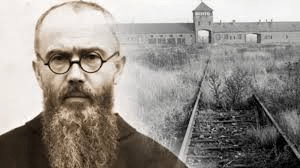
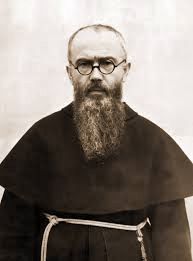
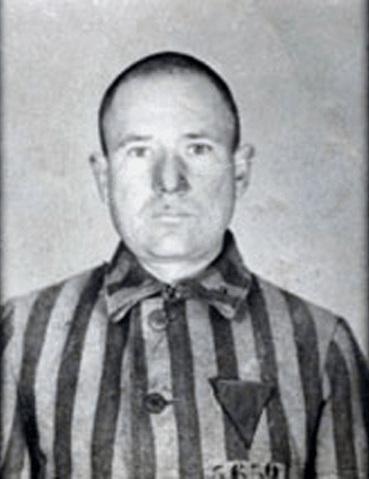
Today, August 14, is the Feast Day of St. Maximilian Kolbe. He was a Polish priest. As a young man, he had witnessed his father murdered by the Russian authorities for fighting for an independent Poland. During World War II, he started a newspaper that stood against the Nazis, and later started a radio station that broadcast against them. He was captured and put into the concentration camp at Auschwitz. While there, he was subjected to beatings and torture for ministering to the inmates. Near the end of July 1941, an inmate escaped. To discourage these attempts, the deputy camp commander picked ten men to be starved to death in an underground bunker. As they were being taken away to be slowly killed, one of the men, Franciszek Gajowniczek, cried out, “My wife! My children!” Kolbe volunteered to take his place.

Kolbe constantly led the men in the cell in prayer. Every time a guard came to check on them, he would either stand in the middle of them or kneel with them in prayer. After two weeks of no food or water, only Kolbe and three others remained alive. The guards wanted the bunker emptied so they could use it to torture others. The remaining four were given injections of carbolic acid. Kolbe, it is said, held out his left arm and calmly took the injection. He died on August 14, 1941, and was cremated on August 15 (the Assumption of Mary date). Gajowniczek survived and lived until 1995.

The story of Kolbe’s life has much more in it than I reported here, and is worth studying. He is the patron saint of amateur radio operators, journalists, and political prisoners.

To be canonized, there had to be a miracle attributed to him. While there was one, the real miracle was his life.

I said a prayer in his name this morning as I listened to news reports of “Alligator Auschwitz” in Florida, and how other states, including my own, South Carolina, are vying to make more of them.

May God forgive us for what we do.

A Life of Prayer

Celtic Christians, like the Celtic pagans before them, prayed continually. From the moment of waking in the morning until they fell asleep at night, their life was surrounded by prayer. Their faith was more passed on to each generation than discussed. Their prayers were about whatever they were doing. Stirring up the peat from last night’s fire, they would pray that the Lord of fire on the earth and in the heart would stir up a fire in them. As they baked bread, they would pray that the food would nourish them and that the world would be nourished. Working the farm, weaving the cloth, washing the clothes, or the body was all part of their prayer. Walking the paths, they would pray for guidance and give thanks for the earth beneath their feet.

This is not to romanticize those days. I would not want to give up all the advantages of modern life. Life was hard then, especially compared to now. But they did not know it was hard. It was just life. In a couple of hundred years, people may say the same thing about the way we live now.

But I do long for something of that life of prayer. To be connected through my spirit to what I do every day, to the people I see, to the earth around, underneath, and above me.

So while I do not have to stir the coals to warm the house, I can utter a prayer to God who has given me a warm place to stay, to Christ who cares for those who do not have the same, and to the Spirit that guides me in sharing warmth with others. While I do not pray to the Creator of all things to bless my fields, I can ask that my time at the computer be helpful, uplifting, and honoring of all who are creators.

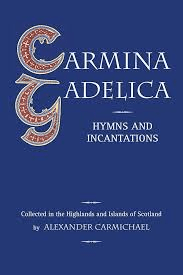
I have a collection of Celtic prayers, Carmina Gadelica, that were gathered from the people in Ireland, Scotland, and Wales in the nineteenth century. These prayers have their roots in the ancient prayers of their people. Many of them speak to me, and I use them to say my heart. Here’s one for starting the day.


Bless to me, O God,
   Each thing mine eye sees;
Bless to me, O God,
   Each sound mine ear hears;
Bless to me, O God,
   Each odour that goes to my nostrils
Bless to me, O God,
   Each taste that goes to my lips;
   Each note that goes to my song,
   Each ray that guides my way,
   Each thing that I pursue.
   Each lure that tempts my will,
The zeal that seeks my living soul.
The Three that seek my heart,
The zeal that seeks my living soul,
The Three that seek my heart.

(From Catherine Maclean, crofter, Naast, Gairloch)

Alison Krauss and Union Station recorded a song, A Living Prayer. It speaks to me, too.

I long for a life of prayer, and I think the longing is a prayer itself.

A Reminder…and a Testimony

This morning I read John 12:44-50. Jesus says this wonderful thing in this passage. “I do not judge anyone who hears my words and does not keep them, for I came not to judge the world but to save the world.” (verse 47) But then he goes on to say, “The one who rejects me and does not receive my words has a judge; on the last day the word that I have spoken will serve as judge,…” (verse 48).

I sat in silence, trying to hear something profound in my heart, when a memory came flooding back from many years ago.

I went one night to hear a friend preach. I was always looking for a sermon idea to “borrow,” a good phrase or turn of words—maybe a story or image. But I also went because I had screwed up some things badly in my life. Nothing new, it seems. I had a habit of doing that. Ask any of my friends, and more of those who used to be friends. They will tell you. I was feeling pretty bad about it. Well, about myself.

It just so happened that my friend was preaching about screwing up. From the way he preached, I could tell that he had, too. Maybe we all have.

Near the end of the sermon, when I was beating myself up inside, he said, “You have been weighed in the balance and found wanting,” quoting Daniel. I thought that’s true right here. Then he said, “You have sinned and fallen short…,” quoting Paul in Romans. I felt another punch to my gut. A third hit came when he said, “For we must all appear before the judgment seat of Christ, so that each one may receive what is due for what he has done in the body, whether good or evil,” from 2 Corinthians.

He wound it up with this- “You have been judged by God and found guilty, and your judgment is this. You are judged to be loved by God forever, and there is nothing you can do to stop it.” Then, as he often did, he sat down.

This morning, I felt the tears of relief and joy again that I felt that night long ago. I remembered. God loves me and there’s nothing I can do to stop it.