

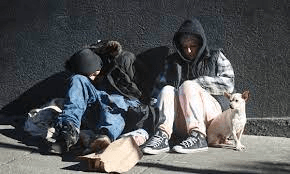
The couple sat on the sidewalk of The Manna House and looked at me as I approached. I had a Bible in my hand, so they asked “Are you a preacher?” Yes. “Can you help us?” They were a rough-looking couple. Life had not been easy or good for them, and they showed it. All their worldly possessions were in a grocery cart next to them. They were waiting for lunch to be served.
(Photo is a stock photo. Not the couple.)
I looked at them and said, “I’m sorry. I can’t.” I walked on by and into the mission site.
A friend asked me to come to The Manna House to bring a devotion. I knew of its ministry and had supported it through the church I served prior to my retirement. But I had never been there.
As I walked into the building and was given a tour of the facility, it all came flooding back to me. Forty-four years ago. Tuesday, September 4, 1979. My first day of a year-long internship as a chaplain at Spartanburg Regional Medical Center.
I was one of seven chaplain interns for the year at the large hospital. It was part of my seminary training. The senior chaplain had given us some general rules about the hospital, and then led us on a tour. We each were assigned a medical wing where we would serve for the entire year, and we would rotate through the various specialty units (Neuro, Psych, ICU, ER, etc.). After lunch, he suggested that each of us go to our wings, introduce ourselves to the nurses (they were expecting us), and check on the patients. My medical wing was L-shaped, with an elevator at each end of the L, the nurse’s station in the crook, and rooms on each side of the hall.
I stepped out of the elevator and through the open door of the first patient room. The patient, a middle-aged woman was still in her street clothes but had checked in. The requisite wristbands were on her arm. She was standing by the window, looking out at the parking lot and woods across the street.
I walked up to her and stood there for a second. She glanced at me, saw the white lab coat I was wearing, and started talking to me about her upcoming surgery. She did not see the chaplain emblem or my name. Thinking I might have been a doctor or medical intern, she started asking me some questions. I said, “Excuse me, ma’am. You may be a little confused. I am not a doctor. I’m a chaplain.”
“A chaplain!” she said. “I’m not going to die, am I?”
“Oh, no ma’am,” I said. “At least not any sooner than most of us. But we chaplains do things other than visit people who are dying.”
“Oh yeah,” she said. “Like what?”
I didn’t know. She was my first patient on my first day. What was I supposed to do? What could I do?
Those feelings came back as I was given the tour of The Manna House by the director. The Manna House feeds people in a very low-income and homeless area of town. The director told me they feed over 7,000 meals per month. Breakfast and lunch every weekday. That’s about 320 meals a day. Breakfast is served at 8 and lunch begins at 10:30. Because of the COVID virus being rampant in this underserved population, the meals are currently being served through a serving window to the outside in to-go boxes. She hopes to soon be able to have folks indoors, especially as the weather gets colder.
People were already beginning to gather in the parking lot. I asked her what she would like me to do. She said, “Anything you like. Read scripture, have a prayer, tell a devotion. Whatever you want.” I asked what they had been doing before, and she told me that they had not had anyone do anything like this for the last year and a half. Whatever I wanted to do would be fine.
I thought about the couple on the sidewalk. I knew I could not give them money. Not only did I not have any, but it would not be good for The Manna House, and maybe not for the couple. I did not have the time, knowledge, or wherewithal to help them with whatever their problems were- a hard life, accidents, bad choices, addictions, or whatever had brought them to this place. I wished I had the power of Peter and John from the story in Acts 3, where they told the lame beggar to rise up and walk. But, alas, that was beyond me, too.
I kept hearing that woman from almost half a century ago. “Like what?” I didn’t know.
I walked outside and back to the sidewalk where they were sitting and waiting. “I’m sorry,” I told them. “I really don’t have any money to spare, since I’m retired. And there’s not much else I can do. But can I pray for you?” They looked at each other and said yes. I asked their names, knelt beside them, put a hand on each one’s back, and prayed for them by name. I asked God to provide for them, to give them hope and a new life, to release them from the past, and to help them during their hard times to see the beauty of the day. When I was through, they thanked me, and then asked if I knew anyone who could get them a motel room. I said I was sorry, but I didn’t know that, either.
“Like what?”
And that’s what I did. I walked around the parking lot, asking those standing and waiting if I could pray for them. Most said yes and told me their names. Some of them would then ask for more help. Which I did not have to give.
I knew that thanks to The Manna House and all who support it, they would have a meal for the day. And maybe that’s all we can do.
But as I drove off, I kept hearing that voice.
“Like what?”
 Michael Henderson